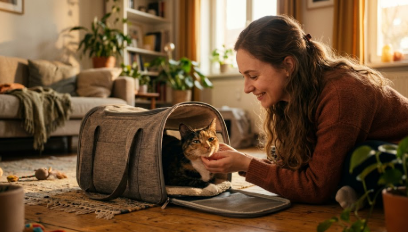
It’s been seven years since Luna came into my life. In those seven years, we’ve moved several times, taken many flights, and driven tens of thousands of miles. She grew from a tiny ball of fluff into a calm, middle‑aged cat. And I grew from a flustered new owner into someone who can read her mood from the angle of her ears – a half‑decent amateur behaviorist.
Over the years, she has taught me far more than I could ever give her.
Especially when it comes to choosing a carrier. I once bought a fully transparent “space capsule” because “it looks great in photos.” I bought an ultra‑light foldable carrier because “it’s easy to store.” I bought a wheeled rolling carrier because “it saves effort.” Luna answered with silence, howling, scratching, and even peeing in the carrier – telling me again and again: “This is wrong, that’s uncomfortable.” Until I learned to crouch down and see the world from her perspective.
This article is not a buying guide. It’s three things Luna taught me over seven years about respect, safety, and patience.
Respect is more important than love
Loving a cat is easy. You buy the best cans, the softest bed, the most expensive toys. But respect is something else. Respect means: I know what you like, even if I don’t fully understand it.
Luna doesn’t like fully transparent carriers. At first, I didn’t get it: “Look how nice the view is outside – why won’t you look?” Then I read about feline behavior and learned that cats are ambush predators while also being prey to larger animals. They need hiding places – not because they’re timid, but because it’s a survival strategy written in their genes. In a cat’s eyes, a fully transparent carrier isn’t a “viewing platform” – it’s a “glass box with no escape.”
I ran an experiment: I placed a partial‑shade carrier and a fully transparent carrier side by side and let Luna choose. Over many trials, she chose the partial‑shade carrier overwhelmingly. She doesn’t “dislike” the transparent one – she fears it. Respecting her nature means choosing the carrier she is willing to enter, not the one I think looks good.
Lesson one: Crouch down and look from your cat’s height. If the carrier has a corner to hide in (an opaque back) rather than 360° exposure, you are respecting her nature.
Safety comes first
The second thing Luna taught me: no matter how good‑looking or expensive a carrier is, if it doesn’t make the cat feel safe, it’s worthless.
What is safety? Not “big enough,” not “smooth‑zippering.” It’s being able to stand on a firm base board instead of swaying like a hammock. It’s having familiar scents instead of harsh plastic smells. It’s knowing there is a wall to lean against when she wants to hide.
Looking through thousands of negative reviews, I noticed a pattern: carriers that owners said “my cat is willing to stay in” almost always had three features – a rigid base, partial‑shade design, and the owner’s worn clothing inside. The carriers left in corners to gather dust were often fully transparent, soft‑bottomed, or had strong chemical odors.
Luna’s favorite carrier now is a years‑old partial‑shade soft carrier. I replaced the base board with a PE board, and I always keep a worn T‑shirt of mine inside. She goes in every day to nap – not because we’re going out, but because she feels safe there. That T‑shirt is covered in her fur, but I never wash it – if I wash it, she won’t go in.
Lesson two: Safety isn’t a spec sheet parameter. It’s whether your pet can relax inside, lie down, close their eyes, even snore. Watch their posture: body stretched, ears forward, tail relaxed – those signals are more truthful than any advertisement.
Slow is fast
When Luna once peed in the carrier, I spent four weeks on positive association training. From “carrier in the living room with treats” to “closing the door for a few seconds” to “carrying it around the house” to “short car rides.” After four weeks, she started going in on her own.
Those four weeks taught me: there are no shortcuts to building trust. You can’t pull a carrier out of the cupboard, shove the cat in, and expect her not to be afraid. You need to give her time, to make the carrier part of her everyday life – a safe space with treats, your scent, and freedom to come and go.
Many owners ask me: “My cat cries as soon as she goes into the carrier – what should I do?” My answer is always: “How many days did you spend introducing her to that carrier?” If the answer is “ten minutes,” then don’t blame the cat. Patience is the most expensive cost of owning a cat – and the most worthwhile investment.
Lesson three: No matter how good a carrier you buy, if you don’t take time to let your cat adjust, it’s money wasted. The carrier itself is just a tool – the real “safety system” is the trust between you and your pet.
Pets can’t speak, but they can express
The last thing Luna taught me: she doesn’t say “I’m scared” or “I feel sick,” but she uses her ears, tail, cries, and even a puddle of urine to tell me.
Ears turned back – tense. Tail tucked – afraid. Crying in the carrier – could be anxiety, carsickness, or too hot. No crying but body curled tight – might be “scared stiff.” Peeing in the carrier – not naughty, but stress overload.
I started recording signals from every trip. Slowly, I could tell that a low “mm” sound was a sign of impending carsickness – so I would pull over and ventilate. Scratching the mesh meant she wanted out – not from fear, but from heat. Silent but body low meant she was tense but managing – then I would comfort her with a gentle voice.
When you learn to read those signals, you can truly choose a carrier that makes your pet comfortable – not by price, not by brand, but by your understanding of her.
Lesson four: The best “testing tool” is your own observation. Put your pet in the carrier, close the zipper, and watch for a few minutes. Does she relax? Is she tense? Is she looking for an exit? That information is more valuable than any review.
Final advice: crouch down and see the world from your pet’s perspective
As I finish this series – from size measurement, rigid bases, material analysis, scratch‑resistant mesh, zipper repair, odor removal, desensitization training, to today’s reflections – all the technical details lead to one question: What kind of space is this carrier for your pet?
Is it a reassuring den, or a terrifying glass box? A solid platform, or a swaying hammock? A familiar‑scented refuge, or a cage of sharp chemical smells?
The ultimate carrier‑choosing advice:
- Partial‑shade – an opaque side to lean against
- Rigid base – solid footing, not tiring
- Top opening – an extra exit for extra peace of mind
- Familiar scent – put a worn T‑shirt of yours inside
- Give your cat time – do desensitization training, don’t just shove her in
If you do these things, the carrier you choose will very likely be one your pet likes. It may not be the most expensive or the prettiest, but when you see your pet relax inside, close her eyes, and even snore – you’ll know you made the right choice.
Thank you, Luna and Tudo
As I write this, Luna is sunbathing on the windowsill, and Tudo is snoring beside her. They don’t know I’ve written so many stories about them. But I know that over the years, they have taught me far more than I have written.
Respect, safety, patience, observation – these are not just tips for choosing a carrier. They are the foundation of living with a pet. The carrier is only a container. What truly makes your pet comfortable is your willingness to crouch down and see the world from her perspective.
I hope that everyone reading this finds that “safe room” where their pet forgets they are even inside a carrier.
Thank you for joining us through this series. If you have any questions about pet carriers, please leave a comment.
Leave a Reply
You must be logged in to post a comment.