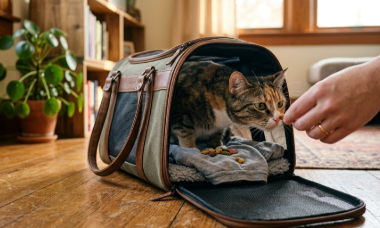
One rushed morning, I took Luna to get her vaccination. I pulled the carrier out of the cupboard a few minutes before leaving, unzipped it, and simply scooped her up and stuffed her inside. She braced all four paws against the opening, trying to back out, but I pushed her in anyway. The moment I zipped it shut, she let out a howl I had never heard before.
Less than ten minutes into the drive, the smell of urine wafted from the carrier. Luna was huddled in the corner, body low to the ground, tail tucked between her legs, with a wet patch beneath her. That was the most guilty I have ever felt as a cat owner. It wasn’t the carrier’s fault – it was mine. I hadn’t given her time to get to know that carrier. I hadn’t let her explore it on her own. I hadn’t built any association of “carrier = safety.” I shoved a completely unfamiliar object at her, closed the door, and took her out – no wonder she peed.
After that, I spent a long time retraining. Not training “to go into the carrier,” but training “the carrier is safe.” This article is the full story of how I went from “peeing in the carrier” to “willingly sleeping inside it.” If your pet is also afraid of the carrier, don’t worry – this method works.
Table of Contents
Luna’s stress incident: she peed as soon as she went in
Why you can’t just force them in – pets need time to build understanding
Positive association training: link the carrier with good things
Scent building: old clothes are the cheapest “calming aid”
Take it step by step: from the living room to downstairs
What not to do: never do these things
Training tracker: 4 weeks to build a sense of safety
Frequently Asked Questions
Conclusion: a sense of safety is not innate – it’s built through practice
Luna’s stress incident: she peed as soon as she went in
After Luna urinated in the carrier on the way to the vet, I took her out and she immediately hid under the examination table, refusing to come out. The vet asked, “Haven’t you used this carrier before?” I nodded. The vet said, “Cats are very sensitive to unfamiliar spaces. You should have let her get used to it beforehand, not just shoved her in.”
When I got home, I put the carrier on the living room floor with the door open. Luna watched from a distance and only dared to approach after making a wide detour. She sniffed the opening and backed away. For an entire week, she never voluntarily went inside.
I realized that in Luna’s mind, this carrier equaled: being forced inside + being locked up + unfamiliar smells + scary trips. All negative associations. To change that perception, I couldn’t just “force her in more times.” I needed to build new, positive associations – carrier = tasty treats + familiar scents + choosing to go in herself + not being forcibly taken away.
That process took me four weeks. But after four weeks, Luna started going into the carrier to sleep on her own. Not because we were going out, but simply because she found it comfortable. Here is how I did it.
Why you can’t just force them in – pets need time to build understanding
Many owners (including my past self) make the mistake of treating the pet carrier as a “tool” – take it out when needed, put it away when done. The pet sees the carrier only a few times a year, and every time it appears, it means “we’re going somewhere scary.” Over time, the carrier becomes a symbol of fear.
The correct approach is to make the carrier part of your pet’s everyday life. The carrier is not “something that only appears when we go out,” but “a safe space that is always at home, full of good things.”
Three elements of building this understanding:
- Predictability: The pet knows what happens after going in (treats, familiar scents, the owner’s gentle voice)
- Choice: The pet walks in on its own, not forced
- Positive reinforcement: Every time it goes in, there is a reward (treat, petting)
All three are essential. Missing any one, the carrier may continue to be a fear symbol.
Positive association training: link the carrier with good things
Principle: Classical conditioning. Make the pet associate “carrier” with “delicious food.” Going into the carrier = getting a treat. Repeat enough times, and the pet will look forward to treats when seeing the carrier, instead of feeling fear.
Steps:
Days 1-3: Place the carrier in the living room with the door open. Put a few high‑value treats inside (something they don’t get at other times, like freeze‑dried chicken). Ignore the pet – let them discover it on their own. Change treats daily.
Days 4-7: After the pet starts willingly going in to eat treats, put the treats at the very back of the carrier so they must go all the way inside to get them. When they go in, say “good” in a gentle voice, but do not close the door.
Days 8-14: Once the pet reliably goes in on its own, try lightly zipping the door shut while they are eating (just 3‑5 seconds), then open it and give an extra treat. Gradually increase the closed time to 30 seconds, 1 minute, 5 minutes.
Key: If the pet starts crying or scratching while the door is closed, open it immediately. That means the duration was too long – go back to the previous step. Don’t wait for them to become overwhelmed.
My log: Luna started going in for treats on day 3, could stay in the open carrier for 5 minutes on day 7, could handle 30 seconds closed on day 12, and 5 minutes closed on day 18. Each step cannot be rushed.
Scent building: old clothes are the cheapest “calming aid”
Positive association training solves “carrier = tasty treats,” but we also need to solve “carrier = unfamiliar smell.” Unfamiliar smells are a major source of fear. The solution is simple: put your scent inside.
How to do it:
- Find a worn T‑shirt (don’t wash it – the stronger your smell, the better)
- Cut a piece or lay the whole shirt flat at the bottom of the carrier
- If you’re worried about it being soiled with urine, put a pee pad underneath, but keep the T‑shirt on top
Why it works: Cats rely on scent to identify “safe territory.” Your scent is a proxy for “safe” to your cat. A carrier with your smell tells the cat, “This is my owner’s space – safe.”
My experience: After Luna peed in the carrier, I put a T‑shirt I had worn for two days inside. The next day, she went in, sniffed it, and lay down on it. It was only for a few seconds, but that was the first time she had “willingly” entered the carrier.
Note: If your pet urinates in the carrier, replace the T‑shirt (don’t wash and reuse – washed clothes lose your scent). For regular training, you can reuse the same T‑shirt as long as it stays clean.
Take it step by step: from the living room to downstairs
Another mistake many owners (including my past self) make: as soon as the pet is okay going into the carrier at home, they take it outside, into the car, to the vet. The leap is too big, and all previous training goes out the window.
The correct sequence should be:
Stage 1: Static acclimation (carrier at home, door open)
- Duration: 3‑7 days
- Goal: pet willingly goes in for treats
- No closing the door, no moving
Stage 2: Short door closure (at home, door closed but not moving)
- Duration: 3‑5 days
- Goal: pet stays quiet for 1‑5 minutes with the door closed
- No moving
Stage 3: Movement simulation (at home, carrying the carrier)
- Duration: 3‑5 days
- Goal: pet is quiet while being carried around the house
- Give a treat through the mesh every few steps
Stage 4: Environmental upgrade (hallway → downstairs → short car ride)
- Duration: 7‑10 days
- Steps:
- Place the carrier in the hallway (door open or half‑open) for 5 minutes
- Place the carrier at the building entrance for 5 minutes
- Carry the carrier a short distance downstairs for 5 minutes
- Get into the car without starting the engine, sit for 5 minutes
- Drive around the block (5 minutes)
- Gradually increase to 10 minutes, 15 minutes
- Only move to the next step after your pet is fully comfortable (no crying, no scratching, no lowered body posture)
My log: From “willing to enter the carrier” to “able to ride in the car for 15 minutes without crying” took Luna three full weeks. But after those three weeks, she never peed in the carrier again.
What not to do: never do these things
× Forcing them into the carrier
This is the most trust‑destroying behavior. Your pet will remember the feeling of being forced and will run away at the sight of the carrier next time. Even if you’re in a hurry, try to lure with treats rather than shove.
× Going to a noisy place on the first trip
The vet, a pet store, or a park (with dogs) are not suitable for the beginning. Your pet’s first trips should be quiet, short, and without threats. If the first trip is to the vet, the cat will associate “carrier” with “painful shots.”
× Scolding your pet inside the carrier
Cats don’t understand “stop crying,” but they can understand your tone. Yelling will only make them more afraid. The carrier should be a safe place, not a place to be scolded.
× Punishment‑based training
For example, locking the cat in the carrier and ignoring them, or putting repellents (like orange peels) inside. These methods will make the cat hate the carrier even more.
× Skipping steps
Thinking “she’s quiet at home, let’s go straight to the car” – the leap is too big and likely to fail. At each level, make sure your pet is fully comfortable before moving to the next.
Training tracker: 4 weeks to build a sense of safety
| Week | Training content | Times per day | Success criteria | Check |
|---|---|---|---|---|
| Week 1 | Carrier in living room, door open, treats inside | All day | Cat voluntarily goes in for treats, not stressed | ☐ |
| Week 2 | Door‑closed training (3 seconds → 5 minutes) | 5‑10 times | Quiet for 5 minutes with door closed, no crying or scratching | ☐ |
| Week 3 | Movement simulation (carrying around the house) | 5‑10 times | Quiet while being carried | ☐ |
| Week 4 | Environmental upgrade (hallway → downstairs → short car ride) | 1‑2 times per day | Quiet on a short car ride (15 minutes) | ☐ |
Daily log template:
- Date: ____
- Training stage: ____
- Pet’s behavior (crying, body posture, willingly entered or not): ____
- Treats used: ____
- Difficulties encountered: ____
- Tomorrow’s plan: ____
Frequently Asked Questions
Q: How long does training take before my pet stops fearing the carrier?
A: It depends on the cat. Luna took 4 weeks from “peeing in the carrier” to “quiet on a 15‑minute car ride.” Some cats may take 2 weeks, some may take 2 months. Don’t compare with others – compare with your own cat. The important thing is making small progress every day.
Q: My cat already had a bad experience. Can I rebuild a positive association?
A: Yes, but it will take longer. I recommend getting a new carrier (different color, different style) so the cat doesn’t link it to the old “scary carrier.” Then start positive association training from scratch.
Q: My pet cries in the carrier. Should I let them out?
A: If they start crying immediately after a short closure, the duration is too long – open the door and shorten the time next time. If they are already trained to be quiet for 5 minutes but let out one or two whines that stop quickly, wait for a few seconds of silence before opening and then reward. Do not open while they are crying, or they will learn “crying = door opens.”
Q: Can I use the same carrier for training and for actual trips?
A: Yes. The carrier you use for training is the same one you will use for trips. However, if you suddenly need to take your pet to the vet (a painful experience) in the middle of training, previous progress may regress. Try to avoid “scary” trips during the training period.
Q: Besides treats, what else can reinforce “carrier = good things”?
A: Petting, a gentle voice, and toys that are only available inside the carrier. You can also place daily meals inside the carrier (door open), associating the carrier with “eating.” For cats, eating is even more powerful than treats.
Conclusion: a sense of safety is not innate – it’s built through practice
After Luna peed in the carrier, I once thought, “She will never accept a carrier in her life.” But four weeks later, she started going into the carrier to sleep on her own. Not because she became braver, but because she slowly learned: the carrier has tasty treats, my owner’s smell, she can come out anytime she wants, and she won’t be suddenly taken somewhere scary.
A sense of safety is not innate – it’s built through practice. Every treat placed inside the carrier, every old T‑shirt laid at the bottom, every time you gently open the door – all tell your pet: this space is safe.
If your pet is also afraid of the carrier, don’t rush. Put the carrier in the living room, add treats, open the door, and wait for them to walk in on their own. They might not go in on day one, but perhaps on day two. Give them time. With your patience, they will redefine that once‑feared box.
Remember these key points:
- Positive association: going into the carrier brings tasty treats
- Familiar scent: your old clothes are the best calming aid
- Step by step: from living room to hallway to car – one at a time
- Never force: let them choose to go in
You’re not just buying a carrier – you’re building a “second home” that your pet will trust. That sense of safety isn’t bought – it’s built through practice.
How does your pet react to the carrier? How long did it take you to help them accept it? Share your training stories in the comments.
Leave a Reply
You must be logged in to post a comment.