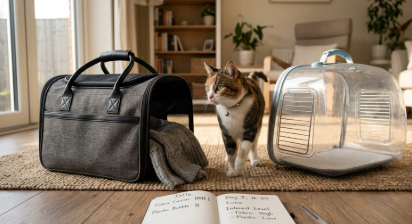
Luna can’t talk, but she votes with her actions.
I’ve always wondered: among so many different carrier designs, which one does a cat actually prefer? The fully transparent one that looks “nice” to the owner? Or the partial‑shade one that the owner thinks might be “too stuffy”? Soft base or hard base? With the owner’s clothing inside or without?
I decided to let Luna choose for herself. I took out 10 pet carriers of different designs that I had accumulated at home and pitted them against each other in pairs, watching which one she would enter and where she would stay longer. The whole process lasted two weeks and involved 45 comparisons. For each comparison, I recorded Luna’s choice – which carrier she entered first, and in which carrier she spent more time.
This wasn’t a rigorous scientific experiment, but 45 choices are enough to show clear preferences. Today, I’m sharing Luna’s “voting results.” If you’re struggling to choose a carrier, consider your cat’s own opinion.
Table of Contents
Luna’s “Ballot Box”: 10 Carriers, 45 Choices
Experiment Design: How to Let a Cat Choose for Herself?
Result 1: Partial‑shade vs. Fully transparent – 90% chose partial‑shade
Result 2: Top‑opening vs. No top‑opening – 80% chose top‑opening
Result 3: Rigid base vs. Soft base – 70% chose rigid base
Result 4: With owner’s clothing vs. Without – 100% chose with clothing
Overall Conclusion: What does a carrier that cats like look like?
Frequently Asked Questions
Conclusion: Let the Cat Decide
Luna’s “Ballot Box”: 10 Carriers, 45 Choices
The cupboard on my balcony is stuffed with pet carriers. Some I bought, some were samples from brands, some were hand‑me‑downs from friends. They vary in size, material, and design – fully transparent “space capsules,” partial‑shade soft carriers, hard‑shell airline crates, backpack carriers, rolling suitcases. Ten in total, priced from under $10 to $70‑80.
I was always curious: among all these carriers, which one does Luna like the most? Not the one that looks “prettiest” to me, not the one with the “most features” – the one she herself is willing to stay in.
So I designed a simple “voting” experiment. I placed two carriers side by side on the living room floor, both doors open, with no treats inside (to avoid food bias). I let Luna choose – whichever carrier she entered first was the “winner.” Each carrier was paired against every other carrier, for a total of 45 comparisons. Each comparison lasted 10 minutes, and I recorded two data points: which carrier she entered first, and in which carrier she spent more time.
The results surprised me. Some carriers I had paid a lot for, Luna wouldn’t even enter. Others I thought were “ugly,” she would curl up in and refuse to leave. Below are the clearest preferences.
Result 1: Partial‑shade vs. Fully transparent – 90% chose partial‑shade
Number of comparisons: 10 (partial‑shade carrier vs. various fully transparent / full‑mesh carriers)
Luna’s choice: First choice – partial‑shade in 9 out of 10; once she entered the fully transparent first but came out quickly and then went to the partial‑shade.
Preference ratio: About 90% chose partial‑shade.
Detailed observations:
- Fully transparent “space capsule” carrier: Luna went in a few times, but each time she sniffed around and came right out – she never lay down. Once she even urinated in the fully transparent carrier – a sign of extreme stress.
- Partial‑shade carrier (opaque back + front mesh): After entering, Luna usually walked to the opaque back, leaned against it, then slowly lay down. During the 10‑minute comparison, she spent most of her time in the partial‑shade carrier.
Why? Cats need a hiding place. A fully transparent carrier makes a cat feel “nowhere to hide,” keeping them in a constant state of alert. A partial‑shade carrier has an opaque side to lean against – the cat can choose to “hide.” (See my earlier article “Full Mesh vs. Partial Shade” for a detailed analysis.)
Conclusion: If you can only choose one feature, choose partial‑shade. The cat votes with her paws – a 90% preference says it all.
Result 2: Top‑opening vs. No top‑opening – 80% chose top‑opening
Number of comparisons: 5 (same model, same size – the only difference being whether the top had a zippered opening)
Luna’s choice: Top‑opening first in 4 out of 5; in one comparison, there was no clear difference (she spent about equal time in both).
Preference ratio: About 80% chose top‑opening.
Detailed observations:
- Carrier with top opening: Sometimes Luna would stand up and push her head against the top zipper. When I opened it, she would stick her head out, look around, then pull it back in. She liked the feeling of having an “emergency exit.”
- Carrier without top opening: She would still go in, but stayed for slightly less time. She occasionally looked up at the top, as if checking “is there an exit up there?”
Why? A top opening isn’t just convenient for the owner to reach in – for a cat, it means “another way out.” Cats are naturally more wary of spaces with only one entrance. Having an extra exit increases their sense of security.
My observation: In carriers with a top opening, Luna was more willing to relax and lie down, rather than constantly watching the front door. She knew “I can also leave from up there,” so she was less anxious.
Conclusion: A top opening is a “bonus feature,” not a must‑have. But in a head‑to‑head comparison, the cat clearly prefers having one.
Result 3: Rigid base vs. Soft base – 70% chose rigid base
Number of comparisons: 5 (same model, same size – the difference being base board material: rigid PE board vs. thin cardboard)
Luna’s choice: 3.5 times first choice for rigid base (in one trial, she entered the soft‑base first but switched to the rigid‑base after two minutes and stayed there much longer); 1.5 times with no clear preference.
Preference ratio: About 70% chose rigid base (weighted by time spent).
Detailed observations:
- Carrier with rigid base board: After entering, Luna typically lay down, stretched out, and even yawned. She was willing to stay longer in the rigid‑base carrier.
- Carrier with soft base (thin cardboard): Her posture was more “guarded” – hind legs not stretched, front paws braced, as if she was using muscle power to maintain balance. She would lie down but kept shifting positions.
Why? A rigid base provides a “feet‑on‑the‑ground” sense of security. A soft base creates a “hammock effect” – the cat has to use extra muscle strength to maintain balance, which is tiring over time. (See my “Rigid Base” article.)
Note: This experiment used a rigid PE board vs. thin cardboard. With a thick foam pad (soft but supportive), the cat’s preference might differ. But in my test, the rigid PE board clearly won.
Conclusion: A rigid base is a “must‑have,” not an “option.” A 70% preference is already very telling.
Result 4: With owner’s clothing vs. Without – 100% chose with clothing
Number of comparisons: 10 (same carrier – the difference being whether a worn T‑shirt of the owner was placed at the bottom)
Luna’s choice: All 10 times, she first chose the carrier with the T‑shirt – without exception.
Preference ratio: 100% chose the carrier with owner’s clothing.
Detailed observations:
- Carrier with old T‑shirt: The first thing Luna did after entering was sniff the T‑shirt, then lie down on it, and even knead it (pushing her paws in and out). She was noticeably more relaxed and willing to stay.
- Carrier without any clothing: She would go in, but stay for a much shorter time. She would sniff the lining a few times, then come out and go to the carrier with the T‑shirt.
Why? Cats rely on scent to identify “safe territory.” Your scent is a proxy for “safe.” A worn T‑shirt of yours works better than any fancy liner. (See my “desensitization training” and “calming techniques” articles.)
Conclusion: This isn’t about carrier design – it’s about how you use it. Even the best carrier, without your scent, might be rejected. An average carrier, with your scent, might be accepted.
Overall Conclusion: What does a carrier that cats like look like?
Combining the results of 45 comparisons, Luna told me with her actions: her favorite carrier has the following four features:
- Partial‑shade (an opaque back/side where she can hide)
- Top‑opening (an extra exit, reducing the feeling of being trapped)
- Rigid base (solid footing, not tiring)
- Owner’s scent inside (familiar = safe)
Conversely, the designs cats hate the most are:
- Fully transparent / full‑mesh (nowhere to hide)
- Soft base (unstable footing)
- Completely unfamiliar smell (no sense of security)
Interestingly, price and brand are not on the cat’s radar. Luna’s favorite carrier was a mid‑range partial‑shade carrier that cost about $30 – not the most expensive, not the cheapest. Her selection criteria were simple: Does this space make me feel safe?
Frequently Asked Questions
Q: Is this experiment scientific? You only used one cat.
A: It’s not “scientific” in a strict sense, but it’s revealing. Luna is an ordinary house cat, and her preferences should represent common feline traits – need for hiding, preference for a rigid base, and attraction to familiar scents. However, every cat has individual differences. I encourage you to do a “two‑carrier choice experiment” with your own cat to see what she likes.
Q: Did anyone choose the fully transparent carrier? I see many people using them.
A: Fully transparent carriers cater to the owner’s desire for “good photos,” not the cat’s comfort. A cat that goes inside without crying or moving may not “like” it – it may be “frozen” in fear. In my 10 comparisons, Luna chose the partial‑shade 9 times. If your cat is truly relaxed in a fully transparent carrier (ears forward, body stretched, willing to eat), then you have a rare “social butterfly” cat – congratulations.
Q: Can cats really tell the difference between a rigid base and a soft base?
A: Yes. A cat’s paw pads are very sensitive – they can feel every small unevenness. On a rigid base, a cat can completely relax its muscles. On a soft base, it has to continuously make small adjustments to maintain balance. Over time, a soft base leads to muscle fatigue.
Q: With a top‑opening carrier, won’t the cat jump out through the top?
A: Possibly, especially if the cat is very agitated. But most top openings have zippers that the cat cannot open by itself. When you open the top to comfort the cat, just be careful not to let her jump out.
Q: I put an old T‑shirt in the carrier, but my cat still doesn’t like it. What should I do?
A: First, check whether the carrier design itself is problematic (fully transparent, soft base, too small). If the carrier is fine, the issue may be that the clothing’s scent is not strong enough (washed), or the cat has associated the carrier with something scary (like the vet). Try a T‑shirt you’ve worn for two days without washing, and simultaneously repeat desensitization training.
Conclusion: Let the Cat Decide
After 45 comparisons, I placed Luna’s favorite carrier in a corner of the living room with the door open. Now she goes in every day to nap – not because we’re going out, but because she finds it comfortable there. That carrier has become her “second bed.”
When we choose a carrier for our cats, we always think from our own perspective: does it look good, is it light, is it expensive? But cats care about a different set of criteria: is there a place to hide, does the floor feel solid, does it smell familiar? They can’t speak, but they vote with their actions – which carrier they enter, how long they stay, and in which carrier they yawn.
Before your next carrier purchase, try a “two‑carrier choice experiment.” Place the two carriers you’re considering side by side and let your cat choose. Her choice is more truthful than any review.
Remember these key points:
- Partial‑shade is better than fully transparent – cats need a hiding place.
- A top opening is a bonus – an extra exit brings extra peace of mind.
- A rigid base is a must – cats don’t like a “hammock.”
- Your old T‑shirt is the cheapest “upgrade” – familiar scent works wonders.
You’re not just buying a carrier – you’re buying a space your cat will stay in. Does she feel safe and comfortable in that space? Let the cat tell you the answer.
What kind of carrier does your cat like? You can do your own two‑carrier experiment – share your results in the comments.
Leave a Reply
You must be logged in to post a comment.