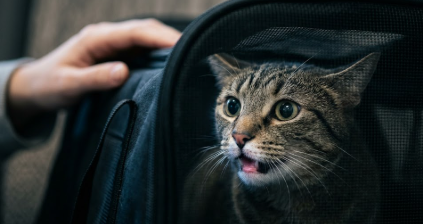
I can understand at least a few of Luna’s cries in the carrier. Not because I have superpowers – because I’ve heard them so many times. From the “heart‑wrenching howls” she made when she first started riding in carriers, to the “soft whimpers” she makes now – same carrier, same route, different sounds reflecting different emotions.
Once, on the way to the vet, she made a sound I had never heard before – a low, continuous, motorcycle‑engine‑like “growl.” I pulled over and checked. The carrier was hit by a slant of sunlight, and the thermometer inside read over 35°C (95°F). I immediately turned on the AC and improved ventilation. A few minutes later, she stopped crying.
That moment made me realize: a cat’s cries in the carrier aren’t “noise” – they’re “language.” She’s telling you: I’m scared, I’m uncomfortable, I’m too hot, I want out. If you can understand these signals, you can calm her in time, adjust the environment, and even avoid danger.
Today, I’ll share the “carrier language” that Luna taught me. I’ll describe each type of cry and each body movement, what they mean, and how to respond.
Table of Contents
Luna’s Different Cries: From Howls to Whimpers
Decoding Cry Types: Continuous Howling, Intermittent Meowing, Low Groaning, Hissing
Body Language: Tail, Ears, Pupils, Mouth
Stress Indicators: Panting, Elimination, Hiding in the Corner
Response Strategies: How to Handle Different Signals
Frequently Asked Questions
Conclusion: Understand the “Language” to Comfort in Time
Luna’s Different Cries: From Howls to Whimpers
When Luna first started riding in a carrier, she made a sound I had never heard – not a normal “meow,” but a drawn‑out, sharp, siren‑like howl. One after another, non‑stop. At the time, I thought it was just “fear.” Later I learned it was a sign of “extreme terror.”
A few months later, her cry changed. Still going to the vet, but this time it was intermittent “meow – meow – ” – a few cries, a pause, then a few more. The sound was less sharp, more like a nudge: “Hurry up – I want out.”
Later, she started making low “mmm” sounds in the car – very short, like a sigh. I noticed this usually happened during braking, turns, or when the carrier was hit by sun. That was a sign of “discomfort,” not “fear.”
On the most recent vet trip, she didn’t cry at all. But I saw her ears turn backward and her tail tuck slightly – she was telling me with her body: “I’m a little nervous, but I can handle it.”
Cries are not black and white. The same type of cry can mean different things depending on pitch, frequency, and duration. Below I break down the common types.
Decoding Cry Types
1. Continuous howling – extreme fear / pain
Sound characteristics: Drawn‑out, high‑pitched, non‑stop, loud. Sounds like a siren or a baby crying.
Meaning: The cat is in a state of extreme terror, or in physical pain (e.g., nausea from motion sickness, old injury being compressed). This cry is a “help” signal, not “being fussy.”
Response: Pull over immediately. First rule out physical causes – is it too hot (carrier temperature over 35°C / 95°F)? Is the base board uneven, causing spinal pressure? Is something sharp poking the cat? If physical causes are ruled out, it’s likely terror. Do not try to reach in (you could be bitten). Instead, cover the carrier with a blanket to reduce visual stimulation. Try to calm the cat after it has settled down a bit.
My experience: Luna once cried like this on a trip. Later I realized it wasn’t because she “feared the vet” – it was because she had been suddenly placed in a moving box with no transition. After that, I spent a week on desensitization training and never heard that cry again.
2. Intermittent meowing – anxiety / wanting to get out
Sound characteristics: Medium pitch, spaced out – a few meows, then a pause. Sometimes sounds like “talking.”
Meaning: The cat is anxious but not overwhelmed. It wants to get out, or wants your attention. Common during the middle of a short trip (partly adapted, but still wants out).
Response: Do not open the carrier door (that would reinforce “crying = door opens”). You can give a treat through the mesh, or say in a gentle voice “almost there.” If possible, place the carrier where the cat can see you (e.g., move it from the trunk to the front seat). Some cats stop crying as soon as they see their owner.
My experience: Luna’s intermittent meowing in the car usually happens in the first few minutes after getting in. I use treats to distract her, or reach through the top opening to pet her head – she calms down.
3. Low groaning – discomfort / motion sickness
Sound characteristics: Low, short, like a sigh or a small engine. Very quiet – easy to miss.
Meaning: The cat is physically uncomfortable – motion sickness (nausea, dizziness), high temperature inside the carrier, or an awkward posture (e.g., uneven base board putting pressure on a joint).
Response: Check carrier temperature (if over 30°C / 86°F, cool it down), check ventilation (is mesh blocked?), check your pet’s posture (is it lying twisted?). If motion sickness is suspected, slow down, open a window for fresh air, or consult a vet about anti‑nausea medication.
My experience: Once Luna made low groaning sounds in the car. I checked and found sunlight was hitting the carrier, pushing the inside temperature over 33°C (91°F). I turned on the AC and moved the carrier to a shaded spot. Within minutes, she stopped groaning. (See my “ventilation test” article – interior temperature can rise to dangerous levels quickly in summer.)
4. Hissing / growling – anger / threat
Sound characteristics: Open‑mouth hiss with a “ssss” sound, sometimes baring teeth.
Meaning: The cat is very angry or feels severely threatened. Usually triggered by an external stressor (a dog approaching, a stranger reaching into the carrier, being startled by another animal).
Response: Keep your distance. Do not reach in. Do not try to force comfort. First remove the stressor (move the other pet or person away). Give the cat a few minutes to calm down. If you’re in the car, pull over and wait for the cat to settle before proceeding.
My experience: Once at the vet, an unleashed dog ran up to sniff Luna’s carrier. Luna immediately hissed and growled. I quickly lifted the carrier onto a chair, and the dog’s owner pulled it away. Luna relaxed after a few minutes. Hissing is not a “carrier problem” – it’s an “external threat” response.
Body Language: Tail, Ears, Pupils, Mouth
Crying is only part of the signal. Sometimes a cat doesn’t cry, but its body tells you “I’m uncomfortable.” Here are the most common body signals I’ve seen in Luna:
| Body Part | Relaxed State | Tense / Fearful State |
|---|---|---|
| Tail | Relaxed down or gently swaying | Tucked between legs (fear), fast flicking (irritated) |
| Ears | Forward or slightly to the sides | Turned back, flattened (airplane ears) |
| Pupils | Normal size (in moderate light) | Dilated (fear / tension – even in bright light) |
| Mouth | Closed, tongue not showing | Open‑mouth panting (over 35°C / 95°F or extreme stress), drooling (motion sickness / fear) |
| Body posture | Stretched out, relaxed lying down | Low to the ground, curled into a tight ball, muscles tense |
Combine signals: A cat may not cry, but if ears are flattened + tail tucked + body low – multiple signals together indicate high stress. Even without crying, you should take calming measures.
Stress Indicators: Panting, Elimination, Hiding in a Corner
Some signals go beyond “cries” and “body language” – they are hard indicators that the cat is in severe distress.
Panting
Cats do not pant to cool down like dogs. If a cat is panting in the carrier (not after heavy exercise), it usually means:
- The carrier is too hot (over 35°C / 95°F)
- Extreme fear causing rapid heart rate
- Respiratory problem
Response: Cool down immediately (turn on AC, move to shade, wipe paw pads with a cool damp cloth). If temperature is normal but panting continues, end the trip as soon as possible or consult a vet.
Elimination (urine / feces)
A healthy adult cat will not eliminate randomly. Urinating or defecating in the carrier is an extreme stress response – the cat feels “I might not survive today,” so it abandons its instinct to hide its waste.
Response: This is not “lack of training” – it is “stress overload.” Go home immediately or move to a safe environment. In the future, shorten trips, increase desensitization training, and consult a vet about possible anti‑anxiety medication.
Hiding in a corner
The cat curls into a ball in the corner of the carrier, head buried, refusing to look outside. This is a “giving up” signal, not “relaxation.”
Response: Cover the carrier with a blanket (reduce visual stimulation), put a piece of your worn clothing inside, and speak in a gentle voice. If the cat stays in this posture for a long time, end the trip early.
Response Strategies: How to Handle Different Signals
| Signal Combination | Possible Cause | Response |
|---|---|---|
| Continuous howling + low body posture | Extreme fear | Cover carrier, reduce stimulation, go home as soon as possible |
| Intermittent meowing + ears turned back | Mild anxiety | Give treats, let cat see you |
| Low groaning + panting | Overheating / motion sickness | Cool down, improve ventilation, slow down |
| Hissing + tucked tail | External threat | Remove stressor, keep distance |
| No crying but ears flat + pupils dilated | Tense but managing | Keep observing, minimize touching |
| Elimination + hiding in corner | Overwhelming stress | End trip immediately, strengthen training for future |
General principles:
- Do not punish the cat (scolding or yelling increases fear)
- Do not force the cat out of the carrier (unless there is immediate danger)
- Record signals from each trip to identify patterns (specific roads? specific sounds? the carrier itself?)
Frequently Asked Questions
Q: My cat cries constantly in the carrier, but quiets down as soon as I take her out. Why?
A: It means she doesn’t want to be in the carrier. Possible reasons: too small, too stuffy, or the carrier is associated with something scary (like the vet). First check the carrier itself (size, temperature, base board). If those are fine, it may be a memory issue. Refer to the “desensitization training” article to rebuild the “carrier = safe” association.
Q: My cat doesn’t cry in the carrier, but keeps scratching the mesh. What does that mean?
A: Scratching the mesh is usually a sign of “wanting to get out.” It could also mean “too small” or “restricted view.” Check interior dimensions (can she turn around?), check if the mesh faces a wall (she wants to see you but can’t). If scratching is frequent and accompanied by meowing, treat it like intermittent meowing.
Q: How do I tell the difference between “fear” and “motion sickness”?
A: Motion sickness signs: tongue sticking out, drooling, vomiting, stiff body posture but not struggling. Fear signs: howling, scratching, elimination, trying to escape. Motion sickness typically starts after the car begins moving; fear can start before departure.
Q: My cat is crying in the carrier – can I open it and pick her up?
A: No. If you open the carrier every time she cries, she will learn “crying = door opens.” Wait until she is quiet for a few seconds, then open and give a treat. If she is crying intensely (stress reaction), you can go home early, but do not let her out while she is crying.
Q: My cat is completely quiet and doesn’t move in the carrier. Is that good?
A: Not necessarily. Some cats “freeze” when extremely frightened – no movement, no sound, no struggle – but that doesn’t mean they are relaxed. Look for other signals: are pupils dilated? Are ears turned back? Is the body low? If those signals are present, she is “scared stiff,” not “adapted.”
Conclusion: Understand the “Language” to Comfort in Time
Luna went from “howling” to “whimpering” to “quiet.” That change didn’t happen because she became braver – it happened because I learned to understand her signals. When she howled, I knew she was terrified – so I pulled over, covered the carrier, and shortened the trip. When she whimpered, I knew she was hot – so I turned on the AC and improved ventilation. When she didn’t cry but her ears flattened, I knew she was a little tense – but could still manage.
Cats can’t speak, but every cry and every movement in the carrier tells you their state. You just need to learn to “translate.” Understand the signals, and you can comfort them before they break down.
Remember these key points:
- Continuous howling = extreme fear: Stop and check; go home if needed.
- Intermittent meowing = anxiety: Soothe with treats, let the cat see you.
- Low groaning = discomfort: Check temperature and base board.
- Hissing = threat: Remove the stressor, keep distance.
You’re not just buying a carrier – you’re buying a space your pet has to stay in. Understand the “language” they speak in that space, and you’ll know whether that space feels safe or terrifying.
What kinds of cries does your cat make in the carrier? How many can you distinguish? Share your experiences in the comments.
Leave a Reply
You must be logged in to post a comment.