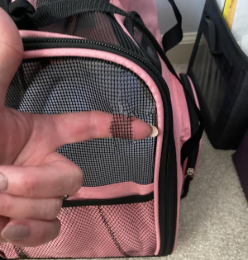
The gray‑blue old carrier on my balcony lasted three full years. The day it retired, I turned it inside out and inspected it closely: the mesh was fuzzy in a few spots but had no holes, the zipper pull had lost all its paint but still worked, and the base board – a PVC board I had replaced once – had cracked down the middle. Every time Luna’s weight pressed on it, the crack opened a little, like a mouth.
I hesitated for a long time. The carrier still worked – the zipper was smooth, the liner was freshly washed. But every time Luna went inside, I could see her hind legs sink slightly. She was still willing to get in, but when she lay down, she always adjusted her position carefully.
Finally, I put it away in the back of the cupboard. Not because it was completely broken, but because it had already started making my pet uncomfortable.
That carrier helped me understand something: you don’t have to wait until a pet carrier is “totally broken” to replace it. Some signs appear when the carrier is still usable, but your pet is already suffering. Below are 10 signs I’ve gathered from my own experience and feedback from 100 pet owners. If any of them appear, I strongly suggest you seriously consider replacing the carrier.
Table of Contents
A Retired Carrier: The Crack Didn’t Warn Me Until Year Three
Sign 1: The mesh has an obvious hole – replace immediately
Sign 2: The zipper cannot be repaired – a safety risk
Sign 3: The base board is cracked – spine compression
Sign 4: The strap stitching is coming undone – sudden failure risk
Sign 5: Your pet obviously doesn’t fit – poor comfort
Sign 6: The carrier body has severely collapsed – squashing your pet
Sign 7: Unremovable odor – material aging
Sign 8: Hardware is severely rusted – safety risk
Sign 9: Your pet resists going in – negative association
Sign 10: The carrier is over 3 years old – natural material aging
Conclusion: Don’t Wait Until It “Breaks”
A Retired Carrier: The Crack Didn’t Warn Me Until Year Three
That gray‑blue carrier accompanied us to many places. It witnessed Luna’s transformation from being afraid of the carrier to willingly entering it, and also witnessed Tudo’s change from a whiny puppy to a quiet old dog. I always thought, “If it still works, don’t waste it.” That was until the crack appeared.
The crack was in the middle of the base board, a few inches long. The PVC board didn’t crack all at once – it started as a thin line and slowly widened. I tried taping it, but the tape wore through quickly under the pressure of the base board. Every time Luna went inside, I could see her hind legs sink slightly. She didn’t cry or scratch, but I could feel she was uncomfortable – she changed position more often and always took a long time to settle down.
That’s when I decided to replace the carrier. Not because it was unusable, but because it was already making my pet suffer.
Later, I interviewed 100 pet owners and asked them, “When did you decide to replace your carrier?” The answers varied, but they can be summarized into the 10 signs below. Not every sign means “the carrier is about to fail immediately,” but each sign means “the carrier is no longer suitable for continued use.”
Sign 1: The mesh has an obvious hole – replace immediately
What counts as “an obvious hole”? Larger than 1cm (0.4 inches), or more than 3 broken threads. A cat can enlarge the hole with its claws and could escape from the carrier. On the road, in a car, or at an airport, the risk of losing your cat is extremely high.
Data support: In many negative reviews about mesh damage, users mentioned “the cat escaped through the hole.” I’m not exaggerating.
How to judge:
- Hole smaller than 0.5cm (0.2 inches): You can temporarily patch it with fabric tape on both sides.
- Hole larger than 1cm, or more than 3 broken threads: Replace the carrier immediately – don’t hesitate.
My experience: When Luna shredded the mesh on one carrier, I taped the hole. She then scratched a new hole right next to it. After that, I learned – a hole in the mesh is a signal that the carrier is done, not a sign that it can be repaired.
Sign 2: The zipper cannot be repaired – a safety risk
The zipper is the most frequently used part of a pet carrier and one of the first to fail. But not every zipper problem requires replacing the carrier – some can be fixed.
Repairable (no need to replace the carrier):
- Zipper is stiff → lubricate it
- Fabric caught in the zipper → use the pull‑back method to free it
- Zipper pull fell off → replace the pull (about $2‑3)
Not repairable (replace the carrier):
- Large section of zipper teeth broken (more than 3 teeth missing)
- Zipper completely “gaps open” – won’t stay closed, and squeezing doesn’t help
- Zipper track is deformed – the pull cannot pass through smoothly
How to judge: If you’ve tried lubricating, replacing the pull, etc., and the zipper still doesn’t work properly, or a repair only lasts a few weeks before failing again, replace the carrier. The zipper is the carrier’s safety lock – don’t settle.
Sign 3: The base board is cracked – spine compression
In my “Rigid Base” article, I explained in detail: the base board is the carrier’s foundation. If the foundation cracks, your pet’s weight is unevenly distributed.
How to judge:
- Cardboard base board: Snaps when bent, or has a noticeable sag (>1cm / 0.4 inches) → replace immediately.
- PE/PVC board: Cracks appear (even very thin cracks) → replace soon – the crack will grow.
- Aluminum plate: Almost never cracks, but if it’s bent (doesn’t spring back) → replace.
Note: If the base board is removable, you can replace just the board (about $2‑5). But if you have a cardboard base, replace it with a PE or PVC board – don’t use cardboard again.
My experience: After the PVC board in my gray‑blue carrier cracked, I tried taping it – no use. Replace just the board? The base board compartment had already been stretched by the crack, so a new board fit loosely. In the end, I replaced the whole carrier.
Sign 4: The strap stitching is coming undone – sudden failure risk
Strap failure is a relatively rare wear point, but when it happens, the consequences are the most severe – the carrier could fall off your shoulder and your pet could be injured.
How to judge:
- Stitching is loose: You can reinforce it with nylon thread (X‑stitch pattern) and continue using the carrier.
- Stitching has already come undone (gap > 1cm / 0.4 inches): Replace the carrier.
- Fabric at the strap base is torn: Replace immediately – cannot be repaired.
Data support: Among the 100 users, a few reported “the strap suddenly broke and the carrier fell to the ground.” Fortunately, no pets were injured, but that’s not something to rely on.
My advice: Before every trip, give the strap attachment a firm tug. If you feel looseness or hear a creaking sound, inspect the stitching. Don’t wait for the strap to “break” – that break could happen while you’re on the road.
Sign 5: Your pet obviously doesn’t fit – poor comfort
This sign is the easiest to overlook – because your pet can’t say “I’m cramped.” You have to observe.
How to judge:
- Cat cannot turn around in the carrier (same position going in and coming out) → insufficient space.
- When lying down, your pet’s head hits the top, neck bent → insufficient height.
- Your pet keeps shifting positions and cannot get comfortable → possibly too little space or an uneven base board.
Data support: In many “size mismatch” negative reviews, users said “it fit when I bought it, but a few months later it was too small.” Cats and dogs grow quickly before adulthood – a carrier that “just fits” may be cramped a few months later.
My advice: When buying a carrier for a kitten or puppy, buy one that will fit the adult size – don’t buy one that “just fits.” If it’s already too small, you can use the emergency tips in the “carrier too small” article, but eventually you’ll need to get a larger carrier.
Sign 6: The carrier body has severely collapsed – squashing your pet
Carrier collapse mainly happens with frameless or frame‑fatigued soft carriers. In my “side collapse restoration” article, I wrote that some collapse can be fixed (stuffing method), but some is permanent.
How to judge:
- Stuffing restores shape, but it collapses again after a week or two → support rods are fatigued – replace the carrier.
- Stuffing doesn’t help – empty carrier won’t stand → no frame or frame already broken – replace.
- Carrier wall presses against your pet’s back (when pet is inside, the wall touches its back) → replace immediately.
My experience: That collapsed foldable carrier – I restored it once with the stuffing method, and it lasted a few months. The second time, it only lasted a week. The third time, I just replaced it. Not because it couldn’t be fixed, but because the cost (time + frustration) exceeded the carrier’s value.
Sign 7: Unremovable odor – material aging
Odor from a new carrier can be removed with baking soda or white vinegar (see the “plastic smell removal” article). But if a carrier you’ve used for a long time develops an odor that won’t go away, it may be from material aging.
How to judge:
- After washing and airing for 3‑5 days, the odor is still obvious → likely material aging.
- Odor from aged PVC coating (like a sour smell) → cannot be removed.
- Liner still smells of urine after thorough washing → liner can no longer be fully cleaned.
Health risk: Odors from aging materials can irritate your pet’s respiratory tract. If your cat sneezes or has watery eyes as soon as it goes into the carrier, odor could be the cause.
My advice: If a carrier older than 2 years has an unremovable odor, replace it. The cleaning cost has already exceeded the carrier’s value.
Sign 8: Hardware is severely rusted – safety risk
Hardware includes zipper pulls, buckles, clips, D‑rings, etc. Light rust can be treated (white vinegar wipe). Severe rust affects function and safety.
How to judge:
- Surface rust spots but still functional → treat and continue using.
- Rusted to the point of being seized – cannot open/close → replace the hardware or the carrier.
- Rusted through and broken (buckle snaps) → stop using immediately.
Note: Iron hardware will rust eventually – it’s just a matter of time. If you live in a humid area, choose nylon buckles or stainless steel hardware, not iron with plating.
Data support: Among the 100 users, a small number reported hardware rust as the “first part to fail.” Although the percentage is low, a rusted buckle can scratch your pet or you.
Sign 9: Your pet resists going in – negative association
If the carrier has no obvious damage but your pet suddenly refuses to go in – runs away at the sight of it, cries inside, constantly scratches – the carrier may have become associated with a negative experience.
Common reasons:
- Something unpleasant happened in the carrier (painful shot at the vet, motion sickness on a bumpy ride)
- Lingering smells in the carrier (disinfectant, other animals)
- Carrier deformed, reducing interior space
How to judge:
- Test with a new carrier: if your cat accepts the new carrier without issue, the old one is the problem.
- After cleaning the old carrier, changing the liner, and adding your worn clothes, if your cat still resists – it may be a memory issue.
My advice: If your pet has used a carrier for a long time without problems and suddenly starts resisting, first check for deformation or odor. If nothing is obviously wrong, try re‑training (see the “desensitization training” article). But if after a week of training your pet still resists, replace the carrier. Sometimes a new carrier is easier than rebuilding trust.
Sign 10: The carrier is over 3 years old – natural material aging
Even if the carrier looks perfectly fine, if it’s been used for more than 3 years, consider replacing it. Materials age naturally – nylon/polyester mesh becomes brittle, plastic parts of the zipper degrade, and thread strength decreases.
How to judge:
- 3‑5 years: Inspect the mesh, zipper, base board, and stitching. If no issues, you can continue using it.
- Over 5 years: Replace it, no matter how new it looks.
Data support: Among the 100 users, the average carrier replacement cycle was 2.5 years. Fewer than 10% of users kept a carrier for more than 4 years.
My experience: That gray‑blue carrier lasted 3 years. Except for the cracked base board, everything else was still okay. But if I had continued using it, the mesh might have become brittle after the next summer’s sun exposure, and the zipper might have failed on the next trip. Rather than waiting for a problem to happen on the road, replace it early.
My rule: 3 years is a “reminder to inspect” – not a hard deadline. But at 5 years, it really is time.
Conclusion: Don’t Wait Until It “Breaks”
After that gray‑blue carrier retired, I switched to a new one. Luna went inside without hesitation, lay down, and closed her eyes within minutes. That’s when I realized – the old carrier wasn’t “still usable”; it was “Luna had been putting up with it.”
A pet carrier can’t talk, but it tells you through your pet’s behavior: holes in the mesh, a sticky zipper, a warped base board, too little space, bad odors, rusted hardware, collapsed sides, your pet resisting. These signs are not “suggestions” – they are “warnings.” If you don’t replace it, your pet keeps suffering.
Remember these key points:
- Replace immediately for safety signs: mesh holes, strap stitching failure, broken hardware – don’t wait.
- Replace soon for comfort signs: pet doesn’t fit, carrier collapsed, odor won’t come out – don’t delay.
- Some parts can be repaired: zipper pulls and removable base boards can be replaced without buying a whole new carrier.
- Inspect at 3 years, replace at 5 years: materials age – don’t wait for a failure on the road.
You’re not just buying a carrier – you’re buying your pet’s mobile safe room. When the walls crack, the foundation warps, or the lock breaks, it’s time to repair or replace. Not because it “stopped working,” but because it’s already making the one living inside uncomfortable.
How long have you been using your pet carrier? Have you noticed any of the signs above? Share your experience in the comments.
Leave a Reply
You must be logged in to post a comment.