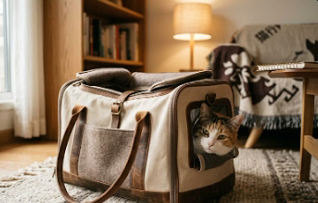
There was a time when Luna and Tudo shared the same carrier – just once. Tudo’s carrier was dirty, so I temporarily gave him Luna’s. Tudo got in, then kept turning in circles, pawing at the mesh trying to see out, whimpering anxiously. The next day, when I switched back to his own carrier, he lay down immediately.
Same dog, two carriers – completely different reactions.
I started paying attention to the design differences between cat carriers and dog carriers. After looking at my own carriers and those of friends, I realized that although cat carriers and dog carriers look similar, their design logic is completely opposite – one needs concealment, the other needs openness; one needs light weight, the other needs load capacity. Using them interchangeably doesn’t just mean “making do” – it makes your pet uncomfortable and you frustrated.
Today’s article breaks down the differences between cat carriers and dog carriers in detail. If you have both a cat and a dog at home, or if you’re about to buy a carrier but aren’t sure which type to choose, this article should help you save money.
Table of Contents
Same Dog, Different Carrier: Why Didn’t Tudo Like the Cat Carrier?
Body Size Differences: Cats Are Small but Need Hiding, Dogs Are Large but Need Visibility
Behavioral Differences: Their Sense of Security Comes from Opposite Sources
Design Specifics: 5 Core Differences Between Cat Carriers and Dog Carriers
Buying Advice: Cat Owners Buy Cat Carriers, Dog Owners Buy Dog Carriers
Frequently Asked Questions
Conclusion: Respect Their Nature – Don’t Mix Them
Same Dog, Different Carrier: Why Didn’t Tudo Like the Cat Carrier?
Tudo’s own carrier is a large dog carrier – a large front mesh panel, mesh on both sides, and a breathable top – very open visibility. Inside, he likes to lie down but always faces the mesh, occasionally lifting his head to look outside. He’s used that carrier for two years and has always been comfortable.
That day, I temporarily switched to Luna’s cat carrier – a partial‑shade design with an opaque back, mesh on the front, and a top opening. After Tudo got in, he first leaned toward the opaque back, then realized he couldn’t see out and started circling. He pressed his face against the front mesh, but the mesh area was much smaller than his own carrier, so his view was restricted. He pawed at the mesh anxiously, making “whining” sounds. I quickly took him out and switched back to his own carrier.
Later, I researched the design logic of cat carriers versus dog carriers. Luna is a cat – she needs a concealed space. Tudo is a dog – he needs an open view. Putting a dog into a cat carrier makes him feel “imprisoned.” Putting a cat into a dog carrier makes her feel “exposed.” Two different animals need two different carrier designs.
Body Size Differences: Cats Are Small but Need Hiding, Dogs Are Large but Need Visibility
Weight and size
Cats typically weigh between 5‑15 lbs. Dogs have an enormous weight range – from 5‑lb Chihuahuas to 100‑lb Golden Retrievers. Weight determines the carrier’s load capacity and interior space.
But body size differences go beyond just “big vs. small.” Cats are more flexible and agile – they can turn around in tight spaces. Dogs (especially medium to large breeds) have stiffer bodies and need more turning space.
Space preferences
- Cats: Like spaces that have clear boundaries and are not too large. An overly large space makes cats uneasy – because “the boundaries are unclear, and threats could come from any direction.” The ideal cat carrier size is “just enough to turn around, stand, and lie down” – not “one size larger.”
- Dogs: Like having room to move. Dogs need to be able to adjust their posture inside the carrier, especially medium to large breeds. The ideal dog carrier size is “one size larger than the pet” – leaving 2‑4 inches of extra room.
Data point: In my “Size Mismatch” article, many negative reviews from dog owners complained “the carrier is too small – my dog can’t turn around,” while cat owners more often complained “not enough height – my cat’s head hits the top.”
Behavioral Differences: Their Sense of Security Comes from Opposite Sources
| Behavior | Cats | Dogs |
|---|---|---|
| Source of security | Concealed space (somewhere to hide) | Owner’s line of sight (able to see the owner) |
| Signs of anxiety | Hiding, crying, lowering body | Scratching, panting, trying to escape |
| Visibility preference | Partial shade (optional viewing) | Full visibility (need to see owner and environment at all times) |
| Reaction to unfamiliar sounds | Alert, freeze | May bark, may get excited |
Cats: concealment is the #1 need
Cats are natural ambush predators, but they are also prey to larger predators. In the wild, cats need hiding places to avoid predators and stalk prey. Applied to cat carriers: having an opaque back, a selectable viewing window, and not being exposed from all directions – allows the cat to choose to “hide.”
In my two‑carrier choice experiment (full‑mesh vs. partial‑shade), Luna chose the partial‑shade carrier in the vast majority of trials. Not because of personal preference – because of instinct.
Dogs: visibility is the #1 need
Dogs are pack animals; in the wild, they rely on group coordination to hunt. Their survival strategy is not “hide” but “maintain line of sight and communicate.” Applied to dog carriers: large mesh areas, multiple viewing directions, ability to see the owner – lets the dog know “my owner is nearby – I am safe.”
Tudo is quiet in his dog carrier because he can see me. He was anxious in the cat carrier because he couldn’t see me. It’s that simple.
Design Specifics: 5 Core Differences Between Cat Carriers and Dog Carriers
| Design Element | Cat Carrier | Dog Carrier |
|---|---|---|
| Mesh area | Moderate or small (30‑50%), with opaque areas | Large (50‑70%), multi‑direction visibility |
| Concealment design | Back/sides opaque, shade possible | Almost fully transparent or full‑mesh |
| Top opening | Yes (for calming and checking) | Less common (dogs need less frequent soothing) |
| Weight capacity | Moderate (up to 15‑20 lbs) | High (20‑100 lbs – needs reinforced base and straps) |
| Ease of cleaning | Moderate | Important (dogs get dirtier, drool more) |
Detailed explanations
- Mesh area: Cat carriers don’t need large mesh. When a cat is nervous, it turns its face toward the opaque side. Dogs need large mesh – ideally on the front and both sides – so the dog can see its owner at all times.
- Concealment design: Cat carriers must have a “hiding” area. Partial‑shade design is best. Dog carriers don’t need concealment – full‑mesh or fully transparent carriers are more suitable for dogs.
- Top opening: A top opening is very important for cat carriers. When a cat is nervous, opening the top and reaching in to pet it can be very calming. Dog carriers have less need for a top opening – a dog’s anxiety is more often expressed as scratching or trying to escape, and a top opening is less effective for calming.
- Weight capacity: Dog carriers need stronger base boards and straps. For large dogs, soft carriers need PE or aluminum base boards and reinforced stitching. Cat carriers have lower weight requirements, but still need a rigid base – no cardboard (see the “Rigid Base” article).
- Ease of cleaning: Dogs are more likely to drool, shed, or get motion sickness and vomit in the carrier. A removable liner and easy‑to‑wipe fabric (nylon is better than canvas) are more important for dog carriers than for cat carriers. Cat carriers have lower cleaning demands.
Buying Advice: Cat Owners Buy Cat Carriers, Dog Owners Buy Dog Carriers
√ If you have a cat
- Prioritize: Partial‑shade design (opaque back) + moderate mesh + top opening.
- Avoid: Full‑mesh, fully transparent “space capsule” carriers.
- Recommended reading: “Full Mesh vs. Partial Shade” article.
√ If you have a dog
- Prioritize: Large mesh area (front + both sides) + good weight capacity (PE base board / reinforced straps) + easy‑to‑clean fabric.
- Avoid: Partial‑shade carriers or those with small mesh areas.
- Note: Small dogs (under 10 lbs) can use a cat‑sized carrier, but the mesh area still needs to be sufficiently large.
If you need to mix them (temporary emergency)
- Dog in a cat carrier: The dog may be anxious (restricted view). Keep it very short (under 15 minutes).
- Cat in a dog carrier: The cat may be stressed (nowhere to hide). Cover part of the mesh with a blanket to create a hiding area.
- Long‑term mixing is not recommended – your pet will be continuously uncomfortable.
Frequently Asked Questions
Q: I have a small dog (5 lbs). Can I use a cat carrier?
A: Yes, but pay attention to visibility. Small dogs are light and small, so a cat carrier’s weight capacity and space are sufficient. However, cat carriers are usually partial‑shade designs – your dog may be anxious because of the restricted view. I recommend choosing a carrier with larger mesh area, even if it’s a small dog carrier.
Q: My cat is very bold. Can I use a dog carrier?
A: Some bold cats can. If your cat doesn’t hide, cry, or lower its body in a full‑mesh carrier, it may be a “social butterfly” with low need for concealment. But most cats are not like that. You can test: leave the dog carrier open with treats inside and let your cat decide whether to enter. If it relaxes and lies down, mixing may work. If it hides in a corner, it still needs a cat carrier.
Q: Is there a carrier that works for both cats and dogs?
A: Very few. An ideal “universal carrier” would need adjustable shade panels (closed for cats, open for dogs), sufficient weight capacity (at least 33 lbs), moderate mesh area (not too large, not too small), and a top opening. Such carriers are usually expensive ($40‑70). If you only have one type of pet, buying a purpose‑designed carrier is more cost‑effective.
Q: Why do dog carriers rarely have a top opening?
A: Because dogs express anxiety differently from cats. When a cat is nervous, an owner reaching in to pet can be very calming. When a dog is nervous, opening the top may encourage the dog to try to jump out – which is unsafe. Calming a dog in a carrier relies more on “seeing the owner” than on “being touched.”
Q: Can I use a cat carrier as a permanent dog carrier? Or the reverse?
A: Not recommended. Long‑term mixing will keep your pet in a low state of anxiety – which may show as reluctance to enter the carrier, constant moving, or crying. Your pet can’t talk, but its behavior tells you “this carrier isn’t right.” Respect their nature – buy the right carrier.
Conclusion: Respect Their Nature – Don’t Mix Them
The few minutes that Tudo spent circling in a cat carrier made me fully understand: the difference between cat carriers and dog carriers is not a marketing gimmick – it’s applied animal behavior. Cats need a “den.” Dogs need a “lookout.” Give a dog a den, and it feels imprisoned. Give a cat a lookout, and it feels exposed.
If you have only one type of pet, buy the right design – don’t try to save money with a universal carrier. If you have both a cat and a dog, buy each their own. One cat carrier and one dog carrier may cost $40‑50 total, but both pets will be comfortable.
Remember these key points:
- Cats need concealment: partial shade, opaque back, optional visibility.
- Dogs need visibility: large mesh area, multi‑directional, able to see the owner.
- Don’t mix: short‑term emergency is okay, but for long‑term use, buy the right one for each.
You’re not just buying a carrier – you’re buying a custom space that respects your pet’s nature. Design the space correctly, and your pet will be willing to go inside.
(Note: The pets in this article are named Luna – cat, and Tudo – dog.)
Leave a Reply
You must be logged in to post a comment.