Once, Luna went into a fully transparent “space capsule” carrier. I watched her from outside. Instead of her usual behavior of sniffing the inner walls, she went straight to the farthest corner, pressed her body as low as possible, turned her ears back into airplane ears, and squinted her eyes into slits. The carrier was transparent, so I could see every move – she kept turning her head, looking in all directions, her tail tightly tucked.
I crouched down and placed my hand on the outside of the carrier. Luna looked at my hand but did not come closer. She stayed scrunched in that corner until I opened the door, then she shot out and hid under the sofa.
That scene made me start thinking: why do some carriers make cats anxious while others help them relax? I read a lot of animal behavior literature and observed Luna’s reactions in different designs. Today’s article re‑examines pet carrier design from a cat’s point of view.
Table of Contents
Luna in a Fully Transparent Carrier: A Story of Fear
Data‑Backed: Behavioral Clues in Cat Anxiety Reviews
The Need for Hiding: Why Cats Need a Concealed Space
The Need for Visibility: Seeing the Exit Creates Security
Spatial Compression: Not “Fits Inside” but “Room to Be”
4 Key Design Elements of an Ideal Cat Carrier
Frequently Asked Questions
Conclusion: Redesigning the “Safe Room” from a Cat’s Perspective
Luna in a Fully Transparent Carrier: A Story of Fear
I bought that fully transparent carrier out of curiosity – thinking “looks great in photos” and “I can see my cat at all times.” After using it once, Luna gave her answer – she hated it.
Later I looked up information and consulted a friend who studies veterinary behavior. Cats are natural ambush predators but are also prey to larger predators. In the wild, cats need two things: a hiding place where they can conceal themselves, and a vantage point to observe the outside world. The hiding place gives them safety, and the vantage point allows them to spot threats early.
A fully transparent carrier provides only the vantage point, no hiding place. The cat can see 360 degrees outside, but the outside can also see the cat. There is nowhere to hide. For a cat, that is like putting you in a glass box surrounded by eyes. Would you relax?
In many negative reviews about “cat anxiety,” I noticed a pattern: many users mentioned that their cats were more stressed in fully transparent or large‑mesh carriers. One user wrote:
“Our cat hates being in this.”
“My cat keeps crying inside.”
Cats can’t talk, but every action Luna took in that transparent carrier screamed: “I am not safe.”
The Need for Hiding: Why Cats Need a Concealed Space
The ancestor of domestic cats – the African wildcat – is a solitary ambush predator. Their survival strategy is to hide behind bushes or rocks, stalk prey, and at the same time avoid being detected by larger predators. Thousands of years of evolution have engraved into a cat’s genes: if there is a place to hide, then it is safe.
Applied to pet carriers:
- Fully transparent or full‑mesh carriers: the cat feels “exposed” and stays in a constant state of alert.
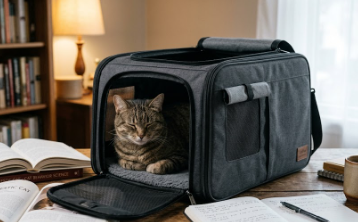
- Carriers with an opaque back: the cat can lean against the opaque side, hide its body, and only observe from one direction. This “escape route” design significantly lowers stress hormone levels.
My tests with Luna confirmed this. In my earlier “full mesh vs. partial shade” article, I conducted a two‑carrier choice experiment: placing a full‑mesh carrier and a partial‑shade carrier side by side, Luna chose the partial‑shade carrier in the vast majority of trials, and each time she leaned against the opaque side.
Conclusion: A cat carrier must have opaque areas. Not “fully closed,” but “somewhere to hide.”
The Need for Visibility: Seeing the Exit Creates Security
Another feline behavioral trait: cats need to know where the escape route is. In an unfamiliar environment, a cat will first find a corner to curl up in, then slowly observe its surroundings, especially the location of the exit. If it cannot find an exit or feels the exit is blocked, anxiety levels rise sharply.
Applied to pet carriers:
- Needs a viewing window: the cat needs to see where the carrier door (exit) is. If completely enclosed, the cat feels “trapped.”
- Does not need a panoramic view: being able to see 360 degrees causes information overload that the cat cannot process.
- Best design: moderate mesh on the front or side, allowing the cat to choose to observe rather than being forced to receive visual information from all directions.
My observation: In a partial‑shade carrier, Luna typically first leans against the opaque side, then slowly pokes her head toward the mesh. She controls how much she sees. In a full‑mesh carrier, with nowhere to hide, she closes her eyes and refuses to look outside – a classic “information overload” response.
Spatial Compression: Not “Fits Inside” but “Room to Be”
Many people choose a cat carrier based only on “does the cat fit.” But a cat’s experience is not about “fitting” – it’s about “room to be.”
What does “room to be” mean?
- Ability to turn around: the cat must be able to reverse direction, not be stuck.
- Ability to stand up: in an unfamiliar environment, a cat instinctively stands up to observe; the carrier height must allow the cat to stand straight.
- Ability to lie down stretched out: the carrier length should allow the cat to fully extend its body, not be curled up.
In many negative reviews about “size mismatch,” a significant portion were not about “couldn’t fit” but “activity restricted once inside.” One user wrote:
“Too small for my cat even though I followed the sizing chart.”
“Bought according to the size chart, but the cat couldn’t turn around.” That is the difference between “fits inside” and “room to be.”
Another dimension of spatial compression: carrier shape. A square, vertical wall is more comfortable for a cat than a trapezoidal, inwardly sloping wall. If the walls slope inward (some foldable carriers are designed narrower at the top for storage), the cat feels like the ceiling is pressing down, even if the actual height is sufficient.
My advice: put your cat in the carrier and observe its posture. If it curls into a ball and refuses to move, the space is too small. If it can turn around, lie down, and poke its head out to see, the space is adequate.
4 Key Design Elements of an Ideal Cat Carrier
Based on behavioral principles and my own testing, a cat carrier that makes a cat feel secure should have the following four elements:
1. Partial shade design
- At least one side (usually the back) is opaque.
- The cat can lean against the opaque side for a sense of concealment.
- Fully transparent carriers are not recommended; full‑mesh carriers are the next worst.
2. Viewing window without over‑exposure
- Moderate mesh on the front or side (mesh area not exceeding 50% of the carrier).
- Mesh positioned so that when the cat lies down, it cannot see out; it can only see when standing up.
- Optional adjustable shade panels (close them when the cat is anxious).
3. Sufficient but not excessive space
- Internal length ≥ cat’s back length + 5cm (lying down allowance).
- Internal height ≥ cat’s shoulder height + 3cm (standing without hitting the top).
- Width allowing the cat to turn around (at least 1.2 times shoulder width).
4. Top opening
- Top opening lets the owner reach in to comfort the cat.
- When the cat is nervous, opening the top allows it to see the owner, increasing security.
- Also useful for quickly removing the cat in an emergency.
Frequently Asked Questions
Q: My cat is very quiet in a fully transparent carrier. Does that mean it’s not scared?
A: Not necessarily. Some cats “freeze” when extremely frightened – no movement, no sound, no struggle – but that does not mean they are relaxed. Look for other signs: ear direction (turned back = tense), pupil size (dilated = fear), body posture (low = defensive). If those signs are present, quietness may be “scared stiff.”
Q: Does a hard‑shell airline crate (with only a front door) meet feline behavioral needs?
A: Yes. Hard‑shell crates are typically opaque on five sides, with only ventilation holes and a door on the front. That design is actually very appealing to cats – there is a hiding place and a single exit to observe. Many cats are quieter in a hard‑shell crate than in a full‑mesh soft carrier.
Q: Are adjustable shade panels useful?
A: Very useful. When your cat is nervous, close the shade – it immediately feels “safe.” After it adjusts, slowly open the shade. This is the most flexible solution I have used.
Q: Is a bigger carrier always better?
A: No. A space that is too large and open can also make a cat uneasy – because “there are no boundaries.” What a cat needs is a “bounded den,” not an empty room. The optimal size is “just enough to turn around, stand, and lie down” – not “big enough to run a few steps.”
Q: How can I tell if my cat is relaxed or tense in the carrier?
A: Relaxed signs: body stretched out, ears forward or slightly to the sides, eyes half‑closed or normally open, tail hanging naturally or wrapped around the body, willing to eat. Tense signs: body low, ears turned back (airplane ears), pupils dilated, tail tucked, refusing food, constant crying or unusually quiet.
Conclusion: Redesigning the “Safe Room” from a Cat’s Perspective
After that experience with the fully transparent carrier, I gave it away. Since then, when choosing a carrier, I no longer look at “how good it looks in photos.” Instead, I crouch down, look inside from the cat’s height – does this space have somewhere to hide? Can the cat see the exit? Is it too cramped?
A cat carrier is not a display case. Your cat does not need to be watched by you at all times; it only needs a safe space. In that space, it can choose to hide or choose to observe. When the choice is in its hands, it will relax.
Remember these key points:
- Partial shade: there is an opaque side to lean against.
- Viewing window without over‑exposure: the cat decides how much to see.
- Sufficient space: able to turn around, stand, and lie down.
- Top opening: for comforting and checking on the cat.
You’re not just buying a carrier – you’re buying your cat’s “mobile den” on the road. The design of that den determines whether your cat will be curled up in anxiety or lying down at ease.
What kind of carrier does your cat prefer – fully transparent or partial‑shade? Share your observations in the comments.
Leave a Reply
You must be logged in to post a comment.