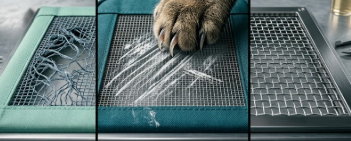
Luna has shredded the mesh on several carriers. One carrier had ordinary nylon mesh – she tore a hole in it overnight. Another had reinforced polyester mesh – it lasted a few months, but eventually her claws snagged and broke the threads. Yet another had PVC mesh – the mesh didn’t tear, but the surface became covered in white scratch marks, like frosted glass.
Every time the mesh ripped, I wondered: is there any mesh that a cat simply cannot destroy? So I ran a brutal test – using a scratching board to simulate a cat’s scratching motion, I scratched each of three common mesh materials 100 times, then examined the damage with a magnifying glass. Today’s article is the result of that test.
If you also have a “scratch‑obsessed” cat at home, this article should help you find the answer.
Table of Contents
Luna’s “Accomplishments”: Several Carriers, Several Holes
Scratch Test Method: 100 Scratches, Magnifying Glass Observation
Test Results: Nylon Mesh, Reinforced Polyester Mesh, PVC Mesh, Metal Mesh
Real‑World Lifespan: From Months to Years
Buying Advice: Choose Different Mesh for Different Situations
Frequently Asked Questions
Conclusion: No Mesh Is Indestructible, but Some Are Far More Durable
Luna’s “Accomplishments”: Several Carriers, Several Holes
Luna has an obsession with “soft things.” She ignores cardboard boxes and sofas, but she goes after pet carrier mesh. The ordinary nylon mesh carrier – I left it in the living room for her to get used to, and by the next morning the mesh had a fist‑sized hole. The reinforced polyester mesh carrier lasted a few months, but eventually the side was dotted with broken threads. The PVC mesh carrier didn’t tear, but its surface was covered with scratch marks, making the cat’s face look blurry from the outside.
I started researching mesh materials. Nylon mesh, polyester mesh, PVC mesh, metal mesh – which one is the most scratch‑resistant? Online opinions are contradictory. Some say stainless steel mesh is best, others say it hurts a cat’s claws. I didn’t want to rely on hearsay – I tested them myself.
Scratch Test Method: 100 Scratches, Magnifying Glass Observation
Test tools
- Scratching board (to simulate a cat’s scratching motion)
- Four mesh samples: ordinary nylon mesh, reinforced polyester mesh, PVC mesh, metal mesh (stainless steel)
- Magnifying glass (10x)
- Digital scale, ruler
Test method
- Using the scratching board, scratch each mesh sample 100 times in the same spot (with roughly equal force each time)
- Record surface condition every 20 scratches
- After 100 scratches, examine damage with a magnifying glass
- Record weight and price (estimated for A4 size)
Why 100 scratches?
A cat might scratch a carrier mesh 10‑20 times per outing. 100 scratches is equivalent to 5‑10 trips worth of scratching. If a mesh can withstand 100 scratches without failing, it will be fine for everyday use.
Test Results
| Material | Condition after 100 scratches | Weight (A4 size) | Estimated Price | Recommendation |
|---|---|---|---|---|
| Ordinary nylon mesh | Obvious fraying, multiple broken threads, deformed holes | ~30g | $1‑2 | 2 stars |
| Reinforced polyester mesh | Slight fuzzing, surface indentations, no broken threads | ~50g | $3‑5 | 4 stars |
| PVC mesh | No broken threads, white scratch marks, reduced transparency | ~80g | $4‑6 | 3 stars |
| Metal mesh (stainless steel) | No marks whatsoever, mesh intact | ~150g | $10‑15 | 4 stars |
Detailed notes
- Ordinary nylon mesh: Fraying started at scratch 20. Broken threads appeared at scratch 50. By scratch 80 there were more than 5 broken threads, and the mesh holes had visibly enlarged. Poking it with a finger felt loose. Conclusion: not suitable for cat‑owning households.
- Reinforced polyester mesh: Fuzzing (tiny lifted fibers) started at scratch 60, but no broken threads. At scratch 100, the fuzzy area had expanded, but the mesh structure remained intact. It felt rough to the touch, but there were no holes. Conclusion: adequate for daily use, but don’t expect it to last years.
- PVC mesh: White scratch marks (scratched surface coating) started at scratch 30. At scratch 100, the scratches were dense, and the cat’s face looked blurry from the outside. However, the mesh was not damaged, and the structure was intact. Conclusion: scratch‑resistant but will become frosted – suitable for situations where transparency is not a priority.
- Metal mesh (stainless steel): No marks after 100 scratches. The mesh was completely smooth, no fraying, no scratches (metal is harder than cat claws). Flicking it with a finger produced a crisp metallic sound. Conclusion: physically impossible for a cat to tear, but it weighs 5 times as much as nylon mesh.
Real‑World Lifespan: From Months to Years
Combining test results with my own experience, here are the actual lifespans of the four meshes (assuming normal use: 1‑2 trips per week):
| Material | Actual Lifespan | Failure Mode | Suitable For |
|---|---|---|---|
| Ordinary nylon mesh | 3‑6 months | Broken threads, holes | Not recommended (cat households) |
| Reinforced polyester mesh | 1‑2 years | Fuzzing, local thread breaks | Daily use, cats that don’t scratch aggressively |
| PVC mesh | 2‑3 years | Frosted / blurred, but won’t tear | Cats that scratch aggressively, when transparency isn’t important |
| Metal mesh | 5+ years | Almost never fails | Ultimate scratch protection, long‑term use |
Note: These lifespans are under “cat scratching” conditions. If your cat doesn’t scratch the carrier, even ordinary nylon mesh can last a long time. But if your cat is a scratcher, use the data above.
Buying Advice: Choose Different Mesh for Different Situations
√ Average household (cat scratches occasionally): choose reinforced polyester mesh. Moderate price, good durability, light weight. 1‑2 years of life is enough for most families.
√ Household with a “scratch maniac”: choose PVC mesh or metal mesh. PVC mesh won’t tear, but it will become frosted. Metal mesh never wears out, but it’s heavy and more expensive. If your cat can destroy reinforced polyester mesh, consider upgrading.
√ Prioritize light weight: choose reinforced polyester mesh. Metal mesh is too heavy (A4 size ~150g; a whole carrier could be half a pound heavier), not suitable for long‑term carrying on the shoulder or by hand.
√ Veterinary / airline cargo use: choose metal mesh. Vet cages and airline cargo kennels often use metal mesh because it cannot be destroyed, offering the highest level of security.
× Ordinary nylon mesh: not recommended. From any angle, ordinary nylon mesh is unsuitable for cat‑owning households. Its only advantage is low cost, but the money you save will be eaten up by having to replace the carrier.
Frequently Asked Questions
Q: Does metal mesh hurt a cat’s claws?
A: With normal use, no. The edges of quality metal mesh are smooth. When a cat scratches, its claws “slide across” the surface rather than “getting stuck.” However, cheap metal mesh may have burrs – check the quality when buying.
Q: Can I still use PVC mesh after it becomes frosted?
A: Yes. Frosting only affects transparency, not structural integrity or durability. If you don’t need to see your cat clearly through the mesh, frosting doesn’t matter.
Q: What should I do if reinforced polyester mesh becomes fuzzy?
A: Quickly pass a lighter flame over the fuzz – it will melt and shrink. Be careful not to burn the mesh itself. If threads have already broken, dab a tiny amount of clear nail polish on the break point to prevent further unraveling.
Q: Is there any mesh that a cat absolutely cannot tear?
A: Metal mesh is the closest to “indestructible.” However, if a cat continuously scratches the exact same spot, the mesh won’t tear, but the stitching around it may loosen over time.
Q: My cat doesn’t scratch the carrier. Is ordinary nylon mesh enough?
A: It could work, but keep normal wear in mind. Even without scratching, ordinary nylon mesh will fuzz and thin out after a few months. If your budget allows, I suggest at least reinforced polyester mesh – the durability difference is significant.
Conclusion: No Mesh Is Indestructible, but Some Are Far More Durable
After Luna shredded several carriers, I switched to a metal mesh carrier. After two years, the mesh still looks new. The downside is that the carrier is noticeably heavier – but I no longer worry about a sudden hole appearing while we’re out and the cat escaping.
No mesh is truly indestructible – a cat’s claws are powerful, and persistent scratching will eventually cause wear. But the time different materials can withstand that wear varies enormously. Ordinary nylon mesh: a few months. Reinforced polyester mesh: 1‑2 years. Metal mesh: 5+ years. Which one you choose depends on your budget, your pet’s destructive power, and how often you’re willing to replace the carrier.
Remember three things:
- Ordinary nylon mesh is not recommended – skip it if you have a cat.
- Reinforced polyester mesh is the best value – 1‑2 years of life, enough for most cats.
- Metal mesh is the ultimate solution – 5+ years without failure, but heavy and more expensive.
You’re not just buying a mesh – you’re buying the first line of defense for your pet carrier. The material of that defense determines whether, when your cat scratches, it will “hold up” or “fail.”
How many carrier meshes has your cat shredded? What material did you switch to? Share your story in the comments.
Leave a Reply
You must be logged in to post a comment.