One spring evening, I tried taking Luna out for a “walk.” I put a harness on her, attached the leash, and opened the door. She stood at the threshold, ears swiveling, sniffed the air in the hallway, then—backed inside. The next day, and the day after, the same thing. She was curious, but scared.
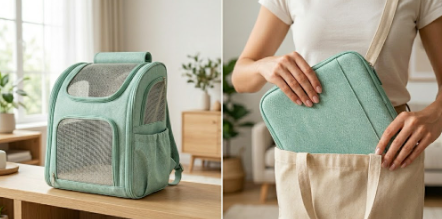
Later, I tried a different approach: instead of a harness, I used a cat carrier. I put Luna into a lightweight foldable carrier, unzipped the opening halfway, and carried her around the neighborhood. She poked her head out, eyes wide open, watching the leaves move and listening to the birds. No struggling, no crying. After ten minutes, she pulled her head back in and lay down inside the carrier—not out of fear, but relaxation.
From then on, every evening when it wasn’t raining, I carried Luna downstairs for a walk. She went from “cowering motionless in the carrier” to “actively sticking her head out to look around,” and then to “sitting by the door waiting as soon as I pick up the carrier.”
My biggest takeaway: the key to walking a cat isn’t the cat—it’s the carrier. A lightweight, foldable carrier that makes your cat feel safe can turn “going out” from a stressor into an enjoyment.
Table of Contents
From Resistance to Enjoyment: Luna’s “Cat Walking” Evolution
Foldable Design Comparison: Pros and Cons of Four Folding Methods
Portability Test: Weight, Storage, and Carrying System
Short Walk Considerations: Ventilation, Visibility, Top Opening
My Cat Walking Carrier Setup: 400g Lightweight Foldable Carrier + Built‑in Leash + Water Bottle Clip
Shopping Checklist: 5 Core Indicators for a Short‑Walk Cat Carrier
Frequently Asked Questions
Conclusion: Lightweight Is the #1 Productivity Factor for Walking a Cat
From Resistance to Enjoyment: Luna’s “Cat Walking” Evolution
In my earlier article about desensitization training, I detailed a four‑week plan to help a cat accept the carrier. But that training aimed at “getting the cat to tolerate the carrier.” Walking a cat requires “getting the cat to enjoy going out.”
I’ve found that the weight and size of the carrier directly determine whether walking the cat is sustainable.
For a while, I used that sturdy carrier to take Luna out—rigid base, metal frame, weighing over 1.5kg. After carrying it for fifteen minutes, my shoulder started to ache. Plus, the carrier was so bulky that it kept brushing against bushes on the narrow paths. Luna was comfortable inside, but I was tired. And being tired meant I didn’t want to take her out every day, so she would forget the feeling of going out and have to re‑adapt next time.
Later, I switched to a lightweight foldable carrier, weighing only 400g, which could be folded down and stuffed into my everyday backpack. Carrying it for half an hour, my shoulder felt nothing. Luna stayed calm inside too—because the carrier was light, I walked steadily, and she didn’t get jostled.
The only thing between resistance and enjoyment was a “lightweight carrier.”
Foldable Design Comparison: Pros and Cons of Four Folding Methods
Foldable cat carriers on the market mainly use four folding methods. I bought one of each and compared them over six months. Here’s the summary:
- Fold‑in‑half – Folded Size: Medium (about A4 paper size); Ease of Setup: Fast (pull to open); Durability: High (simple construction). Most recommended.
- Tri‑fold – Folded Size: Small (about iPad size); Ease of Setup: Medium (two steps); Durability: Medium (folds wear out). Use with caution.
- Roll‑up – Folded Size: Very small (a roll); Ease of Setup: Slow (needs arranging); Durability: Low (Velcro fails). Not recommended.
- Rigid (non‑foldable) – Folded Size: N/A; Ease of Setup: N/A; Durability: High. Not suitable for short walks.
Fold‑in‑half (most recommended): Opens like a book—pull and it’s ready. To store, fold it flat. Simple construction, no complicated hinges or Velcro at the fold, very durable. My cat walking carrier uses this design.
Tri‑fold: Folds down smaller, but each time you need to unfold three sections—a bit of a hassle. The fabric at the fold lines tends to crease and wear over time. Suitable for “occasional use,” not for daily walks.
Roll‑up: Folds down to the smallest size, rolling into a tight cylinder. But after unrolling, you have to fuss with it to get the shape back. Usually secured with Velcro, which loses its grip over time—then it will unroll by itself. Not recommended.
Rigid (non‑foldable): Most stable structure. Good for car rides and long trips, but not for short walks—bulky to store and heavy to carry.
My choice: Fold‑in‑half. It balances folding convenience and durability. Takes one second to open, and folds down to fit into a daily backpack.
Portability Test: Weight, Storage, and Carrying System
The portability of a cat walking carrier depends on three factors:
1. Weight: Under 500g is best for short walks
- <300g: Ultra‑light—you can carry it for 1–2 hours without feeling it. But these often have minimal structure and poor support.
- 300–500g: The sweet spot. Some support, not tiring. My 400g carrier is just right.
- 500–800g: On the heavy side. Okay for 30 minutes, but over an hour your shoulder will ache.
- >800g: Not suitable for short walks. That’s for long trips or car use.
Reference data: My previous sturdy carrier weighed 1.2kg—after 15 minutes of walking, I was exhausted. After switching to the 400g foldable carrier, walking half an hour daily felt effortless.
2. Storage: Can it fit into your everyday bag?
For a short walk, you won’t carry a separate “bag for the carrier bag.” The foldable carrier should be able to fit into your usual commuter backpack or tote.
Test method: Measure the folded dimensions. If it fits into an A4‑sized bag (21×30cm), it passes. My fold‑in‑half carrier folds to about 25×18×5cm, easily sliding into my daily backpack.
3. Carrying system: Shoulder sling, backpack, or hand‑carry—which is best for short walks?
- Shoulder sling (cross‑body): Most common. Worn diagonally across the chest, the carrier sits at your side or in front, making it easy to check on your cat. Downside: uneven load, shoulder may tire over time.
- Backpack (dual‑strap): Most ergonomic—weight distributed evenly on both shoulders, good for long durations. But the carrier is behind you, so you can’t see your cat, which may reduce your sense of security.
- Hand‑carry: Most tiring. Your hand gets sore after a few minutes, and one hand is occupied, making it hard to open doors or hold water. Not recommended.
My choice: Shoulder sling cross‑body. The carrier sits in front, so I can look down and see Luna’s state at any time. The shoulder fatigue issue is solved by “light weight”—with a 400g carrier, one hour on a single shoulder is fine.
Short Walk Considerations: Ventilation, Visibility, Top Opening
Walking a cat is different from long‑distance travel in three special ways:
1. Ventilation must be sufficient (even short walks can get hot)
Many people think “it’s just a few minutes, it won’t get stuffy.” But on a 30°C summer day, after 10 minutes outdoors, the inside temperature of a carrier can rise above 35°C. Earlier tests showed that a single‑mesh carrier in direct sunlight hit 45°C in 10 minutes.
What’s different about walking: You’re moving, the carrier is swaying, and air circulation is better than when stationary—but still not something to ignore. Choose a foldable carrier with at least two mesh sides (front + side or front + top).
2. Cat should be able to see you (reduces anxiety)
When out on a walk, a cat’s most trusted “safety signal” is your face. If the carrier design prevents the cat from seeing you (e.g., a backpack‑style carrier behind you, mesh too small, or carrier too deep), it will be more anxious.
What to look for:
- Carrier positioned in front (shoulder sling cross‑body)
- Mesh panel facing your face
- Carrier not too deep—cat can look up and see you
3. Top opening for quick reassurance
During the walk, your cat may suddenly get scared (encountering a dog, hearing a loud noise). If you can quickly open a top zipper, reach in to pet the cat, and give a treat, it can be very calming.
What to look for:
- Zippered opening on top
- Opening large enough to fit your hand
- Smooth zipper that can be operated with one hand
My Cat Walking Carrier Setup: 400g Lightweight Foldable Carrier + Built‑in Leash + Water Bottle Clip
After a period of cat walking practice, my setup has stabilized as follows:
Primary carrier: Fold‑in‑half lightweight foldable carrier
- Weight: 400g
- Folding method: Fold‑in‑half, folded size approx. 25×18×5cm
- Ventilation: Large mesh on front + small mesh on both sides
- Carrying: Adjustable shoulder sling strap
- Top opening: Yes, zippered
- Base: Thin rigid board (removable, better than pure soft but not as sturdy as a heavy‑duty base)
Built‑in leash
When Luna gets restless inside the carrier, she wants to come out and walk a few steps. I attach a thin leash to the inside of the carrier (removable). When I open the carrier, I first clip the leash to her harness before letting her out. This prevents sudden dashes.
Note: The leash should be light, thin, and not tangle around her legs. I use a 5mm diameter nylon leash, 1.2 meters long.
Water bottle clip
During a half‑hour walk, the cat might get thirsty. I sewed a small clip onto the side of the carrier to hold a 50ml mini water bottle (pet‑specific, with a roller ball spout). When Luna is thirsty, she licks the roller ball; no need to open the carrier.
Shopping Checklist: 5 Core Indicators for a Short‑Walk Cat Carrier
If you want to try walking your cat, use this checklist to screen foldable carriers:
√ Weight <500g
Over 500g, your shoulder will tire quickly. Under 300g may be too flimsy, but for short walks it’s acceptable.
√ Fold‑in‑half design
Fast to open, small to store, durable. Avoid roll‑up designs.
√ At least two mesh sides
Front must have a large mesh panel; side or top mesh is a plus.
√ Top opening
Convenient for calming, handing out treats, and attaching a leash.
√ Shoulder sling cross‑body design
Keeps the carrier in front so you can always see your cat.
Frequently Asked Questions
Q: Can cats really be walked? Isn’t that just for dogs?
A: Yes, but it depends on the cat. Bold, curious cats (like Luna) adapt easily. Timid, sensitive cats may be happier indoors. Never force it.
Q: Do I need a harness for walking my cat?
A: Yes, strongly recommended. When your cat gets tired of the carrier and wants to walk a bit, a harness + leash is a safety line. Don’t use only a collar—a startled cat can slip out of it.
Q: The foldable carrier’s base is thin. Will my cat be uncomfortable?
A: For short walks (under 30 minutes), it’s fine. If you plan to walk for more than an hour, switch to a carrier with a rigid base. The thin board in a foldable carrier sits between “pure soft” and “rigid base”—suitable for short trips.
Q: Will a foldable carrier be too hot in summer?
A: Yes. Recommendations:
- Choose a model with large mesh area
- Avoid midday; walk in early morning or late evening
- Place a small cooling pad inside the carrier
- Keep walks under 20 minutes
Q: What if my cat keeps crying in the carrier during the walk?
A: Stop, open the top opening, reach in to pet the cat, and offer a treat. If it keeps crying, it may be scared (a dog nearby, loud noise). Turn back. Don’t force it to continue.
Conclusion: Lightweight Is the #1 Productivity Factor for Walking a Cat
It took Luna two weeks to go from “cowering motionless in the carrier” to “actively poking her head out to look at the world.” From “poking her head out” to “sitting by the door waiting as soon as I pick up the carrier” took another month. Now, every evening, I put on that 400g foldable carrier, and she climbs in by herself, sticks her head out, and waits for me to leave.
Walking a cat isn’t the goal—letting your cat safely explore the world is. And a lightweight, easy‑to‑carry, secure‑feeling foldable carrier is the foundation for all of that.
If your cat is also curious about the outside world, start with a lightweight foldable carrier. Don’t jump straight to a heavy‑duty carrier—that will wear out both your shoulder and your cat’s enthusiasm.
Lightweight is the #1 productivity factor for walking a cat.
Have you tried walking your cat? Is your cat a social butterfly or a homebody? Share your stories in the comments.
Leave a Reply
You must be logged in to post a comment.