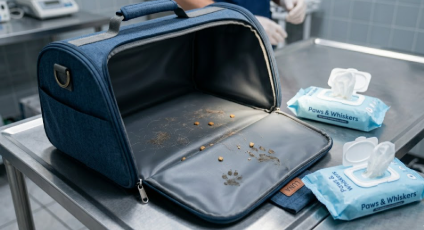
When Luna was young, we went to the vet many times. Checkups, vaccinations, spay surgery, post-op follow‑ups, a bout of gastroenteritis, and one ear infection. Before each visit, I carefully prepared the carrier—lining it with a soft pad, adding her favorite toy. But every time we came back, the state of the carrier was a disaster: cat hair clinging to every surface, urine soaking the pad. Once, just after her spay when the anesthesia hadn’t fully worn off, she vomited right inside the carrier.
The first time it happened, I frantically carried the carrier to the bathroom and wiped it down with a damp cloth for what felt like forever, but the urine smell wouldn’t go away. The liner wasn’t removable, so in desperation I shoved the whole carrier into the washing machine. After the cycle, the carrier was clean—but the frame was bent, and the zipper was stuck.
For the next vet visit, I used an old carrier. Luna smelled the lingering odor and paced around the opening for five minutes before reluctantly going in. The vet saw the carrier and said something that stuck with me: “That one doesn’t look easy to clean, does it? Cats are very sensitive to smells. If the carrier isn’t clean, she’ll stay tense.”
From that day on, my criteria for choosing a pet carrier gained a new priority. Looks, weight, even price—all of them now come second to “how easy is it to clean?”
Table of Contents
Luna’s Vet History: A Cleaning Nightmare After Every Visit
Data‑Backed: Real Pain Points in “Cleaning” Reviews
The Importance of a Removable Liner: Zipper vs. Velcro
Easy‑Clean Fabric Comparison: Oxford, Nylon, Canvas, PU Leather
Disinfection Methods: Upgraded Cleaning for Vet Clinic Scenarios
Shopping Checklist: Essential Features for Vet Visits
Frequently Asked Questions
Conclusion: A Clean Carrier Means a Calm Cat
Luna’s Vet History: A Cleaning Nightmare After Every Visit
The spay surgery was the worst. Luna came out of the operating room still groggy from anesthesia. I placed her in the carrier, and she rolled around dizzily—then vomited. By the time we got home, the vomit had soaked into the seams of the liner and penetrated the back of the pad.
I yanked the liner out and found it was attached with Velcro. When I pulled it apart, the hook side tore little fuzz balls off the loop side of the liner. The pad came out, but there was still a thin cotton layer glued to the bottom of the carrier, sewn in permanently—impossible to wipe, impossible to remove. I spent a full hour scrubbing that carrier just to get it to a barely usable state.
Later, while reading negative reviews, I came across one that perfectly captured how I felt:
“Loose threads, very plastic‑y fabric.”
Loose threads and cheap fabric are problems, yes—but the thing that drove me crazy was something else: this carrier wouldn’t come apart.
Data‑Backed: Real Pain Points in “Cleaning” Reviews
Among the reviews I analyzed, while I didn’t specifically tally “cleaning” as a category, when I sorted through comments about “poor workmanship” and “odors,” I found many users mentioning cleaning‑related issues. When I extracted reviews that explicitly complained about “hard to clean,” “liner won’t come out,” or “difficult to wash,” a pattern emerged:
For carriers with non‑removable liners, users clearly cleaned them less often. Many negative reviews said something like “got dirty after a few uses and I couldn’t bring myself to use it again”—and the reason was usually “the liner is attached; all I could do was wipe the surface.”
One user wrote about a certain carrier:
“The mesh tore after only a few uses.”
That was clearly a quality issue, but another detail stood out: many users said they tore the mesh while scrubbing—because they couldn’t remove the liner to wash it separately, they scrubbed the whole carrier, and the mesh gave way under the pressure.
What makes vet visits different:
- The vet clinic is a “high‑risk” environment—potential exposure to bacteria and viruses from other animals.
- After a visit, the carrier needs thorough cleaning and disinfection, not just a quick surface wipe.
- Cats are extremely sensitive to smells—lingering clinic odors (disinfectant, other animals) will make them more reluctant to go into the carrier next time.
The Importance of a Removable Liner: Zipper vs. Velcro
After the cleaning nightmare following Luna’s spay, the first thing I now check on any new carrier is: can the liner be removed?
Zipper‑Attached (Recommended)
The liner is connected to the carrier body with a zipper; unzip it and the liner comes completely out.
Pros:
- Fully removable—the liner can be machine‑washed or hand‑washed separately.
- Durable; repeated removal and reattachment doesn’t weaken the zipper.
- The carrier bottom has no hidden crevices where dirt can accumulate.
Cons:
- If the zipper is low quality, it may jam or derail.
- Take care that the zipper pull doesn’t snag the liner during washing.
My experience: Zipper‑attached liners are the best I’ve used. After a vet visit, I unzip the liner, toss it in the washing machine (in a laundry bag), and wipe down the carrier body with a damp cloth. Once everything is dry, I zip it back in—good as new.
Velcro‑Attached (Use with Caution)
The liner is secured to the carrier body with Velcro; you pull it apart to remove it.
Pros:
- Quick to remove—no zipper to deal with.
- Lower cost; common on mid‑to‑low‑end carriers.
Cons:
- Velcro loses its grip over time (the hooks wear out, or the loops get fuzzy).
- In the wash, Velcro can snag other fabrics (if machine‑washed).
- The carrier bottom may have gaps where dirt can seep in.
My experience: The carrier I used for Luna’s spay had a Velcro liner. After just two washes, the Velcro no longer held—the liner slid around inside the carrier, and I had to readjust it every time I picked it up.
Bottom line: Choose a zipper‑attached removable liner whenever possible. Velcro liners may become loose after a few months.
Easy‑Clean Fabric Comparison: Oxford, Nylon, Canvas, PU Leather
A removable liner is essential, but the carrier body’s material also determines how easy it is to clean.
- High‑Quality Nylon (1680D): Ease of Cleaning: 5 Stars. Wipe with a damp cloth; doesn’t absorb liquids. Notes: Easiest to clean—water beads up on the surface.
- Oxford Fabric (Coated): Ease of Cleaning: 4 Stars. Wipe with a damp cloth; less absorbent, but coating can wear. Notes: Good coating makes it easy; poor coating allows absorption.
- Canvas: Ease of Cleaning: 2 Stars. Absorbent; stains seep into fibers—hard to clean. Notes: Not recommended for vet visits.
- PU Leather: Ease of Cleaning: 4 Stars. Wipe clean; doesn’t absorb. Notes: Poor breathability; can get stuffy in summer.
- PVC: Ease of Cleaning: 5 Stars. Waterproof; wipes clean instantly. Notes: Poor breathability; may have odor issues (see “material analysis” article).
My recommendation:
- For vet visits, prioritize high‑quality nylon (1680D ballistic nylon)—easy to wipe down, reasonably breathable.
- If you choose oxford fabric, confirm that it has a waterproof coating (water should bead up and roll off, not soak in).
- Avoid canvas—once urine soaks in, it will leave stains and odors no matter how much you wash it.
Disinfection Methods: Upgraded Cleaning for Vet Clinic Scenarios
After a vet visit, it’s not enough to just “clean” the carrier—you need to disinfect it.
Recommended methods
1. Pet‑Safe Disinfectant Spray
Dilute according to the instructions and wipe the inside and outside of the carrier with a soft cloth.
- Note: Some disinfectants need 10–15 minutes of contact time to be effective.
- After disinfecting, wipe again with clean water and let it air dry.
2. UV‑C Light
Open the carrier, place a UV‑C light inside, and let it run for 30 minutes.
- Pros: No residue, no lingering smell, doesn’t damage materials.
- Cons: You need to buy the device, and neither people nor pets should be present while it’s on.
3. Steam Cleaning (Only for Heat‑Resistant Materials)
Use a handheld garment steamer to apply steam to the interior walls of the carrier.
- Caution: Only for heat‑resistant fabrics like nylon or oxford. Plastic parts and mesh may warp.
What to avoid
- × Bleach (sodium hypochlorite) – leaves chlorine residue that can irritate your pet’s respiratory tract.
- × Phenolic disinfectants (e.g., Pine‑Sol) – toxic to cats; residues can be absorbed through the skin or inhaled.
- × Alcohol – can damage mesh and plastic parts; also leaves a strong smell.
Shopping Checklist: Essential Features for Vet Visits
If you know you’ll be making frequent trips to the vet, use this checklist to choose a carrier:
√ Removable liner (zipper‑attached preferred)
- Liner comes out completely, not just a pad on top
- Zipper closure—more durable than Velcro over time
- Liner can be machine‑washed or hand‑washed
√ Easy‑clean body material
- Nylon (1680D) or coated oxford fabric
- Wipes clean with a damp cloth
- Does not absorb liquids
√ Minimal crevices
- Bottom has no gaps where dirt can hide
- Seams are sealed or bound
- No unreachable corners
√ Good ventilation (but mesh should be sturdy)
- At least two sides have mesh
- Mesh should be reinforced (see “mesh damage” article)
- Avoid large‑weave mesh that can trap debris
√ Removable padding
- Bottom pad should be separate from the liner
- Multiple layers that can be taken apart for cleaning
Frequently Asked Questions
Q: Can I put a removable liner in the washing machine?
A: Yes, but put it in a laundry bag first to protect it. Use a gentle cycle with cold water and mild detergent. Avoid fabric softener—it can leave residue that may irritate your cat. Air‑dry; high heat can shrink or damage the material.
Q: How often should I clean the carrier if I go to the vet frequently?
A: After every visit. Vet clinics are high‑risk environments; you don’t want to track bacteria or viruses into your home, and you don’t want your cat to smell lingering clinic odors the next time you bring out the carrier.
Q: The liner comes out, but the bottom pad is attached. Is that okay?
A: That’s better than nothing, but not ideal. If the pad is attached, you can’t wash it separately, and urine or vomit can soak through to the padding and stay there. For vet visits, a fully removable liner plus a separate bottom pad is best.
Q: My carrier has a removable liner, but the body still smells. What should I do?
A: Wipe the carrier body with a pet‑safe disinfectant or a 1:1 white vinegar and water solution. After wiping, let it air out in the sun for a day. If the smell persists, it may have penetrated the foam or padding—check whether those components are also removable.
Q: Is it safe to use disinfectant wipes on the carrier?
A: Yes, but choose unscented wipes designed for pet areas. After wiping, go over the surfaces with a damp cloth to remove any residue, then let the carrier dry completely before putting your cat inside.
Conclusion: A Clean Carrier Means a Calm Cat
All those early vet visits taught me something that wasn’t obvious at first: a carrier that’s hard to clean doesn’t just make life difficult for you—it makes the experience worse for your cat.
After Luna’s spay, when I couldn’t get the carrier fully clean, she smelled whatever was left behind and hesitated to go in. The vet was right—cats are incredibly sensitive to odors. If the carrier doesn’t smell neutral and clean, they associate it with stress.
Now, before I choose a carrier, I flip it inside out. I check if the liner unzips all the way. I look at the bottom to see if there are gaps where dirt can hide. I press my hand against the fabric to see if it wipes clean or soaks up moisture.
Because I know: no matter how nice the carrier looks, no matter how lightweight it is—if I can’t get it clean after a vet visit, I won’t want to use it again. And more importantly, neither will my cat.
You’re not just buying a carrier—you’re buying something that will come home from the vet carrying more than just your pet. It carries smells, germs, and the residue of stressful moments. If you can’t wash that away, it lingers.
When the carrier is clean, your cat trusts it. And when your cat trusts it, those vet visits become a little less stressful for everyone.
Have you ever struggled to clean your pet’s carrier after a vet visit? Share your cleaning tips and lessons learned in the comments.
Leave a Reply
You must be logged in to post a comment.