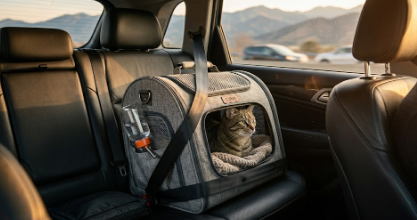
Last summer, I finally did something I’d been thinking about for a long time—taking Luna on a road trip from the west all the way to Yellowstone National Park. Over ten days on the road, thousands of miles, one cat, one carrier. Before we left, I spent an entire evening at home agonizing over two carriers: one was a lightweight, foldable soft carrier that packed down to the size of a laptop; the other was a sturdy carrier with a rigid base—solid but bulky. In the end, I took both. As it turned out, that decision saved me more than once along the way.
That trip taught me something crucial: lightweight/foldable and sturdy base aren’t about “which one is better”—they’re about “which scenario calls for which.” Choose wrong, and it’s not just an inconvenience—it’s a matter of your pet’s safety and comfort.
Table of Contents
Lessons from a Long Road Trip: Why I Brought Both Carriers
Deep Dive into Two Needs: Lightweight & Foldable vs. Sturdy Base
Adapting to Different Vehicles: Sedan Trunk, SUV Back Seat, Passenger Seat
Three Essentials for Long‑Haul Comfort: Rigid Base, Removable Liner, Storage Pockets
My Solution: A Two‑Carrier Strategy (Primary + Backup)
Shopping Checklist: Key Features for a Road‑Trip Carrier
Frequently Asked Questions
Conclusion: There’s No Perfect Carrier—Only the Right Combination
Lessons from a Long Road Trip: Why I Brought Both Carriers
Before we left, I consulted several friends who often travel with their pets. Some said “lightweight is most important” because you’re hauling the carrier in and out of hotels every day. Others said “sturdy base is most important” because your pet will be lying in it for hours on end. After listening to everyone, I decided to bring both.
On the first day at Yellowstone, I already needed the foldable carrier. We’d booked a cabin near the park entrance; we parked the car and had to walk a gravel path to get to the room. Luna weighs 8 pounds, and the sturdy carrier alone has some heft—with the cat inside, carrying it that distance would’ve been a strain. I put Luna in the foldable carrier, slung it over my shoulder, and carried the empty sturdy carrier in my other hand. Once we reached the cabin, I folded up the lightweight carrier and tucked it into a corner, then opened the sturdy one to use as a temporary bed.
The next day, when we drove to the canyon area, I used the sturdy carrier in the car. Luna lay inside for three hours, sleeping soundly. If I’d used the foldable one that day, with its soft bottom and the constant road vibrations, her spine would have taken a beating.
That trip made me realize: on a long road trip, one carrier isn’t enough. You need two carriers—or one carrier that can serve both purposes well. But there aren’t many of those on the market.
Deep Dive into Two Needs: Lightweight & Foldable vs. Sturdy Base
Lightweight & Foldable
Best for:
- Storing in hotels (doesn’t take up room space)
- Frequent in‑and‑out of the car (lightweight, easy to carry)
- Short walks (doesn’t weigh you down)
- As a backup carrier (emergency use)
Drawbacks:
- Usually provides less structural support (as I mentioned in my “structural analysis” article regarding frameless soft carriers)
- Most have a soft bottom without a rigid base (see my article on rigid bases)
- Long‑term use can put pressure on your pet’s spine
Typical characteristics: Lightweight body, can be flattened, packs down very small. But when the pet stands inside, the bottom sags, putting uneven pressure on their legs.
Sturdy Base
Best for:
- Long hours in the car (pet rests inside)
- Pet standing up or turning around (needs stable support)
- As the primary carrier (daily driver)
Drawbacks:
- Usually heavier (rigid base + frame add weight)
- Bulky to store (takes up space in the trunk)
- Tiresome to carry (especially when loaded with a pet)
Typical characteristics: Firm shape, rigid base, noticeable weight when lifted. The carrier doesn’t deform when the pet is inside.
My recommendation:
- For short trips (1–2 days), a foldable carrier may suffice.
- For long road trips (3+ days), you need a sturdy‑base carrier.
- If you’re spending 4+ hours a day in the car, a sturdy base is essential.
Adapting to Different Vehicles: Sedan Trunk, SUV Back Seat, Passenger Seat
On a long road trip, where you place the carrier in the car directly affects your choice of carrier.
Sedan Trunk
Characteristics: Limited space; usually not connected to the back seat.
Carrier requirements:
- Needs to be foldable (the trunk will have luggage; no room for a bulky carrier)
- Must not be too large (or it won’t fit in the trunk)
- Soft‑sided is best (hard‑shell kennels often don’t fit in a sedan trunk)
My approach: I keep the foldable carrier in the trunk, using it at rest stops for Luna to relax. When driving, I put a carrier on the back seat and secure it with the seatbelt.
SUV Back Seat
Characteristics: Plenty of space; rear seats can fold down and may be connected to the trunk.
Carrier requirements:
- Can accommodate a large, sturdy‑base carrier
- Ideally can be secured to the seat (with seatbelt or straps)
- Must have a rigid base (for long‑haul comfort)
My approach: I place the sturdy carrier on the back seat and thread the seatbelt through the securing strap on the back of the carrier. Luna lies inside and sleeps the whole way.
Passenger Seat
Characteristics: Easy to keep an eye on your pet, but limited space and safety concerns.
Cautions:
- The carrier must be secured (seatbelt threaded through the carrier)
- Do not place it where the airbag would deploy (if the passenger airbag goes off, it will hit the carrier)
- The carrier shouldn’t be too large (it will encroach on the driver’s space)
My approach: I only use a foldable carrier on the passenger seat for short trips. For long trips, the carrier goes in the back seat.
Three Essentials for Long‑Haul Comfort: Rigid Base, Removable Liner, Storage Pockets
After that long trip, I realized three things are indispensable in a road‑trip pet carrier:
1. A rigid base is a must
I covered this in detail in my article on rigid bases. On a long road trip, your pet may be in the car for hours, or even an entire day. A soft‑bottom carrier can cause:
- Spinal stress
- Joint strain (in sudden stops, the pet has to brace with their legs)
- Anxiety (that unsettled feeling of not having solid footing)
Real‑world test: In a rigid‑base carrier, Luna slept like a log for hours in the car. In a soft‑bottom carrier, she started shifting positions within half an hour, unable to get comfortable.
2. A removable, washable liner
On a long road trip, accidents happen. Luna drank too much water at a rest stop and ended up peeing in the carrier. If the liner hadn’t been removable and washable, that carrier would have been unusable for the rest of the trip.
What to look for:
- The bottom pad can be removed separately.
- The interior lining is detachable (zipper or Velcro).
- The fabric is washable (nylon is easier to clean than PVC).
3. Side storage pockets
On the road, you need to grab things quickly:
- Water bottle (your pet needs to drink)
- Treats (for comfort)
- Wipes (for paws, for the carrier)
- Waste bags
Side pockets keep these items within reach—no digging through the trunk.
My Solution: A Two‑Carrier Strategy (Primary + Backup)
After coming back from Yellowstone, my setup evolved into this:
Primary carrier: Sturdy base (for the car)
- Rigid base + metal frame
- Three‑side ventilation
- Removable, washable liner
- Can be secured in the car (seatbelt threading)
- Lives in the back seat—never folded away during the trip
Use: Long hours in the car, pet resting inside, serves as a “mobile bed” in the vehicle.
Backup carrier: Foldable (for hotels, short walks)
- Lightweight, foldable
- Packs down very small
- Thin rigid base (better than a pure soft carrier, but not as supportive as the primary)
- Can be carried over the shoulder
Use: Short trips from hotel to room, walking after getting out of the car, emergency backup.
The key takeaway: The carrier must be secured in the car
This was the most important lesson from that trip. In a sudden stop, an unsecured carrier can:
- Slide off the seat
- Slam into the front seats
- Roll around inside the car
How to secure it:
- Best: the carrier has a slot on the back for the seatbelt to pass through.
- If not, wrap the seatbelt around the top of the carrier and tighten.
- Alternatively, use a dedicated pet‑carrier car strap (available online).
Shopping Checklist: Key Features for a Road‑Trip Carrier
If you’re planning a long road trip, use this checklist to evaluate carriers:
√ Rigid base (essential)
- Has a hard bottom (PVC board, composite wood, aluminum plate)
- Doesn’t depress when pressed
- Preferably removable (for easy cleaning)
√ Can be secured in the car
- A slot on the back for the seatbelt
- Or attachment points for straps
- Or compatible with a dedicated car‑securing strap
√ Good ventilation (three sides minimum)
- At least two sides have mesh
- A top vent (hot air rises)
- (See my “ventilation test” article)
√ Removable, washable liner
- Bottom pad can be taken out
- Lining can be detached
- Fabric is easy to clean
√ Side storage pockets
- For water bottle, treats, wipes
- Mesh pockets are best (breathable, visible)
√ Foldable (optional but recommended)
- Choose foldable if space is tight
- But foldable carriers usually have less support—weigh the trade‑off for your use case
Frequently Asked Questions
Q: On a long road trip, is one carrier enough?
A: It depends on your itinerary. If you’re staying in places where the car is parked right outside, a single sturdy carrier might be enough. If you’re changing hotels often and have to walk in and out each time, I recommend two carriers (sturdy + foldable) used together.
Q: Can I use a foldable carrier in the car?
A: For short trips (1–2 hours), yes. For long trips, I don’t recommend it—foldable carriers lack structural support, and prolonged road vibrations can be hard on your pet’s spine.
Q: How do I secure a sturdy carrier in the car?
A: The safest way is to thread the seatbelt through a dedicated slot on the back of the carrier. If there’s no slot, wrap the seatbelt around the top of the carrier and pull it tight. Never leave a carrier loose on the seat.
Q: How often should I stop for my pet on a road trip?
A: Stop every 2–3 hours. Let your pet out to drink, use the bathroom, and move around. Put a cooling pad in the carrier (summer) or a warming pad (winter) as needed.
Q: Can I put a pet carrier in the trunk?
A: Yes, but with caveats:
- The trunk must be connected to the passenger compartment (SUVs can; some sedans cannot).
- The trunk must have ventilation—never seal your pet in a closed trunk.
- In a sudden stop, the carrier can slam into the trunk door—it needs to be secured.
Conclusion: There’s No Perfect Carrier—Only the Right Combination
That long road trip taught me something clear: choosing a carrier for a road trip isn’t about picking “lightweight” over “sturdy base” or vice versa—it’s about combining them according to the situation.
- In the car: sturdy base – protects the spine, stable and safe.
- At the hotel: foldable – easy to store, lightweight to carry.
- Together: primary carrier stays put, backup carrier goes with you.
If you can only buy one carrier, go with the sturdy‑base model—because the car is where your pet spends the most time, and safety there is the highest priority. If you can, get both; it makes a long road trip much more manageable.
You’re not buying just a carrier—you’re buying your pet’s “mobile home” for thousands of miles on the road. The “foundation” of that home determines whether they arrive safely.
Before your next long trip, take a look at your carrier—can it handle the road?
Have you ever taken your pet on a road trip? What carrier issues did you run into? Share your story in the comments.
Leave a Reply
You must be logged in to post a comment.