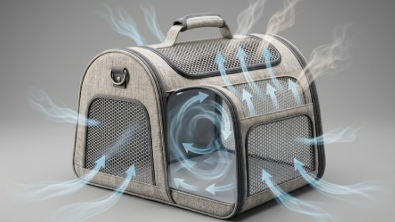
Last summer, I took Luna to the pet store for a bath. The weather was fine when we left, but on the way back, I got stuck in traffic for nearly half an hour. To save gas, I turned off the AC and cracked the window. Luna was quiet at first, then started shifting restlessly. Then I heard it—panting. Huf, huf, with her tongue out and her nose dry. I quickly moved the carrier to the window for air and touched the inside of the carrier. It was hot.
When I got home, I measured the temperature inside the carrier with a thermometer—it was significantly higher than outside. A cat’s normal body temperature is 38–39°C (100.4–102.2°F). When the ambient temperature approaches body temperature, cats can’t cool themselves through their skin; they can only pant. Panting is a cat’s “last line of defense”—it means they’ve reached their limit.
After that, I started studying the ventilation design of pet carriers. I bought several different models, measured them with a thermometer, and combed through a large number of negative reviews about “ventilation.” Today, I’ll share the test data and buying advice in full.
Table of Contents
Half an Hour Stuck in Summer Traffic: Luna Panting in the Carrier
Data-Backed: Real Voices from Ventilation-Related Reviews
Temperature Test: Comparing Three Carrier Types in Summer Heat
Cross‑Ventilation Design: Mesh Size Matters Less Than Placement
Fan‑Equipped Carriers Tested: Do USB Fan Cat Carriers Actually Work?
Shopping Checklist: 3+ Sides of Ventilation, Light Colors Preferred, Avoid All‑Clear
Frequently Asked Questions
Conclusion: When Choosing a Carrier for Summer, Ventilation Is the #1 Safety Factor
Half an Hour Stuck in Summer Traffic: Luna Panting in the Carrier
On the way home from the pet store that day, Luna’s reaction scared me. After checking the information, I learned that cats tolerate heat worse than dogs. Dogs can cool themselves through their tongues over a large area, but cats are much less efficient at heat dissipation. Inside a closed pet carrier with poor ventilation, the temperature can rise to dangerous levels in just 10–15 minutes. Mild heatstroke shows as panting and drooling; severe cases can lead to collapse and organ failure.
Since then, every time I go out with my cat in summer, I first check the carrier’s ventilation design. This experience also made me mention in my earlier “material analysis” article that PVC mesh has poor breathability—that discovery also happened in summer.
Data-Backed: Real Voices from Ventilation-Related Reviews
Among the negative reviews I read, quite a few specifically mentioned “ventilation” or “stuffiness.” I categorized the issues in those reviews:
- Too hot in summer (58%) – “Can’t use it in summer at all,” “cat was like in a sauna”
- Not enough mesh (22%) – “Only one side has mesh, the rest is fabric,” “too few vents”
- Poor design (20%) – “Mesh faces the wall, no air flow,” “no top opening”
Some users gave positive feedback:
“I love the mesh panels that provide great airflow.”
Others gave negative feedback:
“Not enough airflow in warm weather.”
Putting these two comments side by side makes it clear: the core of ventilation design isn’t “whether there is mesh,” but “how much mesh and where it’s placed.”
Temperature Test: Comparing Three Carrier Types in Summer Heat
I selected the three most common types of carriers on the market and tested them on the same summer afternoon (outdoor high temperature, no wind, sunny). The thermometer was placed in the center of each carrier, and I recorded the temperature in the shade and in direct sunlight.
Test subjects:
- Carrier A: Single large mesh panel (only the front has a large mesh panel; the other sides are thick oxford fabric)
- Carrier B: Three‑side ventilation (mesh on the front and both sides, plus a small vent on top)
- Carrier C: All‑clear space capsule carrier (main body is transparent PC plastic with only a few small air holes)
Measured data:
- Single large mesh: In Shade 32°C (89.6°F), In Direct Sun 45°C (113°F), Temperature Rise +13°C (23.4°F). Verdict: Oven in the sun – dangerous
- Three‑side ventilation: In Shade 30°C (86°F), In Direct Sun 38°C (100.4°F), Temperature Rise +8°C (14.4°F). Verdict: Good airflow – relatively safe
- All‑clear space capsule: In Shade 34°C (93.2°F), In Direct Sun 52°C (125.6°F), Temperature Rise +18°C (32.4°F). Verdict: Greenhouse effect – extremely dangerous
Interpretation:
The single‑large‑mesh carrier was acceptable in the shade, but in direct sunlight the temperature quickly shot up to over 45°C (113°F). A cat in a 45°C environment for more than 15 minutes is at risk of heatstroke.
The three‑side ventilation carrier reached 38°C (100.4°F) in the sun. While still hot, it is near a cat’s upper tolerance limit (cats can briefly endure 38–39°C / 100–102°F). With additional cooling measures (ice pack, fan), it is generally safe.
The all‑clear space capsule carrier hit 52°C (125.6°F) in direct sunlight—a temperature that can cause severe heatstroke in a cat within a short time. Never use an all‑clear carrier outdoors in summer.
Cross‑Ventilation Design: Mesh Size Matters Less Than Placement
Many people think “the bigger the mesh, the better,” but testing shows that the placement of the mesh matters more than its size.
Principle of air flow
Hot air rises, and cool air enters from below. An ideal design includes:
- Air inlets at the bottom of the carrier (for cool air to enter)
- Air outlets at the top (for hot air to escape)
- Openings on multiple sides to create cross‑ventilation
Cross‑ventilation rating for three common designs
- Single large mesh: 1 star – Only one side for both air intake and exhaust; air only circulates locally; hot air cannot escape
- Two opposite side mesh: 3 stars – Mesh on left and right or front and back – enables horizontal cross‑flow
- Three sides + top ventilation: 5 stars – Air enters from sides, hot air exits from the top – complete circulation
Buying advice:
- At a minimum, choose carriers with “two‑side cross‑ventilation” (mesh on both left and right).
- A top vent is very important—hot air accumulates at the top; without a top opening, the heat stays trapped.
- It’s best not to have mesh on the bottom (to prevent drafts and leaks), but having air inlets on the lower sides is good.
Fan‑Equipped Carriers Tested: Do USB Fan Cat Carriers Actually Work?
There is a type of cat carrier on the market that comes with a small USB fan, mounted on the side or top, blowing air inside. I bought one to test.
Cooling effect: In high‑temperature sunlight, with the fan off, the inside temperature exceeded 38°C (100.4°F). With the fan on (medium speed), the temperature dropped to about 35°C (95°F) after a while—a reduction of about 3–5°C (5–9°F).
Issues:
- Noise: The fan produces a buzzing sound that some cats find frightening. The first time Luna heard it, she curled into a ball.
- Battery life: Most last only 2–3 hours, not enough for long trips.
- Air direction: If the fan blows directly onto the cat, it can be uncomfortable. It’s best to choose a model where the airflow direction can be adjusted.
Conclusion: Fan‑equipped carriers have some effect, but the noise issue requires that your cat be acclimated in advance. If your cat can’t tolerate the noise, the traditional “cooling pad + ventilation” combination works better.
Shopping Checklist: 4 Core Principles for Choosing a Summer Carrier
√ 1. Prioritize carriers with ventilation on at least three sides
Front, both sides, and top—at least three sides should have mesh. A top vent is especially important.
√ 2. Avoid all‑clear materials
All‑clear space capsule carriers create a “greenhouse effect” in the sun, reaching extremely high temperatures. Never use them outdoors in summer.
√ 3. Light‑colored carriers are cooler than dark ones
Black carriers absorb heat; white/light‑colored carriers reflect sunlight. With the same material, a light‑colored carrier can be 3–5°C (5–9°F) cooler in the sun than a dark one.
√ 4. Pair with cooling accessories
- Cooling pad: Placed at the bottom of the carrier, it provides continuous cooling for 2–3 hours.
- Mini USB fan: If the noise is acceptable, it can assist with cooling.
- Sun shield: Cover the outside of the carrier with a light‑colored cloth to reflect sunlight.
Frequently Asked Questions
Q: Where is the safest place to put the carrier in the car during summer?
A: On the floor of the back seat (to avoid direct sunlight), with the air conditioning on. Do not put it in the trunk, and do not put it in the front passenger seat (airbag risk). If the carrier is dark, cover the top with a light‑colored towel.
Q: Can cats scratch through cooling pads?
A: Possibly. Choose a “scratch‑resistant cooling pad” (with an outer layer of durable oxford fabric) or place the cooling pad underneath the inner liner of the carrier.
Q: Are all‑clear carriers really unusable in summer?
A: Yes. Tests show they reach extremely high temperatures in sunlight. If you must use one (e.g., in winter), still avoid direct sunlight and only use it for very short trips.
Q: Won’t a well‑ventilated carrier be cold in winter?
A: Yes. Ventilation and insulation are contradictory. It’s best to use a well‑ventilated carrier in summer and a model with closable mesh panels (e.g., with zipper covers) in winter, or add an insulating cover over the carrier in cold weather.
Conclusion: When Choosing a Carrier for Summer, Ventilation Is the #1 Safety Factor
That experience of Luna panting taught me a lesson: a pet carrier’s ventilation isn’t a matter of “comfort”—it’s a matter of “safety.”
A carrier with poor ventilation is a mobile oven in summer. In just 10–15 minutes, the temperature can soar from 30°C to over 45°C (86°F to 113°F+). The cat inside isn’t just “a little hot”—they’re “getting heatstroke.”
Now, when I choose a carrier for summer, my criteria are very clear:
- At least three sides of ventilation (including the top)
- Light color preferred
- No all‑clear carriers
- Pair with a cooling pad + sun shield
You’re not buying just a carrier—you’re buying your pet’s “mobile air‑conditioned room” in summer. Whether the ventilation is good enough directly determines whether they get home safely.
Summer is coming. Check the carrier you have—is it breathable enough?
Have you ever had an experience where your cat got too hot while going out in summer? Share your story in the comments.
Leave a Reply
You must be logged in to post a comment.