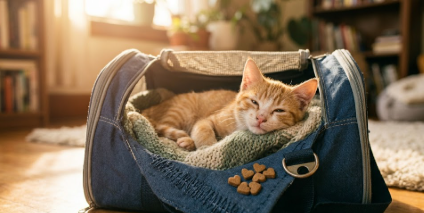
The first time Luna went into a carrier was when I took her for a vaccination as a kitten.
That day, I took the carrier out of the closet, set it on the floor, and the moment I unzipped it, Luna reacted as if she’d seen a ghost—arched back, fur puffed up, ears flattened into airplane ears. She shot under the sofa in a flash. It took me ages to coax her out, and I ended up having to stuff her inside. Once in, she started clawing frantically, her nails catching in the mesh as she thrashed around inside, letting out a yowl I’d never heard before—sharp and long, like someone had stepped on her tail.
Before we even made it out of the neighborhood, a sharp smell of urine drifted out of the carrier. Luna had peed inside.
I turned the car around, left the carrier on the balcony, and didn’t dare try again for an entire week.
After that, I spent a full month using a gradual training method to take Luna from “hides at the sight of the carrier” to where she is now—when I put the carrier on the floor, she walks right in and lies down to sleep inside it. Today, I’m sharing this method in full.
Table of Contents
Luna’s First Time: Scratching, Yowling, and Peeing in the Carrier
Data-Backed: Real Reactions in Cat Anxiety Reviews
Gradual Desensitization Training: Four Weeks to Get Your Cat to Enter the Carrier Willingly
Using Pheromones: Chemical Signals to Help Your Cat Relax
Soothing Techniques: Your Emotions Are Contagious
Practical Checklist: Desensitization Training Tracker + Must-Haves for a Calming Carrier Kit
Frequently Asked Questions
Conclusion: Don’t Let the Carrier Become Your Cat’s “Nightmare”
Luna’s First Time: Scratching, Yowling, and Peeing in the Carrier
After that failed outing, I went looking through reviews and found that Luna’s reaction wasn’t unique.
Someone else had a cat that got so scared it peed in the carrier:
“My cat peed in the carrier before we even left the driveway.”
Someone else was overwhelmed by their cat’s screaming:
“She screamed the whole 15 minutes to the vet. I was in tears by the time we got there.”
Someone else tried repeatedly without success:
“He scratches at the door until his paws bleed. I can’t do this to him anymore.”
These reviews made me realize: a cat’s resistance to the carrier isn’t a “personality problem”—it’s fear. And fear can be overcome.
Data-Backed: Real Reactions in Cat Anxiety Reviews
Among the negative reviews I read, quite a few specifically mentioned “cat anxiety” or “cat resistance.” I categorized the reactions in these reviews:
- Constant Crying (54%) – “Yowling,” “screaming,” “cried the whole way”
- Scratching Carrier Walls (23%) – “Scratched the door frantically,” “claws got caught in the mesh”
- Eliminating in the Carrier (12%) – “Peed,” “pooped inside”
- Drooling/Panting (11%) – “Drooled all over,” “panting with mouth open”
Luna’s reaction that time covered almost all of them—yowling, scratching, peeing.
One review stuck with me:
“I thought my cat just hated the vet. Turns out she hated the carrier. Once I trained her, she was fine.”
That review made me decide: it wasn’t about changing the carrier—it was about changing the approach.
Gradual Desensitization Training: Four Weeks to Get Your Cat to Enter the Carrier Willingly
I spent a month on this, one stage per week, taking Luna from “runs at the sight of the carrier” to “willingly goes in and lies down.”
Week 1: Static Acclimation
Goal: Help your cat associate the carrier with positive experiences.
I placed the carrier on the living room floor with the door open, lined it with Luna’s usual blanket, and tossed in a few of her favorite freeze-dried treats. Next to the carrier, I put a worn T-shirt of mine—cats instinctively feel safe around their owner’s scent.
The first day, Luna only dared to watch from a distance, nose twitching as if trying to identify the “monster.” On the second day, she crept a little closer, sniffed the opening, then backed away. On the third day, she finally stretched a paw inside, then quickly pulled it back. On the fourth day, she poked half her body in, grabbed a treat, and darted out. By the weekend, she was going all the way inside, eating the treats, and even lying there for a while.
I didn’t rush her that week. Whether she went in or how long she stayed was entirely up to her. The only goal was to let Luna learn that this carrier wouldn’t hurt her.
Week 2: Short Periods with the Door Closed
Goal: Get your cat used to the door being closed.
Once Luna was inside, I gently closed the door for just 3 seconds, then opened it and gave her a treat. She was startled at first, but once she realized “closed door = treat,” she gradually relaxed.
I repeated this daily, slowly increasing the time from 3 seconds to 5, 10, 30 seconds, then 1 minute, then 5 minutes. By the weekend, Luna could stay quietly inside the closed carrier for 5 minutes—after finishing her treats, she’d just lie down instead of scratching.
Key detail: While the door was closed, I sat right there with her. I didn’t lift the carrier or move around—I just stayed quietly beside her. Cats feel much safer in a stationary environment than in one that’s moving.
Week 3: Simulating Movement
Goal: Get your cat used to the sensation of the carrier moving.
This was the hardest step. I started walking around the house with the carrier, from the living room to the bedroom and back. Every few steps, I stopped and dropped a treat inside. At first, Luna was still tense—her claws gripped the base, her ears flattened—but because treats came every few steps, she held it together.
I gradually increased the distance and time, from one minute to five, from flat ground to simulating the up-and-down motion of stairs—lifting the carrier from the floor to a chair and back down, repeating the motion many times.
One day, after walking around the house with the carrier for ten minutes, I stopped and noticed Luna wasn’t waiting for a treat. She was lying down with her eyes closed. That’s when I knew she was starting to relax.
Week 4: Environmental Upgrades
Goal: Get your cat used to being in the carrier outside the home.
In the final week, I took the carrier into the hallway, leaving the apartment door open so Luna could run back inside anytime. She was nervous for the first few days—her tail puffed up, her eyes wide—but because of the foundation built in previous weeks, she adjusted quickly.
Next came the elevator—one of Luna’s biggest fears. The first day, she curled up in the corner of the carrier, completely silent. I stood inside the elevator with her for one minute, then went home and gave her a big handful of treats. The next day, we stayed a little longer. By the weekend, she was peeking out to look around while inside the elevator.
Then came the garden downstairs, a short walk around the neighborhood, and finally, getting in the car and going to the vet.
The first time Luna rode in the car without making a sound, I almost cried.
Using Pheromones: Chemical Signals to Help Your Cat Relax
During the training, I also used an aid—pheromone spray.
Pheromones are natural chemical signals secreted by glands on a cat’s face, signaling “this place is safe.” Feliway is the most well-known brand.
How I used it: 15 minutes before each training session, I sprayed the inside of the carrier twice, focusing on the corners. I didn’t spray it directly on Luna, and I didn’t use too much.
Luna’s response was noticeable: before using it, she’d go into the carrier with flattened ears and a stiff body; after using it, her ears would slowly perk up, and her body would relax. One time I forgot to spray, and she was noticeably more agitated, scratching several times before calming down.
Based on my observations, pheromones can reduce anxiety manifestations by more than half—not eliminate them entirely, but enough to make training go smoothly.
Soothing Techniques: Your Emotions Are Contagious
The most important thing I learned during training: if you’re tense, your cat will be even more tense.
One week I was stressed about a project and clearly impatient while walking around with the carrier. Luna was unusually agitated that day—scratching, growling—and nearly undid a week’s progress. I stopped, took a deep breath, adjusted my mindset, and tried again. She relaxed too.
Cats gauge whether an environment is safe by watching their owners. If you’re tense, they sense “danger.” If you’re relaxed, they sense “it’s probably okay.”
A few soothing techniques that worked for me:
Put familiar things inside the carrier: Luna’s old blanket, a worn T-shirt of mine. Familiar scents are the greatest source of comfort. In the first week of training, I put a T-shirt I’d worn for two days at the bottom of the carrier. Luna sniffed it and relaxed faster than usual.
Use treats as a lure: I bought a special freeze-dried treat that Luna didn’t get at any other time—only inside the carrier. Her willingness to go in later was largely driven by that treat. Early in training, I placed the treat at the far end of the carrier so she had to go all the way in to get it. Later, I switched to giving treats after closing the door or while walking, reinforcing the connection between “going in the carrier” and “good things happen.”
Never force: Any time your cat wants to come out, let them out. Forcing only deepens fear. The core of training is “the cat chooses to go in,” not “the owner shoves them in.” One week I got impatient—I closed the door right after Luna went in, and she bolted out in terror. After that, she wouldn’t go near the carrier for two days. I had to go back to week one and start over.
Practical Checklist: Desensitization Training Tracker + Must-Haves for a Calming Carrier Kit
Four-Week Desensitization Training Tracker
- Week 1: Static Acclimation – Goal: Cat willingly enters and stays inside for 5 minutes without stress. Daily practice: Carrier open, place treats and familiar items, allow free access.
- Week 2: Short Periods with Door Closed – Goal: Cat stays quietly in closed carrier for 5 minutes. Daily practice: Close door for 3s→5s→30s→1min→5min, reward each time.
- Week 3: Simulate Movement – Goal: Cat stays quietly in moving carrier for 10 minutes. Daily practice: Walk with carrier, from 1 to 10 minutes, simulate bumps and motion.
- Week 4: Environmental Upgrades – Goal: Cat stays quiet in carrier in unfamiliar environments. Daily practice: Hallway → elevator → downstairs → car → vet clinic entrance.
Must-Haves for a Calming Carrier Kit
- Pheromone spray: Spray inside the carrier 15 minutes before training
- High-value treats: Special treats given only inside the carrier
- Familiar blanket: Your cat’s usual blanket or a worn T-shirt of yours
- Pee pad: Place at the bottom of the carrier during early training to manage accidents
Frequently Asked Questions
Q: How long does training take?
A: It depends on your cat’s personality. Nervous cats may need 4-6 weeks; confident cats might be ready in 2. Luna took a full four weeks, with two setbacks along the way. The key is not to rush—go at your cat’s pace.
Q: My cat already has a bad experience with the carrier. Can I rebuild trust?
A: Yes. Luna peed in the carrier her first time, but after training, she completely changed. The key is to start from zero—just leave the carrier out and let your cat explore it on their own. Don’t try to “use” it right away. It takes enough positive experiences to outweigh the bad memories, and it may take longer, but it’s worth it.
Q: What if my cat won’t go near the carrier during training?
A: Start by placing treats further away, then move them a little closer each day. Go from “eating next to the carrier” to “eating at the entrance” to “eating inside”—one step at a time. That’s how I started with Luna: I placed the freeze-dried treats a meter away from the carrier and moved them ten centimeters closer each day. By the weekend, they were inside. If your cat won’t enter, it means the step was too big—go back and try again.
Q: Does pheromone spray actually work?
A: For most cats, yes. It’s not a “drug”; it’s a “signal” that tells your cat “this place is safe.” Luna responded clearly, but not all cats do. I recommend buying a small bottle to try first. If your cat doesn’t respond, it won’t interfere with training—you’ll just be missing an extra aid.
Q: What if my cat still cries in the carrier?
A: Go back one stage. If they cry during movement simulation, go back to static acclimation for a few more days. If they cry when the door is closed, go back to leaving it open. Training isn’t linear—sometimes you need to take a step back to move forward. One day during week three, Luna suddenly started crying. After checking, I realized I’d forgotten to put her blanket in, and she didn’t like the feel of the bare base. Once I added the blanket, she quieted down. Sometimes the issue is a small detail.
Conclusion: Don’t Let the Carrier Become Your Cat’s “Nightmare”
The first time Luna went into the carrier, I thought she was “naturally afraid of carriers.” Later, I realized she was just scared. Scared of a strange space that suddenly appeared, that trapped her inside, and that she didn’t know where it would take her.
After a month of training, the carrier became her “safe space.” One time, I opened it and set it on the floor. Luna walked right in and slept there all afternoon. On the way to the vet, she was quiet, occasionally peeking out to look at the view.
I often think: if I hadn’t spent that month, if I had just forced her in, forced her out, forced her to go places—would Luna now hide, pee, or scream at the sight of the carrier? Most likely.
Cats can’t speak, but every reaction tells us: I’m scared. And what we can do isn’t to force them to “be brave”—it’s to give them time to discover on their own that this carrier is actually safe.
Does your cat cry when going into the carrier? Share your desensitization experiences in the comments.
Leave a Reply
You must be logged in to post a comment.