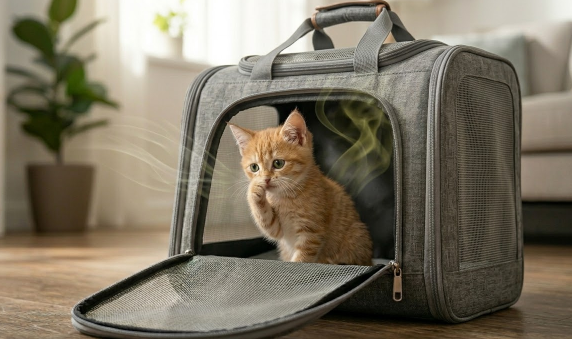
The first time Luna went out in a new carrier was for a vet visit.
I had bought a brand new carrier specifically for the occasion, thinking “new carrier, new start”—I wanted Luna to travel comfortably to the vet. When I unboxed it, I noticed a distinct plastic smell, but I thought, “It’s new, they all smell like this. A little airing out will fix it.” I didn’t wait. I put Luna inside and headed out.
From home to the vet was a 20-minute taxi ride. Luna sneezed continuously inside the carrier, one after another, like she couldn’t stop. I thought she was just nervous, so I reached in to pet her head. When we arrived, I placed the carrier on the examination table. The vet opened it to take her out, but Luna refused to budge. She huddled in the corner, her nose wrinkled, eyes half-closed.
The vet looked at the carrier, gave it a sniff, and frowned. “This carrier has a pretty strong smell. Cats are very sensitive to odors. She might be overwhelmed by it.”
That entire visit, Luna was tense. After the vaccination, she hid at home for two days before finally relaxing. Later, I left the carrier on the balcony to air out for a whole week before the smell dissipated. But the damage was already done—every time she saw that carrier afterward, Luna would go the other way.
That’s when I learned: the plastic smell from a new carrier isn’t a “minor issue”—it’s a major one. It can ruin your pet’s travel experience and even create a lasting aversion to the carrier itself.
Table of Contents
Luna’s Outing: A Vet Visit Ruined by Odor
Data-Backed: Real Stories from Odor-Related Reviews
Analyzing the Source: Where Does the Smell Come From?
5 Odor Removal Methods: A Side-by-Side Comparison
Choosing Eco-Friendly Materials: Which Carriers Have the Least Smell?
What to Avoid: Carriers You Shouldn’t Keep
Frequently Asked Questions
Conclusion: Don’t Let Odor Become Your Pet’s First Negative Impression
Luna’s Outing: A Vet Visit Ruined by Odor
After that experience, I started paying close attention to the smell issue with pet carriers. While reading reviews, I realized I wasn’t alone.
One user wrote:
“Very plastic-y chemical smelling fabric.”
Another:
“Strong smell when opened the package.”
And another:
“Had to air it out for days.”
The experiences behind these comments were exactly like mine—a pungent smell upon unboxing, the assumption that airing it out would fix it, and then the pet suffering inside.
Data-Backed: Real Stories from Odor-Related Reviews
When I looked through negative reviews about odors, I found quite a few. I categorized them by the type of smell:
- Pungent Plastic Smell – “Chemical smell,” “burnt plastic,” “hit me as soon as I opened it”
- Glue Smell – “Smells like super glue,” “adhesive odor”
- Dye Smell – “Strong paint-like smell,” “smells like new clothes that haven’t been washed”
User quotes:
“Very plastic-y chemical smelling fabric.”
This is the most common complaint—a plastic smell from cheap PVC or recycled materials.
“Strong smell when opened the package.”
The smell is present upon unboxing, indicating that the odor accumulated inside the sealed packaging and that the material itself has high volatile emissions.
“Had to air it out for days.”
The smell takes days to dissipate, meaning it’s not just a “surface odor” but a continuous release from the material itself.
Analyzing the Source: Where Does the Smell Come From?
Drawing on the material knowledge from my previous article on carrier materials, I’ve identified three main sources of odor:
1. Cheap PVC Materials (Excess Plasticizers)
PVC itself doesn’t have a strong odor, but to make the fabric flexible, manufacturers add large amounts of plasticizers during production. Low-quality plasticizers slowly release small molecules into the air—that’s the “plastic smell.” When plasticizers exceed safe levels, the odor is pungent and lingers for a long time.
Typical characteristics: Strong, persistent smell that returns even after airing out.
2. Low-Quality Adhesives (Formaldehyde Release)
Carriers often use adhesives for bonding linings, reinforcing seams, and attaching decorative elements. Formaldehyde and benzene compounds from cheap glues can continuously off-gas, creating a “glue smell” or “chemical smell.”
Typical characteristics: Pungent, eye-irritating odor that diminishes after airing but returns when windows are closed.
3. Sealed Packaging (Odor Accumulation)
New carriers are sealed in plastic bags immediately after production. During transit, the odor has no chance to dissipate and accumulates inside the package. The initial burst of smell upon opening isn’t always because the material itself is extremely odorous—it’s often because the smell was “trapped” inside.
Typical characteristics: Intense smell upon unboxing that significantly diminishes after one to two days of airing.
5 Odor Removal Methods: A Side-by-Side Comparison
I tested five odor removal methods using carriers from the same batch (all were new carriers made of cheap PVC) and recorded the results:
- Airing Out + Sunlight (3-5 days) – Effectiveness: Good. Avoid prolonged sun exposure to prevent fading and mesh degradation.
- White Vinegar Wipe (1-2 days) – Effectiveness: Excellent. Requires a final wipe with clean water; may leave a vinegar residue.
- Tea Leaves/Coffee Grounds (2-3 days) – Effectiveness: Good. Use in sealed bags to prevent spills; absorbs rather than neutralizes.
- Activated Charcoal (3-5 days) – Effectiveness: Moderate. Requires a sealed environment; limited effectiveness.
- Baking Soda Spray (1 day) – Effectiveness: Excellent. Best for quick odor removal; needs thorough drying.
Detailed Instructions:
Airing Out + Sunlight
How to do it: Place the carrier in a well-ventilated area with all zippers open for 3-5 days.
Pros: Free, won’t damage materials.
Cons: Slow; sun exposure may cause fading (especially on dark-colored carriers).
Best for: Mild odors when you’re not in a hurry.
White Vinegar Wipe (My Most Recommended Method)
How to do it: Mix white vinegar with water in a 1:1 ratio. Use a soft cloth to wipe all fabric surfaces inside and out. Let it air dry, then wipe again with clean water to remove any vinegar residue.
Pros: Fast-acting; vinegar neutralizes alkaline odor molecules.
Cons: Requires two wipes; lingering vinegar smell may bother some cats.
Best for: Most cases, especially plastic smells from PVC.
Tea Leaves/Coffee Grounds
How to do it: Place dry tea leaves or coffee grounds in a fabric bag. Put the bag inside the carrier, close the zipper, and leave for 2-3 days.
Pros: Natural absorption; leaves a light tea scent.
Cons: Absorbs rather than neutralizes; powder may leak out.
Best for: Mild odors when time is not critical.
Activated Charcoal
How to do it: Place activated charcoal bags inside the carrier, close the zipper, and leave for 3-5 days.
Pros: Professional-grade absorption.
Cons: Requires a sealed environment; limited effectiveness against ongoing emissions from PVC itself.
Best for: “Trapped smells” from sealed packaging.
Baking Soda Spray (Quick Odor Removal)
How to do it: Dissolve baking soda in water (1 tablespoon per 500ml). Pour into a spray bottle and spray evenly inside and outside the carrier. Let it dry thoroughly, then vacuum or brush off any remaining powder.
Pros: Fast; baking soda breaks down acidic odor molecules.
Cons: Requires complete drying; powder residue may remain.
Best for: Heavy odors when you need to use the carrier quickly.
Choosing Eco-Friendly Materials: Which Carriers Have the Least Smell?
In my earlier article on carrier materials, I compared the odor characteristics of different materials in detail. Here’s a focused summary:
- High-Quality Nylon (1680D Ballistic Nylon) – Odor Level: None or very slight. Reason: Dyed directly without heavy coatings. Recommendation: 5 Stars
- EVA (Eco-Friendly Foam) – Odor Level: None. Reason: Environmentally friendly, odor-free. Recommendation: 5 Stars
- Eco-Friendly PVC (Branded) – Odor Level: Slight, dissipates quickly. Reason: Uses food-grade plasticizers. Recommendation: 3 Stars
- Standard PVC (Cheap) – Odor Level: Pungent, persistent. Reason: Excess low-quality plasticizers. Recommendation: 1 Star
- Recycled Fabric – Odor Level: Pungent, persistent. Reason: Impurities and residual dyes. Recommendation: Not Recommended
Buying Tips:
- Prioritize carriers labeled “high-quality nylon” or “1680D”—they have the least smell and are highly durable.
- Carriers labeled “EVA” or “eco-friendly materials” are also good choices, though EVA is more common in hard-shell kennels than soft carriers.
- Be cautious with listings that only say “oxford fabric” or “premium material” without specifying details—these may be cheap PVC or recycled materials.
- If a carrier has a pungent smell that doesn’t dissipate after three days of airing, return it immediately. This indicates a material defect that no amount of odor removal can fully address.
What to Avoid: Carriers You Shouldn’t Keep
If your new carrier exhibits any of the following, it’s best to return it rather than “making do”:
Strong pungent smell upon unboxing
If the smell hits your throat, stings your eyes, or makes you dizzy after a few minutes of exposure—this indicates excessive plasticizers or formaldehyde. While the smell might fade after a few days of airing, the underlying material issue remains and will likely re-emerge with heat (such as inside a car during summer).
Odor persists after three days of airing
A mild glue smell that disappears within a day or two is normal. If after three days of airing there’s still a noticeable pungent smell, the off-gassing is ongoing—it’s best not to keep it.
Smell returns after vinegar wipe
If after wiping with vinegar and airing overnight, the smell returns when you open the carrier the next day—this means the odor is coming from inside the material itself, not just surface residue. Carriers like this will never be completely odor-free.
Special note: Do not use bleach or Pine-Sol for odor removal
Bleach (sodium hypochlorite) can leave chlorine residues that irritate pets’ respiratory tracts. Phenolic disinfectants like Pine-Sol are toxic to cats and can be absorbed through the skin or inhaled. Stick to white vinegar or baking soda for odor removal.
Frequently Asked Questions
Q: My new carrier has a smell. How long is normal for airing it out?
A: A mild glue smell that disappears within a day or two is normal. If the smell remains pungent after three days of airing, it’s best to return it.
Q: If I wipe it with white vinegar, will my cat dislike the vinegar smell?
A: Possibly. Some cats are sensitive to vinegar. That’s why it’s important to wipe again with clean water after the vinegar treatment—this removes most of the vinegar residue. If your cat still seems bothered, placing a small bowl of catnip inside the carrier can help neutralize the scent.
Q: Why doesn’t activated charcoal work well for plastic smells?
A: Activated charcoal absorbs odor molecules that are already airborne, but it can’t stop the ongoing off-gassing from the PVC material itself. For carriers with strong plastic smells (like cheap PVC), activated charcoal has limited effectiveness.
Q: Are there carriers with absolutely no smell?
A: Yes. Carriers made from high-quality nylon (like 1680D ballistic nylon) or EVA typically have little to no smell upon unboxing. That’s why I emphasized in my earlier material guide that choosing the right material saves you the trouble of odor removal altogether.
Q: My carrier developed a smell after using it for a while. What happened?
A: There are two possible reasons:
- Moisture and mildew: Wash and dry thoroughly.
- Heat-induced off-gassing: During summer, high temperatures inside a car can accelerate the release of plasticizers from cheap PVC, causing the smell to reappear. This indicates that the carrier was made with low-quality PVC—it’s not an aging issue but an inherent material flaw.
Conclusion: Don’t Let Odor Become Your Pet’s First Negative Impression
Luna’s terrible vet visit taught me something important: pets are far more sensitive to odors than we realize.
What we think of as “everything new has a bit of a smell” can feel like “this place is dangerous” to a cat. A cat’s sense of smell is 14 times stronger than a human’s. What we perceive as “a bit pungent” can be “overwhelming” to them. That carrier I “made do with” created a lasting fear in Luna—it took a long time to rebuild her trust.
Now, when I receive a new carrier, the first thing I do is not put the cat in it. Instead:
- I sniff it immediately after unboxing—if the smell is strong and pungent, I return it.
- If the smell is mild, I air it out and wipe it down with white vinegar before using it.
- Before introducing it to my cat, I place a treat inside and let her explore on her own—no forcing.
You’re not just buying a carrier; you’re buying your pet’s mobile room. The “air quality” in that room determines whether their travel experience is pleasant or terrifying.
Don’t let chemical odors ruin your trip with your pet.
Have you ever received a carrier with an overwhelming chemical smell? Share your odor-removal tips in the comments.
Leave a Reply
You must be logged in to post a comment.