Size Guide: How to Accurately Measure Your Pet’s Size—and Avoid the “Buy by Weight” Trap
Last summer, my cat Luna (an 8lb British Shorthair) was going on her first big trip with me—a 6-hour drive back to my hometown.
As a devoted pet parent, I did my homework. After reading countless reviews and glowing recommendations, I set my sights on one thing: a soft carrier.
The reasons seemed simple:
- Lightweight: Hard-shell crates can weigh 7-9 lbs. Add Luna’s 8 lbs, and I’d be lugging nearly 20 lbs—my arm would fall off.
- Collapsible: When not in use, it could tuck away in a closet corner, saving precious space.
- Stylish: Soft carriers often have more modern, photo-friendly designs.
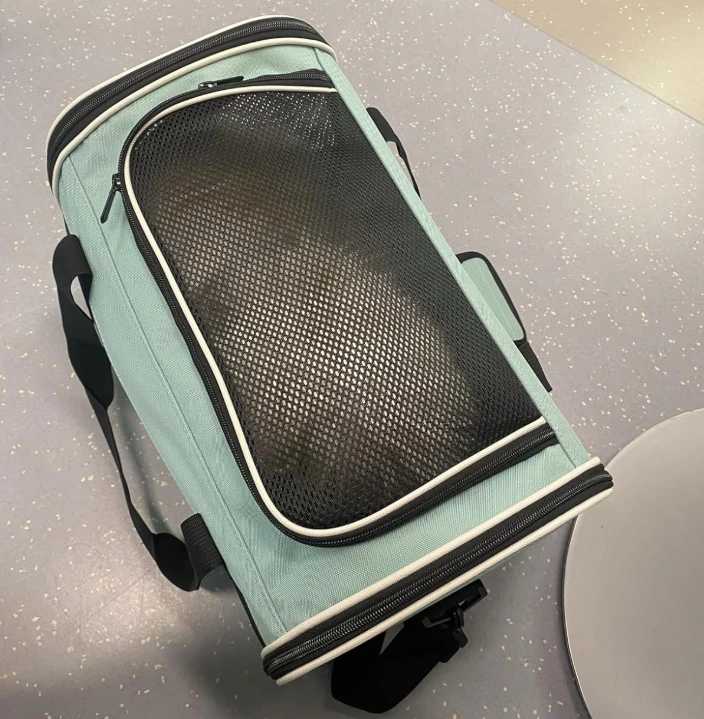
Eventually, I fell in love with a Nordic-style grey soft carrier. The product page clearly stated: “Suitable for pets up to 10 lbs, airline cabin approved, large top opening for easy access.”
The reviews were glowing: “Lightweight!” “Looks great!” “The top opening is so convenient.” I thought, Luna is exactly 8 lbs—perfect! I ordered it without hesitation.
Three days later, the package arrived. Full of anticipation, I opened the carrier, set it on the floor, unzipped the top, and called for Luna.
She walked over, sniffed it, circled it once, and then… jumped right in.
My heart leaped! This is promising!
But then, something happened that left me stunned.
Once inside, Luna tried to turn around to face me—and got stuck.
Half her body was turned, her head and front paws facing me, but her back half was still wedged in place, twisted into a “C” shape. She tried shuffling forward to adjust, but the space was too narrow; she couldn’t move. Finally, she just held that awkward position, looking back at me with an expression that screamed, “This is the new home you prepared for me?”
I quickly lifted her out. I tried three more times—entering through the top, the side, the front—same result. Every time Luna tried to turn around, there just wasn’t enough space.
But what went wrong? I bought according to her weight.
Later, scouring through over 5,000 negative reviews about “wrong size” on e-commerce sites, I found a buyer photo that made me laugh and cry simultaneously:
A user posted a picture of their 10 lb cat next to the carrier labeled “suitable for 10 lb pets.” Only half the cat’s body was inside. The caption read:
“My 10 lb cat can’t fit into this ’10 lb’ carrier. Is this bag meant for a 10 lb cat-shaped snack?”
That’s when it hit me: Weight is the single most misleading criterion for buying a pet carrier.
Scrolling further, similar comments were everywhere:
- “My puppy is now 10.5 weeks and 11lbs and I feel he will outgrow it before he reaches 20lbs.”
- “Too small for my cat even though I followed the sizing chart.”
- “It’s already painfully heavy to carry him in so we won’t be using it much longer.” (It wasn’t the carrier’s weight; he was uncomfortable and squirming, making it feel heavy.)
And one that hit particularly close to home:
“She couldn’t even turn around in it. Just sat there facing the same direction the whole trip.”
These comments drove me to seriously investigate one question: Why does buying by weight lead to failure almost every time?
Today, drawing from my own mistake and the data from 5,000+ negative reviews, I’ll show you how to measure your pet scientifically and break free from the “blind buy-by-weight” curse forever.
Why Weight is the Ultimate Misleading Metric
In my analysis of 540 negative reviews citing “size issues,” over 60% of users mentioned, “Bought by weight, but it was too small.” This isn’t a coincidence; it’s a logical trap in how products are labeled.
Huge body type variations exist within the same weight category:
- My 11 lb Corgi, Tofu, has a body length around 14 inches—the “short and stout” type.
- An 8 lb Maine Coon can have a body length exceeding 18 inches—the “long and lean” type.
- Two cats weighing the same 10 lbs can have a 2-inch difference in shoulder width (e.g., a flat-faced breed vs. a domestic shorthair).
One user’s comment perfectly nails the issue:
“Too small for my cat even though I followed the sizing chart.”
What’s the problem? Most sellers’ size charts only provide “recommended weight,” not the actual internal dimensions. You buy “Suitable for 10 lb pets,” but receive something “Only suitable for a small-framed 10 lb pet.”
More importantly, “fits inside” and “can turn around inside” are two completely different concepts. Luna’s experience taught me: a pet doesn’t just “sit” in a carrier. It needs to adjust its posture, turn around, and lie down. If there’s no room to even turn, the carrier is essentially a “mobile prison.”
The Three-Step Measurement Method: Neck Girth, Back Length, Shoulder Width
After multiple mistakes and comparisons, I’ve developed a “Golden Three-Step Measurement Method.” Measure your pet while they are standing on a flat surface in a relaxed state.
1. Neck Girth: Avoid the Choking Hazard
Wrap the measuring tape around the thickest part of your pet’s neck (usually near the shoulders), leaving a one-finger gap.
Why it’s important: Some carriers have smaller drawstring openings. Cats with larger necks (especially males) can easily get stuck. While Luna didn’t get her neck caught, if the carrier had a cinched opening, neck girth would be critical.
2. Back Length: From Shoulder Blades to Tail Base—The Most Crucial Measurement
This is the most commonly mis-measured point. Many beginners measure from the back of the head to the tip of the tail, adding 4 inches unnecessarily.
Correct Method:
- Locate the most prominent point of your pet’s shoulder blades (just above the front leg joint).
- Measure along the spine to the base of the tail (where the tail connects to the body—do not include the tail).
- Record this number.
Why it’s critical: Pets either stand or lie down in a carrier. When lying down, their body needs to stretch out fully. If the carrier’s internal length is less than the pet’s back length, they have to curl up, leading to anxiety over time. However, an even more overlooked factor is width. If the carrier’s internal width is less than the pet’s shoulder width plus turning allowance, you get the “Luna stuck halfway” situation.
3. Shoulder Width/Chest Width: Width at the Front Legs
Wrap the tape measure around the widest part of your pet’s chest (horizontally around the base of the front legs). Divide this number by 2 to get an approximate single-side shoulder width. A more practical indicator is the “turnaround diameter”—a simple estimate: the minimum width needed for a turn is roughly 1.5 times the shoulder width.
Why it’s important: Shoulder width determines if a pet can turn around inside. Some carriers are made narrow but deep. The pet gets in, but their front legs are squeezed, making turning impossible. Luna’s case was classic—the carrier length was fine, but the insufficient width meant she twisted into a “C” and still couldn’t turn.
Measurement Tool Demo: Soft Tape vs. String (For Uncooperative Pets)
If your pet, like my Luna, sees a measuring tape and thinks it’s time for “torture,” rolling around and refusing to cooperate, try this “String Substitution Method”:
For uncooperative cats and dogs:
- Prepare a regular cotton string or non-elastic shoelace.
- While they are resting or lying down: Gently loop the string around the body part you need to measure. Pinch the point where the string overlaps with your fingernail to mark it.
- Lay the string flat and measure the length with a ruler.
The biggest advantage of this method: the string is soft and non-threatening; pets often don’t resist. Luna would run at the sight of a tape measure, but when I used a string, she thought I was just petting her and stayed relaxed the whole time.
Special Technique for Measuring Shoulder Width:
Have your pet stand. While they are focused on a treat or looking out the window, quickly loop the string around the base of their front legs. Divide this circumference by 2 for the single-side shoulder width. If measuring is truly impossible, use a simpler observation: notice their favorite sleeping position—curled up in a ball or stretched out? Cats that curl up need more width to turn; dogs that stretch out need more length to lie down.
The “Lying Down Test”: How Much Space Does Your Pet Really Need in a Carrier?
This is the most important lesson I learned from 5,000+ reviews. Many size complaints point to the same issue:
“It fits when standing, but when she lies down, she’s all cramped.”
Pets spend most of their time in a carrier lying down or lounging, especially on long trips. They need more space in this position than when standing.
Space Allowance Calculation Formula
- Carrier Effective Length ≥ Pet’s Back Length + 2-3 inches (Lying Down Allowance)
- Carrier Effective Width ≥ Pet’s Shoulder Width × 1.5 (Turnaround Allowance)
For example:
- My dog Tofu has a back length of 14 inches. I need a carrier with an internal length of at least 17 inches.
- If the internal length is only 15 inches, his head and tail will hit the ends when he lies down. He’d have to stay curled up the whole time.
- Tofu’s shoulder width is about 6 inches. I need an internal width of at least 9-9.5 inches, otherwise, he can’t turn around.
How to Simulate: Let your pet lie down in a familiar spot. Measure with a soft tape from the tip of the nose to the base of the tail (note: here it’s the nose tip, not the shoulder blades). Record this length—this is the minimum length needed in “lie-down mode.” Observe if they lie with front legs stretched out or tucked in. If they prefer stretching out, they’ll need even more length and width.
Data-Backed Insights: The Most Overlooked Size Requirements from 5,000+ Reviews
In my analysis of 540 “size issue” reviews, I found some striking patterns:
Finding 1: Width Problems Are More Subtle Than Length Problems
Over 40% of the complaints were actually about “insufficient width,” but users often couldn’t articulate it clearly, simply saying it “felt small.” Typical descriptions include:
- “She couldn’t even turn around in it.”
- “He looked cramped in there.”
- “My cat kept trying to turn and couldn’t.”
Finding 2: Insufficient Height Affects Lying Down Comfort
About 30% of reviews focused on “insufficient height”—the pet wanted to lie down, but their head touched the top, forcing them to stand or sit with their head down the whole time. One user commented:
“She couldn’t lie down comfortably because the top was too low. Just sat there the whole time.”
Finding 3: Carriers Labeled by “Recommended Weight” Have Wildly Different Internal Dimensions
I compared 10 soft carriers all labeled “Suitable for 10 lb pets.” Their internal lengths ranged from 15 to 19 inches, and internal widths from 7 to 10 inches. The difference between the largest and smallest was a whole size category. This is why “buying by weight” is completely unreliable.
One user’s comment is particularly telling:
“It’s already painfully heavy to carry him in so we won’t be using it much longer.”
Look closely: it wasn’t that the carrier itself was heavy, but that the pet was uncomfortable inside, making the owner feel the strain. The pet kept moving, struggling, trying to turn—of course, it felt heavy!
One more easily overlooked point: the pet’s “psychological safe space.” Cats are especially sensitive. If the carrier space is just “skin-tight” with no room to move, they feel trapped, unable to escape, leading to anxiety. This likely explains why 64 reviews mentioned “cat anxious/ resistant”—often it’s not a “bad personality,” but a space so cramped they can’t even turn around.
Summary Checklist: Print a Size Reference Card, Always Carry a Tape
After all these mistakes, I now have one iron rule for buying carriers: Never trust the “Fits X lbs” label. Only look at “internal dimensions” and “actual measurements.”
My Buying Checklist (Screenshot or print this!)
When Measuring Your Pet:
- Neck Girth: Thickest part of neck + one-finger gap.
- Back Length: From shoulder blades to tail base.
- Shoulder Width: Widest part of the chest (circumference at front legs / 2).
- Turnaround Diameter: Shoulder Width × 1.5 (estimate).
- Lying Down Length: From nose tip to tail base + 2-3 inches buffer.
When Choosing a Carrier:
- Only look at the “Internal L x W x H” in the product details, ignore the “recommended weight.”
- Compare your pet’s “Lying Down Length” vs. Carrier Internal Length.
- Compare your pet’s “Turnaround Diameter” vs. Carrier Internal Width.
- Compare your pet’s “Neck Girth” vs. the opening size (if it’s a drawstring style).
What I Always Carry:
I now keep a mini soft tape measure in my bag (costs a couple bucks online). If I see a carrier in a physical store, I whip it out and measure. When buying online, the first thing I do upon arrival is measure the internal dimensions. If it doesn’t fit, back it goes. I also keep a cotton string handy—for uncooperative pets, it works much better than a stiff tape.
A Final Word to Every Pet Parent:
You’re not just buying a “carrier.” You’re buying your pet’s mobile safe space. Taking 5 minutes to measure carefully is worth far more than spending 5 hours returning a product—or worse, subjecting your pet to a miserable experience in a carrier where they can’t even turn around.
Have you ever fallen into the “buy-by-weight” trap? Please share your story in the comments—especially the moment your pet got stuck and couldn’t turn around.
FAQ
Q: My cat is 10 lbs. What size carrier should I actually buy?
A: Don’t look at weight; look at size. First, measure your cat’s back length and shoulder width. Then find a carrier with internal length ≥ back length + 2 inches, and internal width ≥ shoulder width × 1.5.
Q: Soft carrier or hard-shell crate—which has stricter size requirements?
A: Soft carriers have stricter width requirements because the flexible walls can bulge inward, reducing the actual usable width compared to the stated dimensions. Hard-shell crates have more stable dimensions—what you see is what you get.
Q: My cat is very fluffy/chubby. I can’t measure shoulder width accurately. What should I do?
A: Use the string method. Loop it around the base of the front legs while they’re standing and distracted by a treat. If that’s impossible, measure the widest point of their body when they are lying down normally, and use that as a width reference.
Q: The carrier length is enough, but the width is too small. Can I make it work?
A: No. Insufficient width means your pet cannot turn around or adjust their posture. Long trips will be very uncomfortable. Luna’s experience is the perfect lesson—length was fine, width was not, resulting in a miserable, twisted “C” shape.
Leave a Reply
You must be logged in to post a comment.