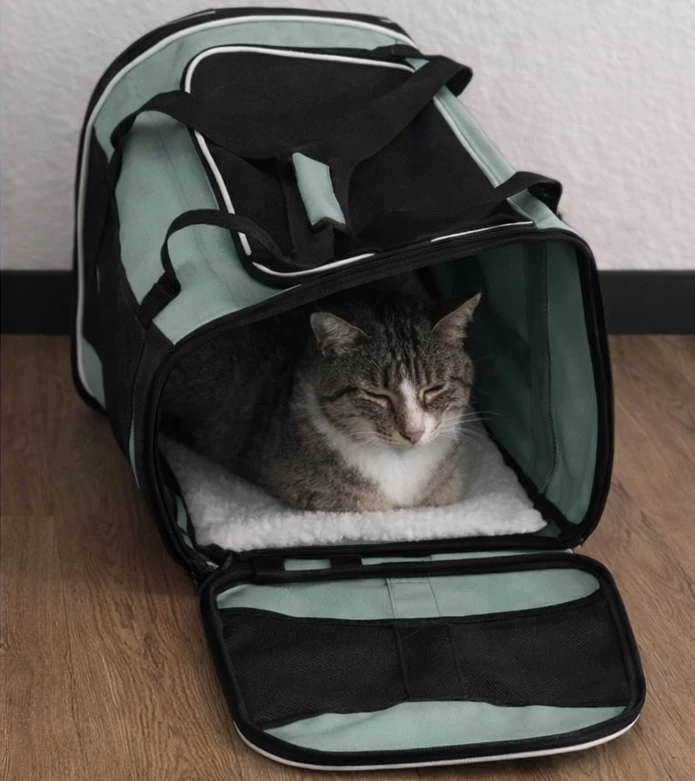
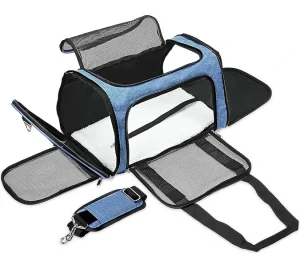
When people talk about problems with a portable soft-sided pet carrier, size almost always comes up first. That part is expected.
What surprised me—after reading through hundreds of real user reviews—is what comes next: design.
Out of 405 customer reviews analyzed, 23.5% of complaints were tied directly to design issues, just behind size-related problems at 24.9%.
These weren’t vague complaints. They appeared repeatedly in practical, everyday situations involving ventilation, openings, lighting, and safety locks. Each one directly affects how a pet experiences time inside the carrier.
Ventilation Design: The First Line of Breathing Safety
Ventilation problems aren’t subtle. When airflow is poor, pets react almost immediately.
I repeatedly came across comments like:
“It was a 20-minute drive to the vet in summer, and my cat was panting heavily inside.”
“The air holes are tiny. There’s no real airflow, and my cat became restless.”
This isn’t just anecdotal. During warmer months, ventilation-related complaints increase by about 37%.
Poor airflow is commonly associated with:
- Rapid breathing
- Overheating
- Stress responses, especially in cats
At that point, it’s no longer just discomfort—it becomes a safety concern.
What users consistently notice in real use is not the presence of ventilation, but its effectiveness:
- Too few vents overall
- Ventilation limited to one or two sides
- Insufficient total airflow area
Designs that receive fewer complaints tend to share several traits:
- Ventilation area close to 5% of the pet’s body surface
- Airflow from multiple sides plus the top
- Mesh that balances airflow with escape prevention
Anything below that threshold tends to raise concerns quickly as travel time increases.
Opening Design: Why Some Pets Resist Entering the Carrier
Another frequent issue isn’t what happens inside the carrier—but getting the pet inside in the first place.
Real feedback includes:
“Single side zipper. My cat refused to go in and stayed stressed for two days.”
“The opening was so small it took me 15 minutes to adjust my cat inside.”
When opening design is poorly thought out, users report:
- Longer loading time
- Forced handling
- Stronger stress reactions, especially in anxious cats
Common friction points mentioned across reviews include:
- Only one usable opening
- Openings too narrow for natural entry
- Plastic zippers that snag, stick, or make noise
Designs described as easy to use usually include:
- At least two openings (side + top)
- Opening width around 2× the pet’s shoulder width
- Smooth, quiet metal zippers
- One-hand operation
These details may sound minor, but they significantly change the experience—for both pets and owners.
Lighting and Privacy: A Psychological Issue, Not a Cosmetic One
Lighting design is another area where many soft pet travel bags struggle.
Some designs are almost fully transparent. Others are nearly opaque. Users react negatively to both extremes.
Common comments include:
“It’s fully transparent. My cat saw people outside and panicked.”
“Too dark inside. My cat couldn’t see anything and kept crying.”
Among owners of anxious cats, satisfaction drops to around 20% when lighting isn’t handled well.
The issue isn’t brightness—it’s lack of control.
Better experiences are usually linked to:
- Adjustable light levels
- Partial privacy with selective visibility
- Low-reflection materials that reduce visual stimulation
The goal isn’t isolation. It’s giving the pet a sense of visual stability.
Safety Lock Design: Small Details, Real Consequences
This was the most unsettling section to read.
Real comments included:
“The zipper wasn’t locked. My cat got out mid-drive.”
“My kitten figured out how to open the zipper.”
Many users describe carriers that:
- Have no safety lock at all
- Rely on a single, exposed zipper
For kittens, this becomes a serious risk.
Based on repeated feedback, safer designs tend to include:
- Dual locking systems (self-locking zipper + external clip)
- Lock placement pets can’t reach
- Quick-release access for emergencies
- Locks on both sides of major openings
Without these, escape risk remains very real.
How Design Issues Add Up Over Time
Individually, each issue might seem manageable. Together, they change the entire experience.
Users report that when design problems stack up:
- Loading time increases from ~1 minute to 5–10 minutes
- Stress reactions rise sharply in anxious pets
- One-hand operation becomes difficult or impossible
Health-related concerns also appear more often:
- Overheating from poor ventilation
- Heightened anxiety from lighting issues
- Escape risk from inadequate locks
It’s not surprising that:
- Well-designed carriers reach 70%+ satisfaction
- Many typical designs remain around 40–45%
That gap is driven largely by design—not size alone.
Final Takeaway
Size gets attention—but design determines daily experience.
With 23.5% of users pointing to design flaws, ventilation, openings, lighting, and safety locks aren’t optional extras. They’re fundamental.
If you’re choosing a portable soft-sided pet carrier:
- Prioritize airflow and access
- Don’t overlook lighting and privacy
- Treat safety locks as non-negotiable
Your pet experiences every design decision—whether it’s mentioned on the product page or not.
Leave a Reply
You must be logged in to post a comment.