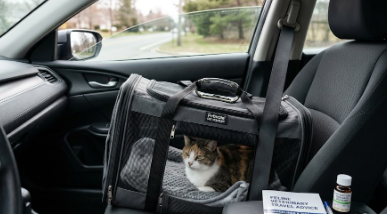
Once, Luna got carsick on a long road trip. Less than half an hour into the drive, I noticed a strand of clear saliva at the corner of her mouth. It kept increasing, like a faucet that wouldn’t shut off. I reached in to touch her chin – it was soaked. Then, with a “wretch,” she vomited all the morning’s cat food inside the carrier.
I pulled over three times on that trip. Each time, I took the carrier to the side of the road, cleaned up the vomit, wiped her mouth, and aired out the carrier. Luna huddled inside, her eyes unfocused, her body trembling slightly. When we arrived, she staggered when she came out of the carrier.
That’s when I learned: cats get carsick too. It’s not “nervousness” or “naughtiness” – it’s a normal physiological reaction of the inner ear vestibular system to vehicle motion. It’s just that cats react more intensely than humans and vomit more easily.
Later, I consulted a vet and researched a lot. Luna still gets carsick occasionally, but I now know how to prevent it and how to handle it. She went from “vomiting the whole way” to “an occasional whimper.” Today, I’ll share this complete plan with you.
Table of Contents
“Vomiting all the way” on a long trip: Luna’s carsickness experience
Data‑backed: How common is carsickness in cats?
5 typical signs of carsickness: drooling, vomiting, lethargy, vocalizing, abnormal posture
Preventive measures: fasting, ventilation, driving habits
How to secure the carrier: keep your pet from jostling inside
Medications: pet‑specific anti‑motion‑sickness drugs vs. human drugs (absolutely forbidden)
Emergency on the road: stop, clean, comfort
Frequently asked questions
Conclusion: carsickness isn’t a habit – it’s a physical response
“Vomiting all the way” on a long trip: Luna’s carsickness experience
That long trip was the first time I took Luna on a long drive. I didn’t prepare at all before leaving – normal feeding, normal water, the carrier just placed loosely on the back seat. Half an hour later, disaster started.
First came drooling. Cats don’t drool like dogs; they almost never drool normally. If you see clear mucus at the corner of your cat’s mouth and she’s not eating, it’s very likely a sign of carsickness. Then came vomiting. After she vomited, Luna was completely lethargic – eyes half‑closed, body limp, lying in the carrier, not lifting her head no matter how I called.
I pulled over, cleaned the carrier, changed the pee pad, and ventilated it. When we got back on the road, Luna was still uncomfortable, but had nothing left to vomit. She didn’t eat anything the rest of the day, and after we reached the hotel, she hid under the bed and slept all afternoon.
Later I looked up data and talked to vets: the incidence of carsickness in cats is actually not low – many owners just don’t realize it. Some of those cats that “cry constantly” in the car may not be scared – they may be nauseous.
Data‑backed: How common is carsickness in cats?
While there are no precise statistics, based on veterinary clinical experience and owner feedback, about 20‑30% of cats experience some degree of carsickness during car rides. Kittens are more prone than adult cats (their inner ear vestibular systems are not fully developed), and brachycephalic breeds (Persians, Exotic Shorthairs, etc.) are also more susceptible.
In my earlier analysis of cat anxiety reviews, a certain percentage of users mentioned “drooling/panting.” Some of those symptoms are actually caused by carsickness, not just fear.
5 typical signs of carsickness
Cats show carsickness symptoms very similar to humans, but some signs can be mistaken for “nervousness” or “illness.”
1. Drooling (most common early sign)
Appearance: Clear mucus dripping from the corner of the mouth, sometimes stringy. When heavy, it may drip to the bottom of the carrier.
Why it happens: Carsickness stimulates saliva production, and nausea reduces swallowing.
Note: If your cat is drooling without eating, suspect carsickness first (rather than dental disease).
2. Vomiting
Appearance: Undigested food, yellow‑green bile, or white foam.
Why it happens: The vestibular system is overstimulated, sending signals to the vomiting center.
Note: If your cat hasn’t eaten for 4‑6 hours before departure, she may only vomit foam or bile.
3. Lethargy
Appearance: Not crying, not moving, not interested in treats, eyes half‑closed, body limp.
Why it happens: Fatigue and discomfort from carsickness.
Note: Don’t mistake this for “finally calming down.” Quiet + lethargic is likely carsickness, not adaptation.
4. Vocalizing (especially low, continuous groaning)
Appearance: Not a sharp howl, but a low, continuous, sigh‑like sound.
Why it happens: Discomfort causing vocalization.
Note: Difference from fear vocalization: fear cries are sharp and rapid; carsickness sounds are low and continuous.
5. Abnormal posture
Appearance: Head low, body stiff, unwilling to lie down (lying down makes it worse), tongue sticking out.
Why it happens: Vestibular dysfunction causing balance problems.
Note: If your cat keeps standing instead of lying down, and the body is tense, it may be carsickness.
Preventive measures: fasting, ventilation, driving habits
1. Fast for 4‑6 hours before departure
Why it works: When there’s food in the stomach, vehicle motion is more likely to trigger vomiting. On an empty stomach, even if carsick, there’s little to vomit.
How to do it: Remove food 4‑6 hours before departure. For a morning trip, feed normally the night before, but no breakfast. For an afternoon trip, skip lunch.
Note: For kittens (under 6 months), prolonged fasting is not recommended – shorten to 3 hours. For long trips over 6 hours, stop and offer a small amount of food.
2. Small amount of water
Why it works: Complete water restriction leads to dehydration, especially in summer. A small amount of water maintains hydration without overfilling the stomach.
How to do it: Remove the water bowl 1 hour before departure. Every 2‑3 hours on the road, stop and offer a few sips of water (not too much).
3. Keep the car well‑ventilated
Why it works: Stuffiness worsens nausea. Fresh air eases vestibular discomfort.
How to do it: Use the car’s AC (on fresh air mode) or crack a window (leave a gap, but don’t blow air directly on the cat). Keep interior temperature at 22‑24°C (72‑75°F).
4. Avoid sudden braking
Why it works: Hard acceleration, sudden braking, and sharp turns strongly stimulate the inner ear vestibular system.
How to do it: Drive smoothly, anticipate traffic conditions. Slow down before turns, don’t jerk the steering wheel. Maintain a steady speed on highways.
How to secure the carrier: keep your pet from jostling inside
The primary cause of carsickness is “motion.” If the carrier slides around on the seat, or your pet can’t stand steady inside, carsickness will be worse.
√ Secure the carrier to the seat
- Thread the seatbelt through the carrier’s back strap (if available)
- Or wrap the seatbelt around the top of the carrier and tighten
- Or use a dedicated pet carrier car strap
Goal: The carrier doesn’t slide, so your pet isn’t jostled by the carrier moving around.
√ Prevent your pet from slipping inside the carrier
- Place an anti‑slip pad on the bottom (silicon mat or a piece of yoga mat)
- Or put a non‑slip fabric under the liner
- A rigid base itself reduces sliding (soft bases allow pets to slide around)
My experience: When Luna got carsick, the carrier was just sitting loosely on the back seat. On a turn, it slid to the edge of the seat. After I secured it with the seatbelt and added an anti‑slip pad, her carsickness improved significantly.
√ Avoid letting your pet see fast‑moving scenery outside
For a carsick cat, watching trees and cars rush by outside the window worsens the conflict between visual input and the vestibular system.
How to do it: Cover the carrier with a light‑colored cloth (leave only ventilation openings) to reduce visual stimulation. (See my “partial‑shade” article – closing the shade helps anxious cats and also helps with carsickness.)
Medications: pet‑specific anti‑motion‑sickness drugs vs. human drugs (absolutely forbidden)
√ Pet‑specific anti‑motion‑sickness drugs
Common ingredients:
- Diphenhydramine (antihistamine – has sedative and anti‑emetic effects)
- Dimenhydrinate (main ingredient in motion‑sickness drugs – available in veterinary formulations)
- Maropitant (specialized anti‑emetic – requires a veterinary prescription)
How to use: Must consult a vet. Dosage is calculated by your pet’s weight. Do not medicate on your own.
Best for: Long trips (over 2 hours) or cats with a known history of severe carsickness.
× Human motion‑sickness drugs – absolutely forbidden
Why forbidden:
- Human dosages are far above a cat’s safe range (one human tablet could be 10 times a cat’s dose)
- Some ingredients are toxic to cats
- High risk of side effects (excessive sedation, abnormal heart rate, liver damage)
Don’t try: Breaking a human motion‑sickness pill in half for your cat. You cannot accurately calculate the dose, and the risk is extremely high.
My advice: If your cat has severe carsickness, make a vet appointment in advance and get a pet‑specific prescription. Do not self‑medicate.
Emergency on the road: stop, clean, comfort
If your cat is already carsick, follow these steps:
- Pull over safely – Don’t try to clean while driving. Find a rest area or a safe spot by the road.
- Open the carrier for ventilation – Unzip it (be careful the cat doesn’t run out) to let in fresh air. If it’s hot, turn on the AC.
- Clean the vomit – Use wet wipes or paper towels to absorb the vomit inside the carrier. If the bottom is soiled, change the pee pad or put down a temporary towel.
- Offer a small amount of water – Use a syringe (without the needle) or the water bottle nozzle to give a few drops. Don’t give too much, or she may vomit again.
- Wait for your cat to settle before driving again – Don’t start right away. Wait 5‑10 minutes to let her recover.
- Shorten the remaining trip – If you still have a long way to go, consider ending the trip early or splitting it over two days.
My experience: After Luna got carsick, I stopped at a rest area for 20 minutes. I cleaned, ventilated, and gave a few drops of water. After she recovered, I secured the carrier and drove another half hour to our destination. After that, I learned prevention – she has never vomited on the road again.
Frequently Asked Questions
Q: Will a cat get used to carsickness over time?
A: No. Frequent carsickness won’t make a cat “adapt” – it will only make her associate car rides with nausea, creating stronger resistance. The solution is preventive measures and desensitization training, not “letting her get sick more times.”
Q: Can carsickness happen on short trips (under 15 minutes)?
A: Yes. Some cats get carsick as soon as the car moves, regardless of trip length. For short trips, still fast for 4 hours, keep ventilation good, and drive smoothly.
Q: My cat vomited in the car. How do I clean the carrier?
A: First remove the vomit, then use an enzymatic cleaner (see the “Why do cats pee in the carrier” article). Vomit, like urine, requires thorough odor removal – otherwise your cat will be even more resistant next time.
Q: Are there non‑medication physical methods?
A: Yes. Pressing the Neiguan acupoint (PC‑6) – on the inner foreleg, about 2cm above the wrist – is said to relieve motion sickness in humans. For cats, it’s debated. More reliable methods: fasting + ventilation + securing the carrier + reducing visual stimulation + smooth driving.
Q: My cat never gets carsick – does that mean there’s no problem?
A: Not necessarily. Some cats hide discomfort. Watch for these signs: does she resist getting in the car? Does she lie still without moving during the ride? Is she lethargic after arrival? If yes, she may have mild carsickness even without vomiting.
Conclusion: carsickness isn’t a habit – it’s a physical response
After Luna’s carsickness episode, I learned to respect her physical reactions. It’s not “tough it out,” not “try a little human medicine next time.” It’s fasting, securing the carrier, driving smoothly, and consulting a vet for medication when necessary.
A carsick cat isn’t vomiting on purpose. She feels even worse than you do. What you can do is not get angry, but prevent it. Fast her for 4 hours before departure, put an anti‑slip pad in the carrier, secure it with the seatbelt, drive smoothly, and keep the car ventilated. If vomiting happens, stop, clean, and give her time to recover.
Remember these key points:
- Drooling is the first sign – pull over and check as soon as you see it.
- Fast for 4‑6 hours before departure – an empty stomach won’t produce much vomit.
- Secure the carrier and keep your pet from jostling – anti‑slip pad + seatbelt.
- Human motion‑sickness drugs are absolutely forbidden – get a pet‑specific prescription from your vet.
You’re not just cleaning up vomit – you’re responding to “I feel terrible” that your pet can’t put into words. When you understand that, you can truly help her.
Does your cat get carsick? Do you have any tips of your own? Share your experiences in the comments.
Leave a Reply
You must be logged in to post a comment.