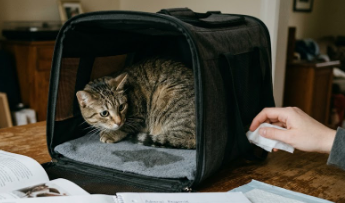
The time Luna peed in the carrier, my first reaction was anger. The carrier had just been cleaned, but after less than half an hour, the bottom was soaked, and the smell of urine mixed with plastic hit my nose. I thought, “Why are you being so naughty? Haven’t you been taught to use the litter box?”
Later I learned that it wasn’t “naughty” – it was “scared out of control.”
In negative reviews about cat anxiety, many users mentioned their cats eliminating in the carrier. One user wrote:
“Our cat hates being in this.”
Another was more direct:
“My cat keeps crying inside.”
Behind those comments are countless cats just like Luna – not peeing because they’re “throwing a tantrum,” but because fear triggered an automatic physical response. Today’s article explains the physiology behind it: why cats pee in the carrier. It’s not on purpose – they can’t help it.
Table of Contents
Luna’s “Naughtiness”: Peed as soon as she went in
Data‑backed: A significant percentage of cats eliminate in the carrier
The stress response mechanism: physiological loss of control in fight‑or‑flight mode
Two evolutionary meanings of urination: reducing weight and marking danger
Preventive measures: reduce water intake, use a pee pad, desensitization training
Cleaning methods: enzymatic cleaner vs. ammonia‑based cleaners
Frequently Asked Questions
Conclusion: Not naughty – just too scared
Luna’s “Naughtiness”: Peed as soon as she went in
On that trip to the vet, Luna howled continuously in the carrier for ten minutes, then suddenly fell silent. I thought she had calmed down. When I looked down, the bottom was soaked, and the smell of urine was strong. She was huddled in the corner of the carrier, body pressed low, tail tucked between her legs, eyes vacant.
At the vet, the doctor opened the carrier, saw the urine stain, and asked, “Have you used this carrier before?” I shook my head. The doctor said, “She didn’t do it on purpose. She was too scared – she couldn’t control it.”
After returning home, I looked up a lot of information and consulted a friend who studies veterinary behavior. A cat peeing in the carrier isn’t because they “couldn’t hold it” or because they’re “getting back at the owner.” It’s a stress response written in their genes – a survival mechanism from thousands of years ago, triggered in today’s small pet carrier.
Data‑backed: A significant percentage of cats eliminate in the carrier
In the cat anxiety reviews I analyzed previously, a notable percentage of users explicitly mentioned their cat eliminating (urinating or defecating) in the carrier. Here is the distribution of common behaviors:
| Behavior | Percentage |
|---|---|
| Constant crying | Over half |
| Scratching carrier walls | About 20‑25% |
| Eliminating in the carrier | About 10‑15% |
| Drooling / panting | About 10% |
10‑15% is not a small number. That means roughly one in every several cats has likely peed in the carrier. And that’s only the “reported” data – the actual percentage may be higher, because many owners are too embarrassed to mention it.
One user wrote in a review:
“My cat keeps crying inside.”
Crying and peeing are essentially different expressions of the same thing: stress overload.
The stress response mechanism: physiological loss of control in fight‑or‑flight mode
When a cat perceives a threat, its body automatically enters “fight or flight” mode. The sympathetic nervous system activates – adrenaline surges, heart rate increases, muscles become engorged with blood – preparing to fight or flee.
But a cat inside a pet carrier has no one to fight and no way to escape. It is trapped in a small, unfamiliar, moving space, constantly sensing danger but unable to mount an effective response. This “trapped” state causes stress to accumulate until it crosses a threshold.
When stress overloads, the body can “short‑circuit.” One manifestation is losing control of urination – not because the bladder is full, but because the sphincter muscles that control urination relax under extreme tension. Just as humans may “pee their pants” in extreme fear, so can cats.
Two evolutionary meanings of urination: reducing weight and marking danger
Beyond physiological loss of control, there are two deeper evolutionary reasons why cats urinate in the carrier:
1. Reducing weight for better escape
In the wild, when faced with an unavoidable threat, a cat’s first reaction is to flee. Urine in the bladder is extra weight. Evolution has wired cats to automatically urinate in extreme fear, instantly reducing weight and increasing the chance of successful escape. This mechanism was a survival advantage tens of thousands of years ago, but in today’s pet carrier, it looks like “naughty behavior.”
2. Marking a “danger zone”
Cat urine contains pheromones. In the wild, when a cat encounters a predator or an extremely dangerous place, it may leave a urine mark to warn other cats: “Danger here.” Inside the pet carrier, the cat feels it is in an extremely dangerous environment and instinctively leaves urine – not to be messy, but to say, “This place is terrifying – stay away.”
So when Luna peed in the carrier, she wasn’t “getting back at me” – she was saying in body language, “I’m scared out of my mind.”
Preventive measures: reduce water intake, use a pee pad, desensitization training
Once you understand the cause, you can take targeted preventive measures.
1. Reduce water intake before going into the carrier
Remove the water bowl 1‑2 hours before departure. This keeps the cat’s bladder in a “half‑empty” state during the trip. But do not withhold water entirely – for long trips (over 2 hours), stop and offer water along the way.
Note: Do not withhold water for too long. In summer or on long trips, reduce intake but do not cut it off completely.
2. Place a pee pad inside the carrier
Put a pet pee pad at the bottom of the carrier (under the liner). The pad absorbs urine and prevents it from soaking into the base board. Pee pads often have attractants, but cats generally won’t pee on them intentionally – they pee because of fear, not because of the pad. The pad’s purpose is to “catch,” not “induce.”
How to do it: Place the pee pad between the base board and the liner, or put an extra thin pad on top of the liner.
3. Desensitization training (the most fundamental prevention)
The root cause of peeing in the carrier is fear. Solve the fear, and you solve the peeing. Refer to the “Going into the carrier causes stress” article for positive association training – link the carrier with treats, familiar scents, and a sense of safety. When the cat no longer sees the carrier as a “danger space,” the stress response won’t be triggered, and it won’t pee.
My experience: After Luna peed, I spent four weeks on desensitization training. Starting with “carrier in the living room with treats,” then “closing the door for a few seconds,” then “carrying it around the house,” then “short car rides.” After four weeks, she never peed in the carrier again.
Cleaning methods: enzymatic cleaner vs. ammonia‑based cleaners
If an accident happens, how you clean is very important. Using the wrong cleaner can cause the cat to urinate in the same spot again.
√ Recommended: enzymatic cleaner
Enzymatic cleaners contain proteases and lipases that break down the proteins and fatty acids in urine, completely eliminating odor molecules. When the cat can’t smell urine, it won’t be prompted to mark again because “there’s already urine smell here.”
Brand examples: Nature’s Miracle, Simple Solution, etc.
How to use:
- Blot up surface urine with paper towels (press, don’t rub)
- Spray enzymatic cleaner thoroughly over the urine stain
- Let sit for 10‑15 minutes (for the enzymes to work)
- Blot dry with a clean damp cloth, then let air dry
× Avoid: ammonia‑based cleaners
Regular laundry detergents, soaps, and ammonia‑based cleaners contain ammonia or alkaline substances. Urine itself contains urea (which breaks down into ammonia). If you use an ammonia‑based cleaner, the residual ammonia smell will make the cat think “my urine smell is already here,” and it may urinate again to mark.
Do not use: Chlorine bleach (irritates respiratory tract), phenolic disinfectants (toxic to cats), regular laundry detergents (may contain ammonia).
Special case: carriers with non‑removable liners
If the liner is sewn into the carrier and cannot be removed, urine that soaks into the carrier body is very difficult to clean completely. Even if the surface is wiped clean, residual odors will make the cat more anxious next time.
Recommendation: If urine has soaked into non‑washable parts, replace the carrier. It’s not a waste – it’s an investment in your pet’s mental health.
Frequently Asked Questions
Q: Does a cat pee in the carrier on purpose?
A: No. Cats do not have a concept of “revenge.” Urination in the carrier is a physiological response triggered by fear – the cat cannot control it. Do not punish the cat; punishment will only increase fear.
Q: If a cat pees in the carrier once, will it become a habit?
A: No, unless the cleanup is incomplete (residual urine smell). Use an enzymatic cleaner to completely break down odors, and combine with desensitization training. A cat will not develop a habit of peeing in the carrier just because it happened once.
Q: Are female cats or male cats more likely to pee in the carrier?
A: No significant difference. Fear‑induced loss of control is not gender‑related. However, unneutered male cats may spray urine (territory marking) in the carrier – that is a different behavior that needs to be distinguished. Spraying is a small amount on vertical surfaces; fear‑induced peeing is a larger amount on horizontal surfaces.
Q: On a long trip, how do I balance “reducing water” with “not dehydrating”?
A: Remove the water bowl 1 hour before departure. Every 2‑3 hours on the road, stop and offer a small amount of water, and check the pee pad. In summer, do not withhold water for more than 2 hours. For very long trips (over 4 hours), consider letting the cat out to drink at a rest stop (using a leash).
Q: Is enzymatic cleaner safe for cats?
A: Yes, when used as directed. Spray, let it sit to break down the urine, then blot dry. The risk of a cat licking residue is very low (since you blot with a damp cloth afterward). If your cat is especially prone to licking, wait until the area is completely dry before letting the cat near it.
Conclusion: Not naughty – just too scared
After Luna peed in the carrier, I didn’t hit her or scold her. I took her out, wiped her paws and belly with warm water, and switched to a new carrier. Then I spent four weeks on desensitization training – she never peed again.
That puddle of urine in the carrier wasn’t a “bad habit” – it was a “distress signal.” It was saying: “This place is too scary – I can’t hold it together anymore.” Once you understand that signal, you can solve the problem at its root – not by buying a more expensive carrier, not by using thicker pee pads, but by making the carrier no longer scary.
Remember these key points:
- Pee in the carrier is a physiological response to fear – not intentional.
- Prevention is better than cleanup: reduce water intake + pee pad + desensitization training.
- For cleaning, use enzymatic cleaner – not ammonia‑based products.
You’re not just cleaning up a puddle of urine – you’re cleaning up the stress your pet couldn’t handle. When you stop being angry about the pee and instead feel for what your pet went through inside, you’ve learned to read their language.
Has your cat ever peed in the carrier? How did you handle it? Share your story in the comments.
Leave a Reply
You must be logged in to post a comment.