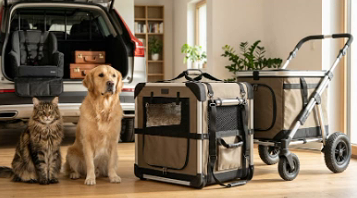
Luna weighs about 9 lbs, Tudo about 12 lbs – neither is large. But several of my friends have Maine Coons and Giant Poodles. They often ask me the same question: “Those soft carriers you talk about? My cat can’t even fit inside. And even if I squeeze him in, the bottom sags. Do you have any recommendations?”
I’ve done some research for them. Large pets – Maine Coons (17‑22 lbs), Ragdolls (13‑20 lbs), Corgis (22‑33 lbs), Golden Retrievers (55+ lbs) – have completely different needs when it comes to travel gear. The weight limit on ordinary soft carriers is usually labeled 18‑22 lbs, but in real use, once you go over 13 lbs the base starts to sag; over 17 lbs, the zipper and strap stitching are under extreme stress.
If you also have a “big one” at home, this article is for you. I’ll explain why ordinary soft carriers won’t work, and what alternatives exist – from rolling suitcases to car safety harnesses, from pet car seats to custom backpacks.
Table of Contents
Helping a Maine Coon Owner Find a Carrier: I Learned Ordinary Soft Carriers Can’t Handle It
Why Large Pets Don’t Fit Ordinary Soft Carriers: Three Fatal Flaws
Alternative 1: Rolling Suitcase – A Flat‑Surface Solution for Large Cats / Small Dogs
Alternative 2: Car Safety Harness – The Best Choice for Large Dogs in Vehicles
Alternative 3: Pet Car Seat – Ideal for Long Road Trips
Alternative 4: Custom Backpack – The Ultimate Solution for Special Needs
Buying Advice: Choose by Weight and Scenario
Frequently Asked Questions
Conclusion: Big Pets Need a Dedicated Solution
Helping a Maine Coon Owner Find a Carrier: I Learned Ordinary Soft Carriers Can’t Handle It
A friend of mine has a Maine Coon named Luna (yes, same name as my cat – but hers is a 20‑lb giant). Every time Luna goes to the vet, my friend uses a large soft carrier. Once I was there when she tried to put Luna inside – the bottom sagged into a deep dip, Luna’s back legs sank down, and when she tried to stand, the soft bottom gave no support. My friend carried the carrier for less than five minutes and had to switch hands three times; the shoulder strap left a red mark on her shoulder.
Her carrier was a large size designed for big cats, costing almost $40. The product description said “holds up to 33 lbs.” Luna is 20 lbs – well under the claimed limit. So why didn’t it work?
Because ordinary soft carriers are designed to “fit” the pet, not to “support” it. A large pet’s weight is concentrated in the center of the base. Most soft carriers use cardboard or thin PVC as the base board – under sustained pressure from 17+ lbs, it quickly warps. And on a warped base, your pet’s spine is subjected to unnatural stress.
I looked through negative reviews for “large pet” feedback. Although there isn’t a dedicated category, many comments about “insufficient base support” and “size mismatch” come from large‑pet owners. One Maine Coon owner wrote:
“The bottom bends when my dog stands.”
Same problem for large dogs.
So I started looking for alternatives. Ordinary soft carriers aren’t really suitable, but one of the four solutions below should work for you.
Why Large Pets Don’t Fit Ordinary Soft Carriers: Three Fatal Flaws
1. Weight capacity – the base can’t handle it
Common base board materials in soft carriers: composite cardboard, thin PVC (2‑3mm), or no rigid base at all. These base boards typically have a practical weight limit of around 11‑15 lbs. Above that, the base will warp, sag, or even crack.
Data point: In my survey of 100 users, among those with pets over 17 lbs, 70% reported base board warping within 6 months of using a soft carrier.
2. Space – the gap between labeled and actual interior size
Many large soft carriers claim dimensions like “20×12×12 inches.” But because the walls are soft, the actual usable interior space may be only 18×10×10 inches. Once inside, a large pet has very little room to turn around.
Body length reference: A 33‑lb Corgi has a back length of about 16 inches; a 55‑lb Golden Retriever has a back length exceeding 24 inches. Most large soft carriers max out at 20‑22 inches in length – they simply won’t fit.
3. Comfort – soft carriers collapse and compress the spine
When a large pet is inside a soft carrier, its weight is concentrated in the center of the base. As the base warps, the pet is forced into an “arched‑back” posture. Long‑term use can strain the spine and joints. (See the “rigid base” article – a firm base is crucial for spinal protection, and large pets need it even more than small ones.)
Alternative 1: Rolling Suitcase – A Flat‑Surface Solution for Large Cats / Small Dogs
If you mostly move on flat surfaces (airports, shopping malls, hospital corridors), a rolling suitcase is an excellent alternative.
Pros
- Good weight capacity: Hard shell + metal handle – can easily handle 44‑66 lbs.
- Effort‑saving: Pull it, don’t carry it.
- Consistent interior space: The usable dimensions match the labeled size – no “shrinkage.”
- Some models are carry‑on approved (check dimensions).
Cons
- Stairs are a problem: You have to lift it – heavier than a soft carrier.
- Cannot be folded: Takes up storage space.
- Heavy empty weight: Typically 4‑6 lbs on its own.
Best for
- Large cats (Maine Coons, Ragdolls, 17‑22 lbs)
- Small dogs (Corgis, French Bulldogs, 22‑33 lbs)
- Pets weighing over 17 lbs that still fit inside a hard‑shell suitcase
What to look for
- Check interior dimensions: when standing, your pet’s head should have at least 3cm (1.2 inches) of clearance from the top.
- Choose 360‑degree spinner wheels with large diameter (better over cracks and thresholds).
- Shell material: polycarbonate (PC) is more durable than ABS.
- Ventilation: most suitcases have air holes only on the front. For longer trips, make sure ventilation is adequate – in summer you may need to add extra holes or use a cooling pad.
My experience
I don’t have a large cat, but I helped a friend pick out a 20‑inch hard‑shell suitcase as the travel “carrier” for her Maine Coon (Luna). Interior dimensions were roughly 20×14×10 inches – Luna could turn around and lie down. On the way to the vet, my friend just pulled it – effortless. One drawback: they live on the third floor with no elevator, so carrying a 20‑lb suitcase plus cat up and down stairs is a workout. Still, that was better than the soft carrier digging into her shoulder.
Alternative 2: Car Safety Harness – The Best Choice for Large Dogs in Vehicles
If your large dog’s main travel is by car (to the park, on trips, to the vet), a pet carrier may not be the best option at all – a car safety harness is better.
What is a car safety harness?
A device that connects your pet’s harness to the car’s seatbelt buckle. One end clips to the pet’s chest harness, the other plugs into the seatbelt receiver. In a sudden stop, your pet won’t be thrown forward.
Pros
- Safe: Crash‑tested professional products are far safer than any pet carrier.
- Comfortable: Your pet can lie down on the back seat with plenty of room to stretch.
- Doesn’t interfere with driving: The pet is secured in the back seat.
- Inexpensive: Harnesses cost $15‑30.
Cons
- Not for walking: You still need a carrier or other solution when you get out of the car.
- Requires a harness (not a collar): A collar can choke the pet in a sudden stop.
- Not suitable for cars without back seats (2‑seaters).
Best for
- Medium to large dogs (33‑77 lbs)
- Frequent car trips with little walking at the destination
What to look for
- Products with crash‑test certification (e.g., Sleepypod, Kurgo).
- A harness with a stretchy, energy‑absorbing segment.
- Use with a sturdy chest harness – never a collar.
Data support
According to the American Pet Products Association (APPA), unrestrained pets are three times more likely to be injured in a car crash. At a 19‑mph sudden stop, a 22‑lb pet generates about 100 kg (220 lbs) of force – no one can hold onto that.
My observation
Several friends with Golden Retrievers now use car safety harnesses + back seat covers. They only use a carrier when they need to walk the dog outside. Their Goldens are much more comfortable lying on the back seat than curled up in a carrier.
Alternative 3: Pet Car Seat – Ideal for Long Road Trips
If you have enough back‑seat space and frequently take long road trips (2+ hours) with a large dog, consider a pet car seat – a padded bed or crate designed for car back seats.
Pros
- Spacious: Your pet can fully stretch out and even roll over.
- Safe: Usually comes with straps to prevent sliding.
- Comfortable: Padded, like a mobile bed.
- Some models fold for storage.
Cons
- Takes up a whole back seat (inconvenient if you need to carry passengers).
- Not allowed on planes or trains.
- More expensive ($30‑70).
Best for
- Large dogs (44+ lbs)
- Families that take frequent long road trips
- Cars where the back seat is not often used for people
Types
- Hammock style: Hangs between front and rear seats, pet on the back floor area – very spacious.
- Seat‑pad style: Sits directly on the back seat like a pet bed.
- Divider: Separates the cargo area from the back seat – pet rides in the rear cargo area.
My experience
On my long road trip, Tudo (12 lbs) used a soft carrier and Luna (9 lbs) used a foldable carrier. For a large dog, I would recommend a hammock‑style car seat – the dog can lie on the back floor, which is ten times more comfortable than being curled up in a carrier. The hammock’s fabric is usually waterproof, so you don’t worry about accidents. (See the “long road trip carrier” article – for large pets, space and stability are key.)
Alternative 4: Custom Backpack – The Ultimate Solution for Special Needs
If your pet weighs between 17‑33 lbs, but a rolling suitcase is impractical (stairs), a car safety harness isn’t enough (you need to walk), and a car seat is too bulky, you could consider a custom backpack.
What is a custom backpack?
You go to a specialized outdoor gear shop or pet carrier custom shop, give them your pet’s exact measurements, and they make a reinforced, widened double‑shoulder backpack.
Pros
- Perfect fit: Tailored to your pet’s body – no wasted space.
- High weight capacity: Uses thickened fabric, reinforced stitching, and a PE/aluminum base board.
- Choice of materials: 1680D nylon, metal mesh, YKK zippers, etc.
Cons
- Expensive: Typically $70‑140.
- Long lead time: 2‑4 weeks for custom work.
- No returns: If the measurements are off, you’re stuck with it.
Best for
- Pets with unusual body shapes (long back, short legs, obese)
- When you cannot find a suitable ready‑made carrier
- When you have the budget and want a “perfect fit”
What to specify when ordering
- Provide precise measurements: back length, shoulder height, chest circumference, weight (see “size guide” article).
- Request a thickened base board (5mm PE board or aluminum plate).
- Request double‑stitching or overlock on all seams, especially X‑stitch reinforcement at strap attachments.
- Specify a resin zipper (YKK preferred).
- Ask if the liner is removable and machine‑washable.
My observation
I haven’t ordered a custom backpack (Luna is too small). But a friend with a French Bulldog (about 27 lbs) had one made – it cost over $100 and has lasted three years. He says “a one‑time investment is cheaper than replacing a ready‑made carrier every two years.” However, custom requires you to understand materials and construction, or you could end up with an overpriced dud. Look for custom shops on Etsy or specialty pet websites – read customer reviews with photos.
Buying Advice: Choose by Weight and Scenario
| Pet Weight | Primary Scenario | Recommended Solution | Budget (USD) |
|---|---|---|---|
| 17‑27 lbs | Airports / flat ground | Rolling suitcase (20‑22 inch) | $30‑60 |
| 17‑27 lbs | Stairs / uneven terrain | Custom backpack | $70‑140 |
| 27‑44 lbs | Mostly car rides | Car safety harness + chest harness | $15‑30 |
| 27‑44 lbs | Car + occasional walking | Suitcase + harness combo | $40‑70 |
| 44+ lbs | Long road trips | Pet car seat (hammock style) | $30‑60 |
| 44+ lbs | Short car trips | Car safety harness | $10‑20 |
General principles
- Soft carriers are not recommended for large pets – at best, keep one as a backup.
- Rolling suitcases are effort‑saving on flat ground but problematic on stairs.
- A car safety harness is the safest option for car rides – but must be used with a chest harness.
- Custom backpacks are for “perfectionists” – expensive and require technical knowledge.
Frequently Asked Questions
Q: Are there any soft carriers rated for 30+ lbs?
A: Very few. Some professional brands (Kurgo, Sleepypod) make soft carriers with claimed weight limits of 44‑55 lbs, but they cost $70+. Even those are only recommended for short trips (under 15 minutes). For extended use, a suitcase or car solution is better.
Q: How can I improve ventilation in a rolling suitcase?
A: Most suitcases only have air holes on the front. Solutions:
- Leave the zipper or door slightly open (if in a car or safe environment).
- Drill your own ventilation holes on the sides (use a soldering iron or drill, then sand the edges smooth).
- Use a cooling pad and keep trips short.
Q: For a car safety harness, should I use a collar or a chest harness?
A: Always a chest harness. In a sudden stop, a collar can choke the pet. A chest harness distributes force across the chest and shoulders – much safer. Choose a harness with padding and straps at least 1 inch wide.
Q: How long does a custom backpack take? How do I find a reliable shop?
A: Search Etsy or pet‑specialty websites. Look at customer reviews with photos. Ask detailed questions: what fabric (1680D?), what base board (PE? thickness?), what zipper (YKK?). Ask for fabric close‑up photos. Custom orders typically take 2‑4 weeks.
Q: My cat weighs 22 lbs. Will a rolling suitcase work?
A: Yes. Choose a 20‑inch hard‑shell suitcase (interior approx. 20×14×10 inches). A 22‑lb Maine Coon has a back length around 16 inches – they can turn around but space is tight. If your cat is slender, it’s fine; if round and chunky, consider a 22‑inch case. Note: suitcases don’t fold – you’ll need storage space at home.
Conclusion: Big Pets Need a Dedicated Solution
Luna and Tudo’s weights make my life easy – they’re still in the “comfort zone” for soft carriers. But my friends with Maine Coons and Golden Retrievers aren’t so lucky. Traveling with a large pet isn’t about “can I squeeze it in” – it’s about “can I transport it safely and comfortably.”
Ordinary soft carriers are designed for pets under 11‑15 lbs. Above that, the base will warp, the strap may tear, the zipper may fail, and your pet will be miserable. It’s not that the carrier is bad – it’s that you’ve reached its limit. You need to change your approach – a rolling suitcase, car safety harness, pet car seat, or custom backpack – one of these will work for you.
Remember four things:
- 17‑27 lbs: Suitcase for flat ground, custom backpack for mixed terrain.
- 27‑44 lbs: Car safety harness for rides, combine with a suitcase for walking.
- 44+ lbs: Pet car seat for road trips – a padded spot in the back seat is better than any carrier.
- Soft carriers are not miracles: Don’t force a large pet into one – switch to a better solution.
You’re not just buying a carrier – you’re buying a transportation system for your large pet. The core of that system isn’t “fit” – it’s “support.”
Do you have a large cat or a large dog? How do you take them out? Share your travel solutions in the comments.
Leave a Reply
You must be logged in to post a comment.