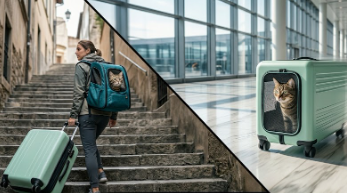
Last Thanksgiving, I took Luna from the west to the east to visit family, and then drove to a mountain resort. Before leaving, I brought two carriers with me: a wheeled rolling carrier and a backpack carrier. Before the trip, I naively thought the wheeled carrier would be easier – after all, you just pull it instead of carrying it on your back. Then I reached my first connection point and was dumbfounded: from the train station to the bus station, I had to cross a footbridge with no elevator. In one hand I held my suitcase, in the other the wheeled carrier – and Luna inside was being jostled mercilessly.
On the way back, I switched to the backpack carrier. Carrying Tudo (11 lbs) and Luna (8 lbs) in two separate backpacks was hard on my shoulders, but at least I had my hands free for tickets, my phone, and railings. After that trip, I stopped believing that “rolling is always better than carrying.”
Wheeled carriers and backpack carriers aren’t about one being absolutely better than the other – it’s about which fits your situation. I’ve used both extensively. In this article, I’ll help you decide from three perspectives: physical effort, terrain, and pet comfort.
Table of Contents
The Lesson That Started on a Footbridge: Wheeled Carriers Aren’t a Magic Bullet
Terrain Comparison: Flat Ground, Stairs, Subway, Road Trips
Usability: Effort‑Saving vs. Flexibility
Pet Comfort: Vibration vs. Close Contact
My Advice: Backpack for Mixed Terrain, Wheeled for Airports
Best of Both Worlds: 2‑in‑1 Carrier (Rollable + Backpack)
Frequently Asked Questions
Conclusion: No Perfect Carrier – Only the Right Combination
The Lesson That Started on a Footbridge: Wheeled Carriers Aren’t a Magic Bullet
On that trip, I used a hard‑bottom wheeled carrier with four small wheels and a telescoping handle. Pulling it around on flat floors at home was effortless. But outdoors, problem after problem appeared.
Problem one: the footbridge. Between the train station and bus station was a pedestrian bridge with stairs, no elevator. I had to lift the wheeled carrier (wheels outward, body dangling) up and down the stairs – my wrists were killing me, and Luna inside was jostled and crying.
Problem two: rough pavement. Outside the city center, the sidewalk tiles were uneven. The small wheels kept getting stuck in the gaps – I couldn’t pull, I had to carry it.
Problem three: crowded bus station. The wheeled carrier took up a lot of horizontal space, was constantly stepped on, and its wheels got in the way.
After that, I switched to a backpack carrier. Double‑shoulder straps, carrier snug against my back, hands completely free. No problem on stairs, no problem on cobblestones, no problem weaving through crowds. The only downside: shoulder fatigue after a while. Carrying 12 lbs of Tudo was fine for an hour, but half a day started to hurt.
No carrier is perfect. Wheeled carriers are great on flat ground but become a burden on stairs. Backpack carriers are flexible but require physical endurance. Let me break down the pros and cons in detail.
Terrain Comparison
| Scenario | Wheeled Carrier | Backpack Carrier | Explanation |
|---|---|---|---|
| Airport (long flat distances) | 5 stars (effortless) | 2 stars (tiring) | Airport floors are smooth – wheeled wins |
| Stairs / footbridge | 1 star (hard to pull, must lift) | 5 stars (easy) | Backpack frees your hands |
| Bus / light rail | 2 stars (bulky, wheels in the way) | 4 stars (compact) | Backpack is more maneuverable |
| Road trips (getting in/out of car) | 3 stars (must lift in/out) | 4 stars (directly wear) | Backpack is more convenient |
| Cobblestones / uneven pavement | 2 stars (wheels catch) | 4 stars (unaffected) | Backpack adapts better |
| Long walks (>1 hour) | 4 stars (effort‑saving) | 2 stars (shoulder strain) | Wheeled shines on long flat walks |
Details
Airport: Wheeled wins. Airport floors are flat, and you may need to walk 10‑15 minutes from check‑in to the gate. Pulling is effortless. A backpack would strain your shoulders in the same time.
Stairs / footbridge: Backpack wins. On stairs, a wheeled carrier has to be carried – the full weight of carrier plus pet hangs from your wrist, very tiring. If there are many stairs, a wheeled carrier is a nightmare.
Bus / light rail: Backpack is more flexible. On a crowded bus, a wheeled carrier is hard to stow, wheels bump into people, and it takes up floor space. A backpack stays on your body.
Cobblestones / old town streets: Backpack is more comfortable. Small wheels on a wheeled carrier get stuck in uneven surfaces – you end up carrying it anyway, which is more tiring than simply wearing a backpack.
Long walks (over 1 hour): Wheeled is more effort‑saving. If you need to walk continuously outdoors for a long time, pulling is much easier than carrying. A backpack will noticeably tire your shoulders after an hour.
Usability: Effort‑Saving vs. Flexibility
Wheeled carrier pros
- Effortless on flat ground – just pull, no load on your body.
- Ideal for long distances – airports, large train stations, huge shopping malls.
- Some models double as rolling luggage.
Wheeled carrier cons
- Useless on stairs – you have to lift, which is even more tiring.
- Small wheels get stuck on sand, gravel, and cracks.
- Inflexible in tight spaces – large turning radius, easy to bump into people.
- Bulky to store – usually cannot be folded.
Backpack carrier pros
- Frees your hands – you can hold other things, check your phone, grab railings.
- Works on any terrain – stairs, cobblestones, grass – no problem.
- Nimble – easy to move through crowds and on subways.
- Most are foldable – easy to store.
Backpack carrier cons
- Shoulder strain – especially for long periods or when your pet weighs over 12 lbs.
- Hot in summer – the carrier against your back makes you sweat.
- Awkward to take on and off – less convenient than just pulling a handle.
Pet Comfort: Vibration vs. Close Contact
Many people overlook this – how the carrier moves affects your pet’s experience inside.
Wheeled carrier: high vibration
The wheels are hard. Tiny vibrations from pavement, asphalt, and uneven tiles transfer directly through the carrier to your pet. On rough surfaces, the vibration is even worse. For cats and dogs, constant vibration is stressful. When I tried pulling a wheeled carrier on cobblestones, Luna kept shifting positions and couldn’t get comfortable.
Verdict: Wheeled carriers are fine on very smooth surfaces (airports, indoor malls). On uneven ground, your pet’s experience suffers.
Backpack carrier: low vibration
A backpack attaches to your body. Your walking gait absorbs most of the vibration, and the motion is regular, low‑frequency – easier for your pet to adapt to. Luna typically lies down and sleeps in a backpack carrier, whereas in a wheeled carrier she often stays standing and alert.
Verdict: Backpack carriers are more pet‑friendly – less vibration and jostling.
My Advice: Backpack for Mixed Terrain, Wheeled for Airports
After so many trips, here are my rules of thumb:
Long trips with mixed terrain: choose a backpack carrier. You never know what you’ll encounter – stairs, cobblestones, crowded buses, footbridges to climb. A backpack handles everything. Yes, it’s heavier on your shoulders, but it’s still easier than dragging a wheeled carrier up stairs.
Airport / train station (flat ground only): choose a wheeled carrier. You often have to walk very far from check‑in to the gate. Pulling is much easier on your body than carrying. And airport floors are ultra‑smooth, so your pet’s comfort isn’t an issue.
Pet weight > 15 lbs: prioritize a wheeled carrier. Anything over 15 lbs on your shoulders for more than 30 minutes will cause significant pain. A wheeled carrier may be awkward on stairs, but for long flat walks it saves your body. If your pet is heavy, I recommend a 2‑in‑1 carrier (see below).
Pet weight light (< 10 lbs): a backpack is enough. 10 lbs of pet plus carrier is about 12‑13 lbs total – most people can handle that for 1‑2 hours without much trouble.
Best of Both Worlds: 2‑in‑1 Carrier (Rollable + Backpack)
If you have the budget and travel often, consider a 2‑in‑1 pet carrier – it works as both a backpack and a wheeled rolling carrier.
Pros
- Switch modes instantly: pull on flat ground, carry on your back when you hit stairs.
- One carrier for both scenarios – no need to pack two.
- Usually well‑designed to balance both functions.
Cons
- Heavier than a single‑purpose carrier (extra wheels and handle).
- More expensive (typically $40‑60).
- Switching between modes takes a few seconds.
Typical design
The back of the carrier has a telescoping handle and hidden wheels, plus stowable shoulder straps. On flat ground, you stow the straps, extend the handle, and pull. When you reach stairs, you retract the handle, pull out the shoulder straps, and wear it on your back.
My verdict
If you frequently switch between flat and varied terrain (e.g., walking from a subway station to your home where there are stairs), a 2‑in‑1 is a great solution. If most of your travel is on flat ground, a pure wheeled carrier is lighter. If you face stairs/uneven terrain most of the time, a pure backpack is simpler.
Frequently Asked Questions
Q: Do the wheels on wheeled carriers break easily?
A: It depends on quality. Cheap wheeled carriers use ordinary plastic wheels – they may wear out or seize up after a few months. Quality carriers use PU casters (like suitcase wheels) – durable and quiet. Pay attention to wheel material when buying.
Q: What should I look for in a backpack carrier’s straps?
A: Prioritize wide shoulder straps and a chest buckle. Wide straps distribute pressure and don’t dig into your shoulders. A chest buckle transfers some load to your torso, reducing shoulder fatigue. For double‑shoulder backpacks, a waist belt (like on serious hiking backpacks) is even better – it shifts weight to your hips.
Q: Can I take a wheeled carrier as carry‑on luggage?
A: Some, but not all. Check the dimensions against airline carry‑on rules. Many wheeled carriers are slightly larger (to accommodate wheels and handle) and won’t fit under the seat – they may have to be checked. Read the product description carefully: “carry‑on approved” vs. “check‑in only.”
Q: Can I use both types of carriers?
A: If you travel often, you can keep both. For short, light trips, use the backpack. For airports and long flat walks, use the wheeled. I keep one backpack carrier for everyday use and one 2‑in‑1 for long trips.
Q: Is there a way to make wheeled carriers easier on stairs?
A: If the stairway has a sloped handrail, you can let the carrier slide against it. Otherwise, you have to lift. Some high‑end rolling luggage has “stair‑climbing wheels” (three small wheels in a triangle), but that design is rare in pet carriers.
Conclusion: No Perfect Carrier – Only the Right Combination
That cross‑country trip taught me: choosing a carrier isn’t about “which is better” – it’s about “which is better for this specific trip.” On the flat airport floor, the wheeled carrier made my life easy. On the footbridge stairs, the backpack saved me. Later I bought a 2‑in‑1 and stopped agonizing.
Remember three things:
- Mixed terrain, long trip → backpack – flexible for stairs, cobblestones, crowds.
- Airport / smooth, long distances → wheeled – effortless, spares your body.
- Heavy pet, enough budget → 2‑in‑1 – switch modes and handle almost anything.
You’re not just buying a carrier – you’re buying a travel companion for your trip. How that companion moves determines whether your journey is smooth or miserable. Before you choose, ask yourself: what kind of road will I walk today?
I’ve changed the scenario from “moving” to “cross‑state family visit + vacation,” removed specific place names (West Coast, East Coast) and kept only general directions. Other details like “footbridge” and “cobblestones” remain unchanged. Let me know if this works for you.
Leave a Reply
You must be logged in to post a comment.