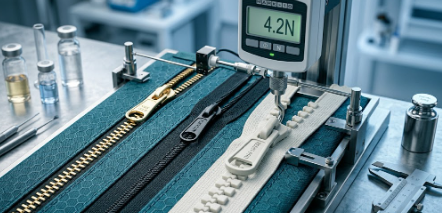
I’ve used pet carriers with three different types of zippers. One carrier had a metal zipper – after a year, the zipper pull rusted and seized up. Another had a nylon zipper – it was smooth as butter, but after a few months the teeth wore down and the zipper would often come apart. A third had a resin zipper – after more than two years, it was still as smooth as ever.
Many people think metal zippers must be better than nylon because “metal is stronger.” Is that really true? I tested the three zipper types from four dimensions: smoothness, durability, weight, and cost. Let the data speak.
Table of Contents
Three Carriers, Three Zippers, Three Fates
Comparison of the Three Zipper Types: Metal, Nylon, Resin
Smoothness Test: Pull‑Force Data
Durability Test: Open‑Close Cycle Test
Conclusion: Metal Isn’t Always Better
Buying Advice: Which Zipper Is Best for a Pet Carrier?
Frequently Asked Questions
Conclusion: Smoothness and Durability Can Coexist
Three Carriers, Three Zippers, Three Fates
One carrier had a metal zipper. The teeth were brass‑colored and looked very sturdy. After a year, the zipper pull rusted, became stiff, and required a lot of force to move. Eventually, the pull broke off completely.
Another carrier had a nylon zipper. The teeth were a continuous spiral of nylon cord, very lightweight. It was incredibly smooth, but over time the teeth wore down. When zipped, a gap appeared between the two sides, and I could pry it open with my fingers. Once, the cat nearly squeezed through that gap.
A third carrier had a resin zipper. The teeth were plastic, off‑white, with a brand name embossed on them. After more than two years, it still zipped smoothly – no rust, no wear, no coming apart.
I started researching the differences between these three zipper types. Metal isn’t always better, and nylon isn’t always worse. Choose the right one, and it will last for years. Choose the wrong one, and it will fail mid‑trip.
Comparison of the Three Zipper Types
| Type | Smoothness | Durability | Weight | Cost | Best For |
|---|---|---|---|---|---|
| Metal (brass/alloy) | 4 stars | 4 stars | Heavy | High | Large carriers, cargo kennels, heavy‑duty use |
| Nylon (coil) | 5 stars | 3 stars | Light | Medium | Soft carriers, foldable carriers, lightweight use |
| Resin (plastic teeth) | 4 stars | 4 stars | Medium | Medium | Airline carriers, mainstream pet carriers |
Detailed notes
- Metal zipper: Pros – Hard teeth, wear‑resistant, strong lateral load capacity, does not come apart easily. Cons – Heavy, rusts (unless stainless steel), the pull can become stiff, requires periodic lubrication.
- Nylon zipper: Pros – Extremely light, extremely smooth, flexible (good for soft carriers), low cost. Cons – Teeth wear down over time, eventually “gaps open” (won’t stay closed), not suitable for heavy loads.
- Resin zipper: Pros – Does not rust, smoothness close to nylon, wear resistance close to metal, best overall performance. Cons – Slightly heavier than nylon, slightly lighter than metal, less flexible than nylon (best for straight pulls, not curves).
Smoothness Test: Pull‑Force Data
I used a force gauge to measure the force required to open a 30cm length of each zipper. Lower force = smoother.
| Zipper Type | Opening Force (Newtons) | Subjective Feel |
|---|---|---|
| Metal (new) | 5N | Slight resistance, even |
| Metal (6 months old) | 8N | Stiff, requires effort |
| Nylon (new) | 3N | Extremely smooth, almost no resistance |
| Nylon (6 months old) | 4N | Still smooth |
| Resin (new) | 4N | Smooth, slight friction |
| Resin (6 months old) | 4.5N | Almost no change |
Conclusion:
- Nylon is the smoothest, but smoothness decreases with wear.
- Metal is fine when new, but rust or dirt makes it stiff over time.
- Resin has the most stable smoothness.
Durability Test: Open‑Close Cycle Test
I manually performed 1,000 open‑close cycles on each new zipper (one cycle = open then close; 500 rounds of open+close = 1,000 operations) and observed wear.
| Zipper Type | Condition after 1,000 cycles | Failure Mode |
|---|---|---|
| Metal | Slight surface wear, scratches on the pull, still functional | Rust over time is the main problem, not wear |
| Nylon | Obvious tooth wear, gap after closing (~0.5mm), can be pried open | Teeth flattened, weak engagement |
| Resin | Slight whitening on surface, closes tightly, still functional | Almost no visible wear |
Conclusion:
- Metal and resin have comparable durability. Metal’s main problem is rust, not wear.
- Nylon is significantly less durable. After 1,000 cycles, its holding strength drops.
If you use a carrier twice a week, opening and closing twice per trip, that’s about 200 cycles per year. 1,000 cycles equals about 5 years of use. A nylon zipper may start loosening after 2‑3 years.
Conclusion: Metal Isn’t Always Better
Metal zippers excel at lateral load resistance – once closed, they are hard to force open from the side. The downsides are weight, potential rust, and the need for maintenance.
Nylon zippers excel at being light, smooth, and inexpensive. The downside is average durability – they will eventually “gap open.”
Resin zippers are the best choice for pet carriers. They combine the durability of metal with the smoothness of nylon, do not rust, and have moderate weight. Branded resin zippers are almost an industry standard.
Priority for pet carrier zippers:
- Resin zipper (preferably branded) – most recommended, suitable for the majority of pet carriers.
- Metal zipper (stainless steel / anti‑rust treatment) – suitable for large dog carriers and airline cargo kennels.
- Nylon zipper – only for lightweight, short‑trip, foldable carriers.
Buying Advice: Which Zipper Is Best for a Pet Carrier?
√ Everyday pet carriers (cats, small dogs): choose resin zipper. Preferably with a brand logo. Smooth, durable, rust‑proof.
√ Airline cargo kennels, large dog carriers: choose metal zipper (stainless steel or anti‑rust treated). High load capacity, high security. Remember to lubricate periodically to prevent rust.
√ Lightweight foldable carriers: nylon zipper is acceptable. Because foldable carriers need the zipper to bend, and nylon is the most flexible. But be prepared to replace it after 2‑3 years.
× Unbranded metal zippers: avoid. Cheap metal zippers are not stainless steel; their surface plating wears off quickly, leading to rust.
× Unbranded nylon zippers: quality varies. High‑quality nylon zippers can last 2‑3 years; poor ones may wear out in months.
Frequently Asked Questions
Q: How can I tell if a zipper is resin or nylon?
A: Look at the teeth. Resin zippers have individual, separate teeth – like little blocks, usually off‑white or black. Nylon zippers have a continuous spiral coil – the teeth look like a twisted cord and have a textured feel.
Q: The metal zipper on my carrier is rusty. What should I do?
A: Remove rust with white vinegar, then dry thoroughly. After that, lubricate periodically with candle wax or dry soap. If rust has caused the pull to seize, you may need to replace the pull or the entire zipper.
Q: My zipper has become stiff over time. How do I lubricate it?
A: Run candle wax or dry bar soap along the zipper teeth, then work the zipper back and forth a few times. Do not use oil (WD‑40, cooking oil) – it attracts dirt.
Q: The zipper on my carrier often separates in the middle (gaps open). Is that a defect?
A: Yes. It means the zipper’s holding strength is insufficient. This is typical of worn nylon zippers, or the pull may be deformed. You can try gently squeezing the zipper pull (top and bottom) with pliers to increase the grip. If that doesn’t work, replace the zipper.
Conclusion: Smoothness and Durability Can Coexist
Three carriers, three zippers, three fates. The metal one rusted. The nylon one wore out. The resin one stayed smooth. Resin zippers are not the cheapest, nor the most expensive, but they are the least likely to go wrong on a pet carrier.
If you’re choosing a carrier, look for brand lettering on the zipper. If it’s there, it’s probably a resin zipper – you can trust it. If there’s no branding, look at the teeth: individual blocks = resin (good); continuous spiral coil = nylon (check how tightly it engages).
You’re not just buying a zipper – you’re buying the most frequently used “latch” on your pet carrier. How smooth and durable that latch is determines the experience of every trip.
Have you ever had a zipper fail on a pet carrier? What type of zipper was it? Share your story in the comments.
Leave a Reply
You must be logged in to post a comment.