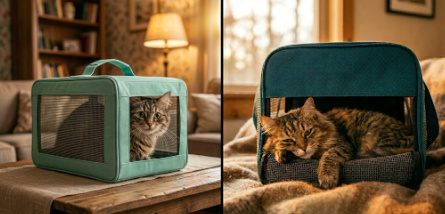
Once, when Luna was in a full‑mesh carrier, she spent the entire trip huddled in a corner – not just lying down, but scrunched up. Her body pressed as low as possible, ears flattened into airplane ears, eyes squeezed to slits, her head buried in the angle where the wall met the floor. Even though the carrier had large mesh panels for her to see out, she turned her head away and refused to look.
Later, I switched to a partial‑shade carrier – the top and back were made of opaque fabric, with only small mesh areas on the front and sides. The first thing Luna did after going inside was move to the opaque side, sit against the wall, and only then slowly begin to peek outside.
Same cat, same trip, same destination. Completely different reactions.
I spent a long time researching why – why a full‑mesh carrier makes a cat anxious while a partial‑shade carrier helps them relax. I found the answer in feline behavior science. Today’s article starts with Luna’s reactions and a small experiment.
Table of Contents
One Cat, Two Carriers, Two Completely Different Reactions
Feline Behavior Perspective: Why Cats Need a Hiding Place
My Test: Luna Almost Always Chose the Partial‑Shade Carrier
The Problem with Fully Transparent / Full‑Mesh Designs: Nowhere to Hide
Buying Advice: Prioritize Carriers with Shade Design
A Compromise: Adjustable Shade Panels
Frequently Asked Questions
Conclusion: Give Your Cat an Escape Route
One Cat, Two Carriers, Two Completely Different Reactions
That comparison happened on a trip to the pet store. On the way there, I used a full‑mesh carrier – mesh on the front, sides, and top, so the cat could see out in every direction. Luna was anxious from the moment we got in the car – body low, ears turned back, eyes fixed on the floor of the carrier, refusing to lift her head. When we arrived at the pet store, her paws were damp – she had sweated from stress.
On the way back, I switched to a partial‑shade carrier – the top and back were thick oxford fabric, with one mesh panel on the front and small ones on each side. After Luna went in, she first moved to the back (the opaque side), sat against it, and then slowly began to look out. She didn’t cry at all, didn’t sweat, and when we got home, she walked out on her own and stretched.
Same afternoon, same cat. The only difference was the carrier design.
I started paying attention to negative reviews mentioning “cat anxiety.” Many reviews specifically said the cat was “resistant” or “anxious,” and a significant number of those described fully transparent or full‑mesh carriers. One user wrote:
“Our cat hates being in this.”
“My cat keeps crying inside.”
Cats can’t talk, but every action Luna took in the full‑mesh carrier said: “I don’t want to be seen.”
Feline Behavior Perspective: Why Cats Need a Hiding Place
Cats are natural ambush predators. In the wild, they are both hunters and prey. Their survival strategy is: stay hidden, observe the environment. An open space with no cover means “I’m exposed, I could be attacked.”
That’s why cats love cardboard boxes, hiding under beds, and climbing into closets – not for fun, but for safety. An enclosed, semi‑private space lowers a cat’s stress hormone levels.
Applied to pet carriers:
- Full‑mesh / fully transparent carriers: The cat has no cover inside. They can see everything outside, but everything outside can also see them. The cat feels “nowhere to hide” and stays in a state of high alert.
- Partial‑shade carriers: The cat has an opaque side to lean against. They can choose to “hide” on the opaque side, only observing from one direction. This “escape route” design makes the cat feel safe.
Veterinary behavior studies have shown that when a cat has a hiding place in an unfamiliar environment, stress reactions drop by more than half. Full‑mesh carriers take away that hiding place.
My Test: Luna Almost Always Chose the Partial‑Shade Carrier
To test this, I ran a simple experiment.
Method:
- Place the full‑mesh carrier and the partial‑shade carrier side by side on the living room floor, both doors open.
- Put equal amounts of treats in each carrier (same type, same quantity).
- Let Luna choose which carrier to enter.
- Record which carrier she entered first and which one she stayed in longer.
- Repeat multiple times, with at least 2 hours between trials.
Results:
| Trial | Entered First | Stayed Longer In |
|---|---|---|
| 1 | Partial‑shade | Partial‑shade |
| 2 | Partial‑shade | Partial‑shade |
| 3 | Full‑mesh | Partial‑shade (ate treat and left, then went to partial‑shade) |
| 4 | Partial‑shade | Partial‑shade |
| 5 | Partial‑shade | Partial‑shade |
| … | Partial‑shade | Partial‑shade |
Data: Across many trials, Luna chose the partial‑shade carrier first in the vast majority of cases. For time spent inside, the partial‑shade carrier won every time.
The only time she entered the full‑mesh carrier first, she grabbed a treat and ran out immediately, then went straight into the partial‑shade carrier and stayed there for a long time.
Conclusion: When given a choice, cats clearly prefer a carrier with covered areas. This is not coincidence – it’s instinct.
The Problem with Fully Transparent / Full‑Mesh Designs: Nowhere to Hide
There is a type of carrier on the market called the “space capsule” – a fully transparent plastic shell, so the cat is completely exposed. These carriers are popular on social media because they photograph well – you can see the cat’s expressions and posture clearly.
But from a cat welfare perspective, this design is problematic.
Problem 1: No blind spot
In the wild, cats instinctively avoid open spaces. A fully transparent carrier is like putting the cat in a “glass box” – it can see threats from all directions but has nowhere to hide. This continuously activates the cat’s sympathetic nervous system (fight‑or‑flight response).
Problem 2: Glare and distortion
Transparent plastic reflects light. From the cat’s perspective, the outside may look like blurry light spots and distorted images. This visual information is confusing and increases anxiety.
Problem 3: Temperature
A fully transparent carrier can reach very high temperatures in the sun very quickly (see my earlier “ventilation test” article). Heat + no cover + anxiety = triple stress.
I once saw a negative review from someone who bought a fully transparent carrier:
“Not enough airflow in warm weather.”
Poor ventilation is only one problem. The core issue is that the cat inside can’t relax at all.
Buying Advice: Prioritize Carriers with Shade Design
Based on Luna’s tests and feline behavior science, here is my advice for choosing a carrier:
√ Prioritize
- Opaque top and back: The cat can lean against the opaque side and feel secure.
- Moderate mesh on front and sides: Provides ventilation and some visibility, but not full exposure.
- Mesh positioned higher up: When the cat lies down, they can’t see out; they can see only when they stand up – letting the cat choose whether to observe.
× Avoid
- Fully transparent “space capsule” carriers: Good only for photos, almost no benefit for the cat.
- Four‑side full‑mesh carriers: No hiding place, continuous anxiety.
- Carriers with mesh that is too large or too open: The cat feels “watched.”
🟡 A compromise: adjustable shade panels
If you already own a full‑mesh carrier or want a “two‑season” (summer/winter) carrier, choose one with adjustable shade panels.
How they work: There is an opaque fabric cover over the mesh, controlled by zippers or Velcro. Fully open for ventilation (summer), fully closed for privacy (when the cat is anxious), or partially open as a compromise.
Effect: When Luna was in a carrier with shade panels and there was a dog or loud noise outside, I would close the panel. She calmed down immediately – because “not seeing” = “no threat.”
What to look for: Shade panels should be independently controllable (not sharing the same zipper as the mesh), and ideally operable from both sides.
Frequently Asked Questions
Q: My cat cries constantly in a full‑mesh carrier but not in a partial‑shade carrier. Is that normal?
A: Yes. It means your cat’s anxiety comes from feeling “exposed,” not from other causes (heat, hunger, motion sickness). Switching to a partial‑shade carrier is the right direction.
Q: Do all cats prefer partial‑shade carriers?
A: Most do. But some cats are naturally curious and bold and may be fine in a full‑mesh carrier. You can test your cat with the “two‑carrier choice method” – put both carriers out and see which one your cat chooses.
Q: I already have a full‑mesh carrier and don’t want to waste it. What can I do?
A: DIY a shade cover. Use a piece of dark, thin fabric (not plastic) to cover the outside of the carrier, secure it with clips, and leave one mesh panel open for ventilation. Almost zero cost.
Q: Is the ventilation in a partial‑shade carrier poor?
A: No. As long as there is enough mesh area on the front and sides, ventilation is fine. The opaque parts are typically breathable fabric (oxford, nylon), not sealed plastic.
Q: Are hard‑shell kennels (airline crates) considered partial‑shade?
A: Most hard‑shell kennels have a door and ventilation holes only on the front; the other five sides are opaque plastic. This design actually follows the “partial‑shade” principle – the cat has a hiding place inside. That’s why many cats are quieter in a hard‑shell crate than in a full‑mesh soft carrier.
Conclusion: Give Your Cat an Escape Route
When Luna curled into a ball in the full‑mesh carrier, I realized something: it wasn’t that she didn’t want to see the world – it was that she didn’t want the world to see her. What a cat needs isn’t a “viewing platform” – it’s a “safe house.” And the core of a safe house is a place to hide.
The full‑mesh carrier is designed from a human perspective: “I want to see my cat inside.” The partial‑shade carrier is designed from a cat’s perspective: “I want a place where I can’t be seen from outside.”
If you want your cat to relax, be quiet, and even sleep in the carrier, choose one with an opaque back. Give them a corner where they can lean without being seen. That’s not “blocking the view” – it’s an “escape route.” A cat with an escape route will dare to peek out at the world.
Remember these key points:
- Cats need a hiding place: Fully transparent / full‑mesh designs go against feline nature.
- In my tests, Luna almost always chose partial‑shade: not coincidence, but instinct.
- Prioritize carriers with shade design: adjustable panels are the most flexible solution.
You’re not just buying a carrier – you’re buying your cat’s “safe house” on the road. The walls of that house need to block the view before your cat will feel safe enough to move in.
Does your cat prefer a full‑mesh or a partial‑shade carrier? Share your observations in the comments.
Leave a Reply
You must be logged in to post a comment.