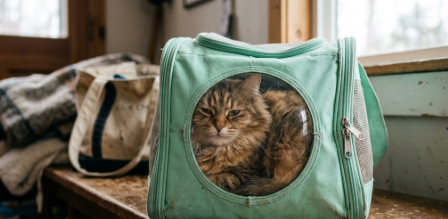
When Luna was three months old, I bought my first pet carrier. I chose size S based on the seller’s “recommended weight,” thinking, “She’s a kitten, that’s enough.” But she grew like a balloon. By six months, she no longer fit. Every time I tried to get her in, it was a struggle – head in, rear out; rear in, head stuck.
That carrier was still quite new, not broken or torn. I didn’t want to waste it, so I started figuring out how to still use it for outings, even though it was too small. Of course, only for short trips and emergencies.
Later, when I looked through negative reviews, I found that “size mismatch / too small” was the most frequent complaint – it ranked first. I wasn’t alone. If you’re also stuck with a carrier that’s too small, don’t throw it away yet. These short‑trip emergency tips might help you get a little more use out of it.
Table of Contents
Luna’s “Shrinking” Carrier: From Size S to No Longer Fitting
Data‑Backed: Lessons from Size Mismatch Complaints
Three Space‑Saving Tricks: Remove the Liner, Skip the Pad, No Clothes
Shorten the Time: A Small Carrier Is Only for Short Durations
When You Must Replace the Carrier: Three Signs – Don’t Push It
My Advice: Keep the Small One as a Backup, Buy One Size Larger for Primary
Frequently Asked Questions
Conclusion: Emergency Use Is Fine, but Don’t Settle Long‑Term
Luna’s “Shrinking” Carrier: From Size S to No Longer Fitting
When that size S carrier first arrived, Luna had room to spare. She could turn around, lie down, and poke her head out. I thought, “This carrier will last a long time.” But cats grow much faster than expected – a few months later, she could only curl up inside; turning around was difficult. Once, on the way to the vet, she cried in the carrier – not from fear, but because she was genuinely cramped.
At the time, I thought, “The carrier is still new – it would be a shame to throw it away.” So I started researching how to make the cat as comfortable as possible despite the size issue. I tried removing the liner, skipping extra pads, and not putting clothes on her – these methods did free up a little space, but they only worked for short trips.
In negative reviews, I saw similar struggles:
“My puppy is now 10.5 weeks and 11lbs and I feel he will outgrow it before he reaches 20lbs.”
“Too small for my cat even though I followed the sizing chart.”
“Too small even though I followed the sizing chart” – too many people have fallen into that trap.
Data‑Backed: Lessons from Size Mismatch Complaints
Among the negative reviews I analyzed, “size mismatch / too small” was one of the most frequent complaints. Here is the breakdown of typical problems:
| Problem | Percentage | Typical Description |
|---|---|---|
| Actually smaller than described | ~45% | “Size chart inaccurate,” “narrower than listed” |
| Pet outgrew it quickly | ~30% | “Fit when I bought it, too small a while later” |
| Not enough height | ~15% | “Cat can’t stand up,” “head hits the top” |
| Fits under seat but cat can’t turn | ~10% | “Fits the airline size, but cat can’t turn around” |
What the data shows:
- Over 60% of size problems come from buying by “weight” instead of by actual measurements.
- The growth rate of kittens/puppies is severely underestimated – a carrier that “just fits” now may be too small in a few months.
- Insufficient height is the most overlooked issue – many people measure length and width but forget that cats need room to stand and lie down.
If you’re also stuck with a carrier that’s too small, the emergency tips below can help you get by for a while, but eventually you’ll need to buy a larger one.
Three Space‑Saving Tricks: Remove the Liner, Skip the Pad, No Clothes
These three tricks can free up 1‑3 cm of space – not much, but enough for short‑trip emergencies.
Trick 1: Remove the liner
Many pet carriers have a removable liner (pad) that is about 1‑2 cm thick. Removing it slightly increases the usable height and width inside.
How to do it:
- Take the liner out, leaving only the carrier shell.
- If the carrier has a rigid base, you can use it as is.
- If the bottom is soft, put a thin pee pad down instead of the liner.
Result: Gains about 1‑2 cm of interior space. Very effective when the pet “almost doesn’t fit.”
Trick 2: Don’t put extra pads inside
Besides the liner, many people add extra pads, blankets, or pee pads. Each layer takes up a little more space.
For emergencies:
- Keep only the most essential (e.g., a pee pad for leaks).
- Don’t add thick blankets, memory foam pads, or pet clothes.
- If the weather isn’t cold, put nothing at all.
Result: Gains another 1‑2 cm.
Trick 3: Don’t dress your pet
In winter, many people put sweaters on their cats. Even a thin sweater takes up space and restricts movement.
For emergencies:
- For short trips (within 15 minutes), skip the clothes and turn up the car heater.
- If your pet is cold, use a carrier cover instead of adding clothes inside.
Result: Reduces your pet’s “bulk” so they can stretch out a little more.
Together, these three tricks can free up 2‑4 cm of space. For a carrier that’s “just a little too small,” that might be enough. But if the carrier is two sizes too small, these tricks won’t help.
Shorten the Time: A Small Carrier Is Only for Short Durations
Space‑saving tricks only alleviate the problem – they don’t cure it. The time your pet spends in a too‑small carrier must be strictly limited.
√ Scenarios where a small carrier is acceptable (within 15 minutes)
- Walking from downstairs to the vet (a few minutes)
- From home to the car (1‑2 minutes)
- A short walk around the neighborhood (within 15 minutes)
- Temporary transfer (e.g., home repairs, temporarily putting the cat in the carrier)
× Scenarios where a small carrier is absolutely not acceptable
- Long road trips (over 30 minutes)
- Air travel
- Going to the vet for surgery or a checkup (you may have to wait a long time)
- Extended outdoor activities
My experience: Once I used the size S carrier to take Luna for a vaccination. There was a traffic jam, and the trip took 20 minutes. She cried the whole way, and when she came out, her legs seemed stiff. After that, I always use a larger carrier for any trip longer than 15 minutes.
Time vs. risk:
| Duration | Risk Level | Recommendation |
|---|---|---|
| Within a few minutes | Low | Small carrier is fine |
| Within 15 minutes | Medium | Barely acceptable – watch your pet closely |
| Within 30 minutes | High | Not recommended |
| Over 30 minutes | Extremely high | Absolutely not |
When You Must Replace the Carrier: Three Signs – Don’t Push It
If you see any of these three signs, replace the carrier immediately. Emergency tricks won’t help.
× Sign 1: Your pet cannot turn around
A cat needs to be able to turn around inside the carrier. If they can only face one direction and can’t reverse, the space is severely inadequate. Inability to turn for extended periods causes muscle stiffness and joint stress.
Test method: Put your cat in the carrier, close the door, and see if they can change direction on their own. If yes, it’s okay. If no, replace the carrier.
× Sign 2: Your pet’s head hits the top when lying down
When a cat lies down, their head and body should be level. If the carrier isn’t tall enough, their head will press against the top, forcing their neck into an awkward angle. That position becomes uncomfortable within minutes.
Test method: Watch your cat lying down from the side. If there is no gap between their head and the carrier top (or the gap is less than 1 cm), replace the carrier.
× Sign 3: Your pet is clearly anxious inside
If your cat cries constantly, scratches, pants, and you have ruled out other causes (not hot, not hungry, not thirsty), it may be claustrophobia caused by the small space.
Note: Some cats are naturally timid, but if your cat doesn’t cry in a larger carrier but cries in the small one, then size is the issue.
My rule: If any of these three signs appears, I stop using the small carrier. Emergency tricks are only for a “transition period” – they are not a long‑term solution.
My Advice: Keep the Small One as a Backup, Buy One Size Larger for Primary
That size S carrier later became my “backup” and “emergency” carrier. I keep it in the car – if the main carrier has a problem (broken zipper, gets dirty), I can use the small one temporarily. But for primary travel, I switched to a larger carrier.
Size advice for buying carriers
- Don’t buy by current weight. Kittens and puppies grow fast before adulthood. A carrier that “just fits” now will be too small in a few months.
- Buy one size larger. If the seller says “size S fits pets under 5 lbs,” buy size M (fits 5‑10 lbs). Extra space can be filled with a blanket – that’s better than being cramped.
- Prioritize back length and shoulder height. Weight is misleading; body size is what matters. See the earlier “Size Guide” article.
Other uses for a small carrier
- Temporary restraint in the car (short transfers)
- As a cat bed at home (door open)
- Lend to a friend for emergencies
- Donate to an animal rescue
Don’t throw it away. A small carrier may not be suitable for primary travel, but it has many other uses.
Frequently Asked Questions
Q: Can I return or exchange a carrier that’s too small?
A: If you haven’t used it, the tags are still on, and it’s within 7 days, yes. But if you’ve used it for a while, you probably can’t return it. That’s why I recommend testing the carrier with your cat as soon as you receive it – don’t wait until later to find out it’s too small.
Q: Will removing the liner make my cat uncomfortable?
A: Yes. The liner provides softness and warmth. Without it, the bottom becomes harder and cooler. For short trips (within 15 minutes), it’s acceptable. For longer trips, it’s not.
Q: My cat can barely turn around, but the car ride is only a few minutes. Can I tough it out?
A: Once in a while might be okay, but don’t make it a habit. Even a few minutes can stress your cat if they are cramped the whole time. If you can replace the carrier with a larger one, do it.
Q: My carrier isn’t tall enough – my cat can only lie down, not stand. Is that a problem?
A: For short trips, not a big problem. Cats don’t usually stand much in a moving carrier (it’s too shaky). But if they can’t stand for long periods, their muscles may stiffen. Keep trips under 15 minutes.
Q: What size carrier should I buy for a kitten?
A: Buy one that will fit the adult size. Don’t buy a “growing” small carrier. Put a soft pad or old clothes inside to take up extra space. As the cat grows, remove the padding, and the space becomes just right.
Conclusion: Emergency Use Is Fine, but Don’t Settle Long‑Term
I used that size S carrier as my “primary” for about two months. Every trip was stressful – worried about traffic jams, worried about Luna being uncomfortable. After I switched to size M, she went right in and lay down to sleep. That’s when I realized how uncomfortable she had been before.
A small carrier can work for emergencies and as a backup, but it’s not suitable for long‑term use. If you notice your pet can’t turn around, hits their head on the top, or is clearly anxious, don’t hesitate – get a larger carrier. The money you save isn’t worth their comfort and peace of mind.
Remember these key points:
- Three space‑saving tricks: remove liner, skip pads, no clothes – frees up 2‑4 cm.
- Strictly limit time: a small carrier is only for trips within 15 minutes.
- Replace the carrier if you see any of three signs: can’t turn around, head hits top, obvious anxiety.
You’re not just buying a carrier – you’re buying your pet’s “mobile room” on the road. If that room is too small, they will stay curled up, uncomfortable, and scared. Give them a room that’s big enough – then they will feel safe.
Have you ever bought a carrier that was too small? What did you do with it? Share your story in the comments.
Leave a Reply
You must be logged in to post a comment.