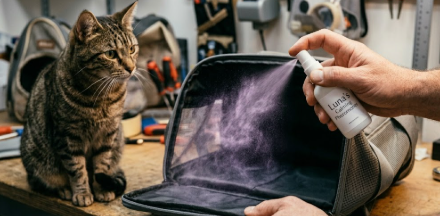
Luna used to be the “queen of screaming in the carrier.” Every time I took her out, she would yowl from the moment we got in the car until we arrived at the vet, and then all the way home. I wanted to plug my ears. I tried again – still screaming. I once decided she was just not cut out for going anywhere, so I gave up on taking her places.
But then I had to move, take her for checkups, and get vaccinations. I had no choice. I started seriously researching how to keep her quiet in the carrier. I tried pheromones, used old clothes, and attempted treat luring – some methods didn’t work, but others were surprisingly effective. Now Luna can stay calmly in her carrier for two hours, occasionally letting out a small whimper, but no more of those heart‑wrenching howls.
If your cat also screams non‑stop as soon as they go into the carrier, don’t give up. These are methods that worked for me – they might help you too.
Table of Contents
Luna’s “Screaming History”: From Getting in the Car to Getting Out
Data‑Backed: Why Do Cats Cry in the Carrier?
Pheromone Spray Guide: A Secret Weapon to Reduce Anxiety
Owner’s Clothing Method: Familiar Scent – the Cheapest and Most Effective Calming Aid
Treat Luring: Make Your Cat Think “Going in the Carrier Is a Good Thing”
Short Trips First: Don’t Go to the Vet on the First Try
Training Log: Seeing Your Progress
Frequently Asked Questions
Conclusion: Calmness Isn’t Born – It’s Trained
Luna’s “Screaming History”: From Getting in the Car to Getting Out
The first time Luna went in the carrier was for a vaccination. From the moment we got in the car, she made a sound I had never heard before – not a normal meow, but a drawn‑out, sharp, siren‑like howl. One after another, non‑stop. My mother, who had been driving for ten years, almost ran the car onto the curb.
At the vet, Luna screamed even louder. Even the vet noticed and said, “This cat is very stressed. Next time before you come, you can spray some pheromone in the carrier.” That was the first time I heard that word.
I tried a few more times. Eventually, it got a little better – she cried for only half the trip. Then later, she stopped crying and switched to a low growl. Now, she can stay quietly in the carrier for two hours, occasionally peeking out, then curling up and going back to sleep.
This change didn’t happen by “toughing it out” – it happened through the right methods.
Data‑Backed: Why Do Cats Cry in the Carrier?
In the cat anxiety reviews I analyzed earlier, the distribution of reasons for crying was roughly:
| Anxiety Manifestation | Percentage | Typical Description |
|---|---|---|
| Constant crying | Over half | “Howling,” “screaming,” “cried the whole way” |
| Scratching carrier walls | Over 20% | “Frantically pawing the mesh” |
| Eliminating in the carrier | Around 10% | “Scared and peed” |
| Drooling / panting | Around 10% | “Panting with mouth open” |
Why cats cry:
- Fear: unfamiliar environment, unfamiliar smells, unfamiliar sounds.
- Feeling trapped: can’t see out, can’t escape.
- Motion discomfort: car vibrations, carrier swaying.
- Separation anxiety: can’t see the owner.
Most crying comes from fear. And fear can be soothed.
Pheromone Spray Guide: A Secret Weapon to Reduce Anxiety
Pheromone spray (Feliway) is the most effective single‑use calming tool I’ve used. It’s not a drug; it’s a synthetic version of the feline facial pheromone – the scent cats release when they rub their cheeks on things in a safe environment, meaning “this place is safe.”
When to spray
About 15 minutes before putting the cat in the carrier. Spray too early and the effect fades; spray too late and it hasn’t had time to work.
Where to spray
- Inside walls of the carrier (one spray on each of the four sides)
- On the surface of the liner (one spray)
- Do not spray directly on the cat, on food, or on the water bottle.
How much
For a standard airline carrier, 4‑5 sprays are enough. Too much will create a strong smell that might bother the cat.
Effectiveness
Vets say it can reduce anxiety manifestations by about half. In my observation: after spraying, Luna’s howling went from “the whole trip” to “occasional,” and her body posture changed from “curled into a tight ball” to “able to lie down.” She didn’t stop crying entirely, but she was noticeably calmer.
Precautions
- Not all cats respond to pheromones. Before using, you can spray a little on a tissue and let your cat sniff it.
- Pheromones are not a substitute for training. They are an aid, not magic. Your cat still needs time to adjust.
- The spray has an alcohol smell (normal) that dissipates within a few minutes.
Owner’s Clothing Method: Familiar Scent – the Cheapest and Most Effective Calming Aid
This method costs nothing, but its effectiveness is often underestimated.
How it works
Cats rely on scent to identify “safe territory.” Your scent is synonymous with safety for your cat. Putting a piece of your worn clothing in the carrier is like telling the cat: “This is my turf – you can relax here.”
Steps
- Find a worn T‑shirt (don’t wash it – the more it smells like you, the better).
- Lay it flat at the bottom of the carrier, then put the liner or pad on top.
- If your cat might pee in the carrier, put a pee pad over the T‑shirt.
Effectiveness
When I used this method, Luna sniffed the T‑shirt and then lay down on it. Her crying frequency dropped noticeably. One time I forgot to put the T‑shirt in, and she started crying again. When I added it back, she slowly calmed down. That wasn’t a coincidence.
Precautions
- Fold the T‑shirt flat – don’t bunch it up (the cat could get tangled).
- After each trip, the T‑shirt will have cat hair and smells. You can reuse it several times before replacing.
- If the cat pees on the T‑shirt, throw it away and use a fresh one (don’t wash it – a washed T‑shirt no longer has your scent).
Treat Luring: Make Your Cat Think “Going in the Carrier Is a Good Thing”
A cat’s behavior logic is simple: good things = repeat, bad things = avoid. If every time they go into the carrier they get a tasty treat, they will slowly learn that the carrier is not a bad thing.
High‑value treats: only given inside the carrier
Prepare a special treat that your cat absolutely loves but doesn’t get at other times (e.g., freeze‑dried chicken, a lickable treat). Only give it when the cat is in or near the carrier. Not before, not after.
Steps
- Place the open carrier on the floor.
- Put one high‑value treat at the entrance.
- When the cat goes in to eat it, don’t close the door.
- Repeat several times until the cat willingly goes in looking for treats.
- Once the cat willingly enters, try closing the door for a moment while giving the treat.
Effectiveness
It took Luna a few days to learn “going in the carrier = freeze‑dried treat.” Now, as soon as I pick up the carrier, she sits nearby waiting. Not because she loves car rides, but because she loves freeze‑dried treats.
Precautions
- Use small treats that can be eaten in a couple of bites. Don’t give a large piece – the cat might take it and run.
- You can also give treats in the car. While stopped at a red light, poke one through the mesh.
- Don’t overdo it – a few treats per day is enough. If you don’t go out often, it’s fine.
Short Trips First: Don’t Go to the Vet on the First Try
A common mistake: using the carrier for the first time to go directly to the vet. The vet’s office has disinfectant smells, barking dogs, strangers, and the pain of shots – all of which get associated with the carrier. The cat learns “carrier = scary place.”
The right approach: start with just a few minutes
- First couple of days: Leave the carrier open at home with treats inside. Let the cat go in and out freely. Don’t close the door, don’t go out.
- Next: Close the door for a few seconds, give a treat, then open. Repeat several times.
- Next: Close the door for one minute, then walk around the house with the carrier in hand.
- Then: Take the carrier downstairs, stand at the building entrance for a few minutes, then go back inside.
- Gradually extend: Walk around the neighborhood for a few minutes, then ten, then fifteen…
Don’t start with a noisy environment
The vet, pet store, or park (where there are dogs) are not suitable for the beginning. Start with quiet neighborhood streets.
Record each session
I use a note on my phone to track daily progress, like:
- Day 1: Ate treat inside carrier, door open, several minutes.
- Day 2: Door closed for a few seconds, no crying, treat.
- Day 3: Door closed for 30 seconds, whimpered once, treat.
- Day 4: Carried carrier a few steps, quiet.
- Day 5: Went downstairs and stood outside for a few minutes, cried twice.
Recording helps you see progress. Sometimes you feel like “why is she still crying?” but looking back, a few days ago she wouldn’t even let me close the door.
Frequently Asked Questions
Q: How long does a bottle of pheromone spray last? How many uses?
A: A typical 60ml bottle, with 4‑5 sprays per use, lasts for many uses. If you go out once a week, it can last close to a year.
Q: When my cat cries in the carrier, can I open it and pick her up?
A: No. If you open the carrier every time she cries, she will learn “crying = door opens.” Wait until she is quiet for a few seconds, then open and give a treat. If she is crying too intensely (a stress reaction), go back home and shorten the session next time.
Q: My cat isn’t interested in treats. What should I do?
A: Try different treats: freeze‑dried, lickable tubes, wet food. If she still won’t eat, she may be too stressed to have an appetite. In that case, don’t force it. Leave the carrier open at home with regular kibble inside and let her explore on her own.
Q: How long will these methods take to work?
A: It depends on the cat. Luna took about two weeks to go from “howling the whole way” to “occasional whimper.” Some cats may take a month, while naturally bold cats might take only a few days. Don’t compare with others – compare with your own cat.
Q: My cat doesn’t cry in the carrier, but she constantly scratches the walls. What should I do?
A: Scratching, like crying, is a sign of anxiety. The same solutions apply: pheromone spray + old clothing + treats + short trips. Also, check whether the carrier is too small (refer to the “size guide” article). Insufficient space can also cause scratching.
Conclusion: Calmness Isn’t Born – It’s Trained
Luna can now stay quietly in her carrier for two hours – not because she suddenly became brave, but because she gradually learned that nothing terrible happens after going into the carrier. Inside, she smells my scent, occasionally gets a treat, and even though the outside sounds are unfamiliar, they aren’t so scary.
Calmness isn’t born – it’s trained. Every cat has their own pace. Some are fast, some are slow. But as long as you are willing to put in the time and use the right methods, your cat will slowly relax.
Remember these key points:
- Pheromone spray: Spray inside the carrier before putting the cat in – reduces anxiety.
- Owner’s old T‑shirt: Place at the bottom – familiar scent is the best security blanket.
- High‑value treats: Only given in the carrier – builds a “carrier = good things” association.
- Short trips first: Start with a few minutes – don’t begin with a noisy environment.
You’re not just buying a carrier – you’re giving your cat a “new world” to face. Give them time and use the right methods – they will slowly accept it.
Does your cat cry in the carrier? What methods have you tried? Share your story in the comments.
Leave a Reply
You must be logged in to post a comment.