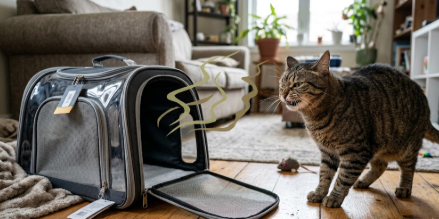
How sensitive is Luna to smells? Once, I received a new carrier. The moment I opened the shipping bag, a strong, sharp plastic smell hit my nose. I put the carrier on the living room floor. Luna looked at it from a distance, then—took a wide detour and hid under the sofa. I put treats inside. She sniffed from the entrance and backed away. That carrier sat on the balcony for a full week before Luna would go near it.
That was the carrier that annoyed me the most. The smell was so strong that three days of airing barely helped. I couldn’t wait any longer, so I decided to use it as a “test subject.” I tried every odor removal method I could find online: airing, white vinegar, tea leaves, activated charcoal, baking soda. For each method, I carefully recorded the time, steps, and results.
After a week, I found the fastest and most effective method. Today, I’ll share my real‑world test results. If you’ve ever received a “smelly carrier,” don’t rush to return it—try baking soda first.
Table of Contents
The Smelliest Carrier: Luna Walked Around It
5 Methods – Real Test Data Comparison
Detailed Steps: Baking Soda Spray Method (Fastest)
White Vinegar Wipe Method (Most Thorough)
What to Avoid: Never Use These Methods
Frequently Asked Questions
Conclusion: Make a New Carrier Odor‑Free in as Little as 1 Day
The Smelliest Carrier: Luna Walked Around It
That carrier was a “great value” model I bought on a certain platform. It cost less than fifteen dollars and looked decent in the pictures. The moment I opened the box, I thought the package contained a chemical plant sample. The smell wasn’t the ordinary “new product smell”; it was pungent, throat‑irritating, and made me want to cough.
I put it on the balcony to air out. Day one – the smell faded a little, but up close it still stung my eyes. Day two – the same. Day three – Luna still walked around it. I couldn’t wait any longer. I happened to have several odor‑removing materials at home, so I decided to test each method to see which worked fastest.
I disassembled the carrier into parts: body, liner, base panel. I applied a different method to each area and strictly recorded the time. The results surprised me: the fastest method wasn’t the most expensive, nor the most complicated.
5 Methods – Real Test Data Comparison
Below are the results from testing different methods on the same carrier (material: cheap PVC‑coated oxford fabric).
| Method | Difficulty | Time Cost | Odor Removal Effectiveness | Recommendation | Key Takeaway |
|---|---|---|---|---|---|
| Airing out / Sunlight | Low (just leave it) | 3‑5 days | 3 stars (lighter but still present) | 3 stars | Good when you’re not in a hurry; sunlight may cause fading |
| White vinegar wipe | Medium (two wipes) | 1 day | 4 stars (glue smell mostly gone, temporary vinegar scent) | 4 stars | Most thorough; great for glue‑type odors |
| Tea leaves / coffee grounds | Medium (need to bag and place) | 2‑3 days | 3 stars (moderate absorption, leaves tea scent) | 3 stars | Natural but limited; for mild odors |
| Activated charcoal | Low (just place inside) | 3‑5 days | 2 stars (poor effect on PVC’s own smell) | 2 stars | Absorbs but doesn’t neutralize; useless for plastic smell |
| Baking soda spray | Medium (mix + wipe) | 1 day | 5 stars (odor almost gone, no residue smell) | 5 stars | Fastest and most thorough – highly recommended |
Test conclusion:
- Fastest: Baking soda spray method – odor essentially gone within 1 day.
- Most thorough: White vinegar wipe – especially effective on glue smells.
- Least effective: Activated charcoal – slightly helpful for “trapped” smells from sealed packaging, but almost useless for the plastic smell coming from cheap PVC material itself.
Detailed Steps: Baking Soda Spray Method (Fastest)
This is the method I highly recommend. It costs almost nothing, is simple to do, and works within a day.
Materials needed
- Baking soda (food grade – very inexpensive)
- Warm water (around 40°C / 104°F, not too hot)
- Spray bottle (clean, preferably never used for chemicals)
- Soft cloth or towel
Step‑by‑step
Step 1: Mix the baking soda solution
Mix baking soda and warm water in a 1:10 ratio (e.g., 10g baking soda + 100ml water). Stir well until the baking soda is fully dissolved. Don’t use water that’s too hot – it may damage the fabric coating.
Step 2: Pour into the spray bottle
Pour the solution into the spray bottle and shake well.
Step 3: Spray evenly inside and outside the carrier
Open the carrier completely (unzip everything, remove the liner). Spray all fabric surfaces inside and out evenly. Don’t miss the seams and corners. Spray until the surface is slightly damp, not dripping.
Step 4: Let sit for 30 minutes
Allow the solution to sit on the fabric for 30 minutes. Baking soda neutralizes acidic odor molecules and breaks down some volatile compounds.
Step 5: Wipe off with a damp cloth
Use a clean, damp cloth (with plain water, wrung out) to wipe all surfaces inside and out. Remove any residual baking soda powder and dissolved grime.
Step 6: Air dry
Place the carrier in a well‑ventilated area to dry. Avoid direct sunlight. It usually dries completely in 2‑4 hours.
Result: After drying, the sharp plastic smell is essentially gone. Touch the fabric – no powder residue. Luna sniffed it and went inside.
Precautions
- Do not spray metal parts (zipper pulls, buckles) – baking soda may accelerate oxidation.
- Do not spray too much on mesh (could clog the openings).
- If the smell is extremely strong, repeat once.
White Vinegar Wipe Method (Most Thorough)
If your carrier has a “glue smell” rather than a “plastic smell,” the vinegar method is better. White vinegar neutralizes alkaline odor molecules and is especially effective on glue and adhesive odors.
Materials needed
- White vinegar (food grade – not dark vinegar)
- Warm water (1:1 ratio)
- Soft cloth or towel
- A second soft cloth (for plain water)
Step‑by‑step
Step 1: Mix the vinegar solution
Mix white vinegar and warm water in a 1:1 ratio. Stir.
Step 2: Wipe with the solution
Dip a soft cloth into the solution and wring it out until it’s not dripping. Wipe all fabric surfaces inside and out, paying special attention to seams and folds.
Step 3: Let sit for 15 minutes
Allow the solution to sit on the fabric for 15 minutes. The vinegar will evaporate and carry away odor molecules.
Step 4: Wipe off with plain water (very important)
Use a second clean, damp cloth (plain water) to thoroughly wipe all surfaces inside and out, removing any residual vinegar smell. This step cannot be skipped – while vinegar smells better than plastic, your cat may still dislike it.
Step 5: Air dry
After drying, the vinegar smell will be completely gone, and the plastic/glue smell will be largely eliminated.
Precautions
- Do not use dark vinegar or fruit vinegar (they contain sugar and may become sticky).
- After wiping, you must wipe again with plain water – otherwise, white vinegar crystals may remain.
- Vinegar slightly corrodes metal parts – try to avoid them.
What to Avoid: Never Use These Methods
I saw these methods online, but after testing, I found they either don’t work or are harmful. Please avoid them.
× Bleach (sodium hypochlorite)
Why not: Bleach releases chlorine gas, which strongly irritates your pet’s respiratory tract. Residues can also be licked by your cat. Even diluted, the smell is extremely hard to remove. Never use it.
× Cheap fragrances / air fresheners
Why not: They mask odors instead of removing them. A cat’s sense of smell is 14 times stronger than a human’s; artificial fragrances can be even more irritating. Plus, mixing fragrance with plastic smell creates an even stranger odor.
× Rubbing alcohol
Why not: Alcohol evaporates quickly, but it can corrode some fabrics (especially PVC coatings and PU leather). After wiping with alcohol, coatings may turn white, harden, or even crack. Also, the sharp smell of alcohol is unpleasant for cats.
× Phenolic disinfectants (e.g., Lysol, Dettol)
Why not: Phenolic disinfectants are toxic to cats. Even diluted, residues can be licked or inhaled. I specifically warned about this in my “cleaning” article: never use phenolic disinfectants on pet supplies.
× Sunlight as a primary odor removal method
Why not: Sunlight does accelerate off‑gassing, but it also fades fabrics, ages mesh, and makes plastic parts brittle. It can be a supplement, but not the main method. If you must use sunlight, limit it to 2 hours.
Frequently Asked Questions
Q: How long should I air out a new carrier to consider it normal?
A: A mild glue smell that disappears within 24‑48 hours is normal. If after 72 hours of airing there is still a strong pungent smell, the material itself is problematic (cheap PVC or recycled material) – odor removal will only be a temporary fix. I recommend returning it.
Q: Baking soda or white vinegar – which is better?
A: It depends on the type of smell:
- Plastic smell (sharp, chemical) → baking soda is more effective.
- Glue smell (like super glue) → white vinegar is more effective.
If you can’t tell, try baking soda first; if that doesn’t work, try vinegar.
Q: Will baking soda damage the fabric?
A: No. Baking soda is mildly alkaline and does not corrode nylon, oxford fabric, or PVC coatings. However, don’t soak the fabric for more than 1 hour, and don’t use it on real leather or silk.
Q: After deodorizing, my cat still won’t go into the carrier. What should I do?
A: Possibly the smell hasn’t completely disappeared, or your cat has already formed a negative memory (“this carrier = bad smell”). Try:
- Wiping again with plain water to remove any remaining residue.
- Airing out for another 2 days.
- Putting an old T‑shirt of yours and high‑value treats inside.
- Letting your cat explore freely – no forcing.
Q: Are there carriers that have no smell at all from the start?
A: Yes. Carriers made of high‑quality nylon (1680D ballistic nylon) or EVA typically have almost no smell when unboxed. Choose the right material and avoid the hassle of deodorizing. See my “material analysis” article.
Conclusion: Make a New Carrier Odor‑Free in as Little as 1 Day
When you receive a smelly carrier, don’t rush to throw it away or suffer through using it. After testing 5 methods, my conclusion is clear:
- Fastest: Baking soda spray – works in 1 day, almost zero cost.
- Most thorough: White vinegar wipe – great for glue‑heavy smells.
- Least effective: Activated charcoal – nearly useless for PVC plastic smells.
If you have time, combine baking soda + airing: day 1 – baking soda spray, wipe, dry; day 2 – air out again. After two days, even a very smelly carrier can become acceptable.
But there is a bottom line: If after three days of airing plus baking soda treatment the smell is still strong, the material itself is defective. Don’t “make do” – return it. Your pet’s respiratory system is much more sensitive than yours. What you think is “bearable” may be a constant irritant for your cat.
Luna eventually went into that carrier. I treated it once with baking soda, let it dry for a day, and she approached, sniffed, then slowly walked inside. That’s when I knew – this method worked.
What’s the smelliest carrier you’ve ever received? What method did you use to remove the odor? Share your tips in the comments.
Leave a Reply
You must be logged in to post a comment.