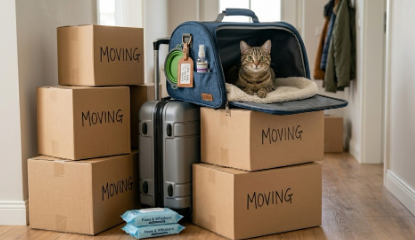
Last fall, I made the biggest move of my life—a cross‑state relocation from the East Coast to the Midwest, over 750 miles, two days and one night of driving. Luna and Tudo would have to spend 48 hours in their carriers: in the car, in a hotel, and then back in the car.
Before leaving, I pulled out both carriers. One was my everyday sturdy carrier (rigid base + metal frame), the other was a backup foldable carrier. I thought to myself: Luna is timid; Tudo is a little better, but neither had ever been on such a long trip. For them, the carrier wasn’t just a “container for the car”—it was the only “safe room” they would have for 48 hours.
As it turned out, my preparation was still insufficient. After eight hours of driving on the first day, Luna stayed curled up inside the carrier, refusing to eat or drink, not even licking the rollerball on the water bottle. When we reached the hotel, I took her out of the carrier, and she dove straight under the bed, not coming out for half an hour. Tudo, being more easygoing, slept through half the trip, but by the second day he became restless, scratching at the carrier walls repeatedly.
That move taught me a lesson: on a long‑distance relocation, a pet carrier is not a “transportation device”—it is a temporary safe haven. Your pet may spend dozens of hours inside it. Their comfort, sense of security, and even basic survival needs depend on that small space.
Later, I went through many reviews about “long trips” and “moving” and combined them with my own experience to write this article. I hope everyone who needs to relocate with a pet can avoid some of the detours I took.
Table of Contents
48 Hours of Cross‑State Moving: Luna and Tudo’s “Life in a Carrier”
Data‑Backed: Core Pain Points of Pet Carriers for Long‑Distance Relocation
Long‑Haul Comfort Design: Rigid Base, Space, Visibility
Feeding and Watering Design: Hanging Water Bottle, Collapsible Bowl, Stop Schedule
Emotional Calming: Familiar Scents, Soothing Music, Pheromone Spray
Special Relocation Considerations: Early Acclimation, Backup Carrier, Contact Info
Essential Checklist for Long‑Distance Relocation
Frequently Asked Questions
Conclusion: A Carrier Is a Safe Haven, Not a Shipping Container
48 Hours of Cross‑State Moving: Luna and Tudo’s “Life in a Carrier”
On that move, my first mistake was not getting the cats accustomed to the long‑haul carrier environment in advance.
Luna’s usual sturdy carrier had never been used for more than a two‑hour drive to the vet. Suddenly expecting her to stay inside for eight hours was too much. In the first afternoon, I noticed she had buried her face in the corner of the liner, her body curled into a tight ball, and the water in the bottle hadn’t gone down at all. I tried to lure her with a treat; she sniffed it and refused.
Tudo adapted more quickly, but his problem was insufficient space. An 11‑pound Corgi could lie down in a standard‑size carrier, but turning around was tight. By the second day, he became restless—constantly standing up, lying down, standing up again, pushing against the carrier walls and slightly deforming them.
At the hotel, I placed both carriers beside the bed, unzipped them, and let the cats come and go freely. Luna stayed inside her carrier all night—she chose to sleep in the carrier rather than on the bed. That was when I realized: for this timid little cat, the carrier had become the only familiar place in this strange environment.
I had once read a review that didn’t mean much to me at the time, but now it resonates deeply:
“My puppy is now 10.5 weeks and 11lbs and I feel he will outgrow it before he reaches 20lbs.”
Size issues become magnified on a long‑distance relocation. The longer your pet stays in the carrier, the more obvious insufficient space becomes. A carrier that is “just right” for a short trip becomes torture on a long journey.
Data‑Backed: Core Pain Points of Pet Carriers for Long‑Distance Relocation
Among the negative reviews I analyzed, there wasn’t a specific category for “long‑distance relocation,” but when I combed through comments about “size mismatch,” “base support,” “ventilation,” and “odor,” I found many users mentioning long‑haul scenarios. Here are typical pain points:
| Pain Point | Typical Manifestation |
|---|---|
| Insufficient space | “Pet couldn’t turn around,” “head touched the top when lying down” |
| Poor base support | “Base bent,” “pet’s spine was under pressure” |
| Poor ventilation | “Stuffy inside in summer,” “cat was panting” |
| Difficult to clean | “Carrier was filthy after the long trip,” “liner wouldn’t come out” |
What makes long‑distance different:
- The time span is long (hours to days), so comfort requirements are much higher than for short trips.
- Your pet may eat, drink, and eliminate inside the carrier.
- The carrier environment (temperature, smell, space) directly affects your pet’s stress level.
One user wrote about a carrier:
“It’s a bit flimsy but gets the job done.”
On a long trip, “flimsy” is not just “a little soft.” In a poorly supported carrier, your pet’s spine and joints will be under constant pressure for hours.
Long‑Haul Comfort Design: Rigid Base, Space, Visibility
1. The carrier must have a rigid base (for extended periods inside)
I’ve written in detail about rigid bases before—they are essential for protecting your pet’s spine and joints. On a long‑distance relocation, your pet may be inside the carrier for many hours. A soft‑bottom carrier can cause:
- Spinal stress: Especially for long‑backed dogs like Corgis; lying on a soft base for a long time puts uneven pressure on the lumbar spine.
- Joint strain: Pets need to adjust their posture inside the carrier; a soft base provides no stable support.
- Psychological discomfort: The “falling‑through” feeling of not having solid ground underfoot creates ongoing anxiety.
Real‑world comparison:
- Rigid‑base carrier: Tudo lay in it for 4 consecutive hours; when he got up, he moved normally with no stiffness.
- Soft‑bottom carrier (test): After the same 4 hours, Tudo’s legs were noticeably stiff, and he took several steps before recovering.
Buying advice: For long‑distance relocation, a rigid base is non‑negotiable. PVC board or composite wood board are fine; cardboard is not (it softens when damp).
2. Enough interior space (to turn around and lie down)
For a long‑distance move, the carrier should be one size larger than “just fits.”
Calculation formulas:
- Internal length ≥ pet’s back length + 10cm (4 inches) (allow 5cm more than for short trips)
- Internal height ≥ pet’s shoulder height + 5cm (2 inches) (so they don’t hit the top when standing)
- Internal width ≥ pet’s shoulder width × 1.5 (to turn around)
Why more space is needed:
- Staying in one position for hours means your pet needs room to shift posture.
- Eating and drinking require moving space.
- When anxious, they need a corner to “hide” in (to curl up against the side).
My lesson: Tudo’s standard‑size carrier became too small by the second day. Later, at a rest area, I opened the foldable backup carrier and placed the two carriers side by side, which gave enough space.
3. Large side mesh (wider view reduces anxiety)
Cats are visual animals. In an unfamiliar environment, being able to see outside reduces anxiety. But there is a balance between “seeing” and “being scared.”
Design points:
- Side mesh should be large but positioned relatively high (so the cat can’t see out when lying down, only when standing up).
- A removable cover/curtain is best (can be closed when the cat is nervous).
- The mesh should not face strong light sources (like fast‑moving scenery outside the car window).
My approach: I draped a thin gauze scarf over the outside of the carrier. It let Luna see blurry outlines without being overwhelmed by rapidly moving images.
Feeding and Watering Design: Hanging Water Bottle, Collapsible Bowl, Stop Schedule
Hanging water bottle (attachable inside the carrier)
On a long trip, your pet may get thirsty at any time. A hanging water bottle (rollerball type) is the best choice.
Advantages:
- Doesn’t take up floor space in the carrier.
- Your pet can drink whenever thirsty without you having to stop.
- Hard to spill.
What to look for:
- The bottle’s clip must be secure (won’t fall off during bumps).
- The rollerball should roll smoothly (a single lick releases water).
- Capacity: 50ml is fine for short trips; for long trips, 100ml or more is recommended.
Note: Some cats don’t know how to use a rollerball bottle. Train them at home before departure—let them learn to lick the ball for water.
Collapsible bowl (feed during rest stops)
Do not feed dry food inside the carrier (crumbs will scatter and be hard to clean). For long trips, use a collapsible bowl to feed during rest breaks.
Suggested schedule:
- Stop every 4 hours.
- When stopped, open the carrier and let your pet come out to move around and relieve themselves (use a leash).
- Offer water and food (if it’s mealtime).
Choosing a collapsible bowl: Silicone, foldable for storage, easy to clean. Do not use disposable paper bowls (cats may bite and shred them).
Watering frequency on long trips
| Temperature | Recommended Watering Interval |
|---|---|
| Below 25°C (77°F) | Every 4 hours |
| 25–30°C (77–86°F) | Every 2–3 hours |
| Above 30°C (86°F) | Every 1–2 hours (also take cooling measures) |
Signs of dehydration: Dry gums, decreased skin elasticity (gently lift the skin on the back of the neck; if it doesn’t snap back quickly), lethargy. If you see any of these signs, stop immediately and offer water.
Emotional Calming: Familiar Scents, Soothing Music, Pheromone Spray
Place an old piece of your clothing inside the carrier (familiar scent)
This is the simplest and most effective calming method. Put a worn T‑shirt (unwashed) at the bottom of the carrier. Your scent gives your pet a strong sense of security.
My approach: A week before departure, I placed the T‑shirt where my pets usually hung out, so they became familiar with it. When we left, I put it in the carrier. If the T‑shirt got soiled with urine along the way, I swapped in another one.
Play soothing music (masks unfamiliar noises)
Noises outside the car (horns, engine sounds, strangers talking) can stress your pet. Studies show that calming classical music or music designed specifically for pets can lower heart rates.
Recommendations:
- Classical music (piano pieces, string instruments)
- Pet‑specific music (e.g., “Through a Dog’s Ear” series)
- White noise (rain sounds, fan noise)
Volume: Loud enough to mask outside noise, but not too loud.
Use pheromone spray
I’ve covered Feliway (for cats) and Adaptil (for dogs) in detail in my desensitization training article.
When to use:
- Spray 2–3 pumps inside the carrier 15 minutes before departure.
- Reapply every 4–6 hours (for long trips).
- Do not spray directly on your pet or on food.
Effectiveness: Can reduce anxiety manifestations by about half, but does not replace acclimation training.
Special Relocation Considerations: Early Acclimation, Backup Carrier, Contact Info
1. Get your pet used to the new carrier in advance
Don’t wait until the day of departure to put your pet in the carrier. Start at least a week early to familiarize them with this “long‑trip special” carrier.
Acclimation steps:
- Days 1–2: Leave the carrier at home with the door open, put treats inside, let your pet explore freely.
- Days 3–4: Close the door for short periods (a few minutes to half an hour).
- Days 5–6: Carry the carrier around the house to simulate the car environment.
- Day 7: Take a short test drive (20–30 minutes) and observe reactions.
2. Prepare a backup carrier (in case of emergencies)
On a long trip, something can go wrong with the carrier: a broken zipper, torn mesh, or being soaked by pet urine. A backup carrier can be a lifesaver.
My experience: On the second afternoon, Luna peed in her carrier. Even though the liner was removable, the bottom of the carrier body was also wet and there was no time to dry it. I moved Luna to the backup foldable carrier, put the wet carrier in a plastic bag, and washed it at the hotel.
Choosing a backup carrier: Foldable, lightweight, and compact. It doesn’t have to be as good as the primary carrier, but it should at least have a thin rigid base and basic ventilation.
3. Attach contact information to the carrier (in case of loss)
On a long relocation, you might open the carrier at a rest area to let your pet stretch, or an accident could happen (car crash, carrier stolen). Putting your contact info on the carrier is the last line of defense.
Where to put it:
- A visible spot on the outside of the carrier.
- A hidden spot inside the carrier (in case the outside label falls off).
- Also on your pet’s collar (double protection).
What to write: Your name, phone number, destination address (or “REWARD IF LOST”). Use waterproof labels or cover them with clear packing tape.
Essential Checklist for Long‑Distance Relocation
Before you leave, check everything with this list:
√ Primary carrier
- Rigid base (PVC board or composite wood board)
- Enough space (to turn around, lie down)
- Ventilation on three or more sides
- Removable liner (for easy cleaning)
- Attachment point for a hanging water bottle
√ Backup carrier
- Foldable, lightweight
- At least a thin rigid base
- Spare liner or pad
√ Feeding supplies
- Hanging water bottle (filled)
- Collapsible bowl
- Dry and wet food (packed in small portions)
- High‑value treats (for calming)
√ Cleaning supplies
- Spare pee pads (placed under the liner)
- Wet wipes, paper towels
- Plastic bags (for soiled items)
- Odor‑removal spray
√ Calming supplies
- Your worn T‑shirt
- Pheromone spray
- Soothing music (downloaded to your phone)
- Familiar small toy (compact)
√ Safety supplies
- Contact info attached to the carrier (waterproof)
- Pet collar with ID tag
- Leash (for rest area breaks)
- Car thermometer
Frequently Asked Questions
Q: On a long‑distance relocation, how often should I stop to let my pet rest?
A: Every 4 hours is recommended. Stop, let your pet out to move around, drink water, and go to the bathroom. If driving at night, stop every 6–8 hours (but it’s best to avoid overnight long drives).
Q: My cat won’t drink water in the car. What should I do?
A: Try these methods:
- Use a syringe (without the needle) to slowly drip water from the corner of the mouth.
- Feed wet food (high moisture content).
- Stop at a rest area, take the cat out, and offer water from a bowl.
- If the cat hasn’t drunk for more than 8 hours, consult a vet.
Q: My pet keeps crying in the carrier. What should I do?
A: First, pull over and check: is it too hot? Is it hungry? Did it soil the carrier? After ruling out physical issues, use treats to calm, play soothing music, or open the carrier curtain a little so your pet can see you. If the crying continues, it may be a stress reaction—consider shortening each driving segment.
Q: After moving, my pet only wants to stay in the carrier and won’t come out. What should I do?
A: That’s normal. The carrier is the only familiar place in the new environment. Put the carrier in a quiet corner of the new home with the door open, and let your pet decide when to come out. Don’t force it. Place food and water near the carrier; it will gradually explore the new space.
Q: Can I put two pets in the same carrier?
A: Not recommended unless the carrier is very large (like a small dog crate) and the two pets get along very well. On a long trip, tight space increases the risk of conflict. It’s better to use two separate carriers placed side by side so they can see each other.
Q: Does my pet need motion sickness medication for a long trip?
A: Consult a vet. Do not medicate on your own. Some pets get motion sickness (drooling, vomiting, lethargy). A vet may recommend appropriate medication. Never use human motion sickness drugs—they can be toxic to pets.
Conclusion: A Carrier Is a Safe Haven, Not a Shipping Container
That cross‑state move taught me the true meaning of “pet carrier as a temporary safe haven.” Over those two days, Luna and Tudo’s carriers were not just transportation devices—they were “home” on a strange journey: a small, familiar, safe space of their own.
A qualified long‑distance pet carrier should provide:
- Rigid base: Protects the spine and provides a solid, reassuring feel.
- Enough space: To turn around, lie down, and hide.
- Water access: Ability to drink anytime.
- Emotional calming: Familiar scents, soothing music, pheromones.
- Backup plan: Spare carrier, contact info, cleaning supplies.
You’re not just buying a carrier—you’re buying your pet’s mobile safe haven on a long‑distance relocation. How comfortable and secure that haven is determines whether your pet will suffer or feel at ease during the journey.
Before your next long move or trip, prepare a week in advance and let your pet slowly get used to the carrier that will become their “temporary home.” They will find security inside it, and you will have one less worry on the road.
Have you ever moved with a pet? What problems did you encounter on the road? Share your long‑distance experiences in the comments.
Leave a Reply
You must be logged in to post a comment.