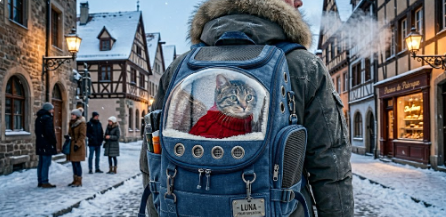
Last winter, I did something crazy—I took Luna to the north for the Chinese New Year.
Before leaving, I searched through all the pet carriers at home and finally chose the one I thought was “warmest”: thick oxford fabric with a thin layer of fleece lining. I thought, “It works fine when it’s a few degrees below zero where I live. It should handle the north’s minus ten‑something degrees, right?”
On the first day at our destination, I knew I was wrong.
That evening, I took Luna out to see an ice sculpture display. It was about a ten‑minute walk from the hotel to the exhibition area. Just three minutes in, I felt Luna moving inside the carrier. I looked down—she was curled into a tight ball, her body trembling slightly, her nose tip cold. I reached my hand into the carrier; the inner wall was icy, and that thin layer of fleece felt like paper, offering no warmth at all. Luna buried her face in her tail, her ears pressed flat against her head.
I turned around and hurried back to the hotel. I walked fast, my heart racing.
Back in the room, Luna jumped out of the carrier and dove straight into the bed, not coming out for ten minutes. I touched the inside of that carrier—cold, damp (from condensed moisture from her breath), completely unable to retain body heat. That was when I realized: in summer, you look for ventilation; in winter, you look for warmth. And most pet carriers are designed for “indoor” or “spring/autumn” use, never considering sub‑zero temperatures.
That night, I searched every local pet store and bought a fleece liner and a carrier cover. The next time we went out, Luna was warm inside the carrier.
Table of Contents
Minus Ten Something Degrees in the North: Luna Shivering in the Carrier
Data‑Backed: Winter Pet Travel Pain Points Around Warmth
Insulation Material Analysis: Comparing Six Common Materials
Fleece Liner Review: A Removable Liner Is a Winter Must‑Have
Cold‑Weather Accessories: Carrier Cover, Hand Warmers, Pet Clothing
Special Winter Travel Reminders: Temperature Shock, Duration, Paw Pads
Winter Travel Essential Checklist
Frequently Asked Questions
Conclusion: In Winter, Warmth Is the #1 Priority
Minus Ten Something Degrees in the North: Luna Shivering in the Carrier
After that trip to the north, I went through negative reviews mentioning “winter” or “cold.” While there weren’t as many as for “size mismatch” or “zipper damage,” one comment stuck with me:
“My puppy is now 10.5 weeks and 11lbs and I feel he will outgrow it before he reaches 20lbs.”
That review was about sizing, but someone replied underneath: “When I take him out in winter, this carrier is too thin. My puppy still feels cold inside.”
I started to realize: when you take your pet out in winter, the temperature inside the carrier is a seriously overlooked issue. Most pet carriers are designed for “abrasion resistance,” “water resistance,” and “breathability”—not “insulation.” And in sub‑zero temperatures, a non‑insulated carrier is a mobile icebox.
Insulation Material Analysis: Comparing Six Common Materials
I compared six common pet carrier materials on three dimensions: insulation, breathability, and weight.
| Material | Insulation | Breathability | Weight | Suitable Temperature | Typical Use |
|---|---|---|---|---|---|
| Single‑layer Oxford fabric | 1 star | 3 stars | Light | Above 15°C | Summer short trips, indoor |
| Single‑layer nylon (1680D) | 1 star | 3 stars | Light | Above 15°C | Summer, spring/autumn |
| Thick nylon + thin lining | 2 stars | 2 stars | Medium | 5–15°C | Spring/autumn, air‑conditioned rooms |
| Fleece liner | 3 stars | 2 stars | Medium | -5 to 10°C | Late autumn, early winter |
| Down liner | 4 stars | 1 star | Light | -15 to 5°C | Deep winter, long trips |
| Waterproof coating + insulation layer | 4 stars | 2 stars | Heavy | -15 to 5°C | Snow, wet cold |
Material breakdown:
- Single‑layer Oxford/nylon: Great ventilation in summer, but zero insulation in winter. Wind cuts right through, and your pet’s warm breath won’t stay inside. Not suitable below 0°C.
- Thick nylon + thin lining: Common in mid‑range carriers. The lining is usually a thin fleece or mesh that blocks some wind, but insulation is limited. Not enough below 5°C.
- Fleece liner: The most common “winter edition” configuration. Fleece traps air to create an insulating layer, offering noticeable warmth. Downside: poor breathability; your cat may feel stuffy after a while.
- Down liner: Best insulation and light weight. But down liners are often non‑removable (or hard to wash), and once wet, they lose all insulation. Good for dry cold (e.g., northern winters), not for wet cold (e.g., southern winters).
- Waterproof coating + insulation layer: Good for snow or sleet. The outer layer blocks moisture, the inner layer provides warmth. But it’s heavy and has poor breathability.
My advice:
- Above 0°C: Thick nylon + thin lining is enough.
- 0°C to -10°C: A fleece liner is a must.
- Below -10°C: Down liner or waterproof + insulated layer.
- Rain or snow: A waterproof outer layer is essential.
Fleece Liner Review: A Removable Liner Is a Winter Must‑Have
After my northern lesson, I bought a carrier with a removable fleece liner. Here are the test results:
Test environment: Outdoor temperature around -10°C, no wind, carrier placed in a shaded outdoor area for half an hour.
| Liner Type | Initial Inside Temp | Inside Temp After 30 Min | Luna’s Reaction |
|---|---|---|---|
| No liner (single‑layer nylon) | 5°C (brought from indoors) | -3°C | Shivering, curled into a ball |
| Thin fleece liner (attached) | 5°C | 0°C | Quiet, but body still curled |
| Thick fleece liner (removable) | 5°C | 3°C | Relaxed, able to lie down and sleep |
Conclusion: At -10°C, a fleece liner keeps the inside temperature above 0°C (more than 10°C warmer than outside). The thick fleece liner works best, maintaining around 3°C—a temperature where a cat can stay comfortably without shivering.
Advantages of a removable liner
- Two‑season use: Remove it in summer for ventilation; install it in winter for warmth.
- Easy to clean: The liner can be machine‑washed separately. In winter, condensation from your pet’s breath can make the liner damp—removable means you can dry it.
- Replaceable: If the liner becomes thin or deformed over time, you can replace just the liner.
What to look for
- Attachment method: zipper √ > Velcro ×
- Liner material: fleece √ > thin fleece > mesh
- Coverage: full coverage (bottom + sides + top) √ > bottom and sides only
Cold‑Weather Accessories: Carrier Cover, Hand Warmers, Pet Clothing
Beyond the carrier’s own materials, I tried several accessories for extra warmth.
1. Carrier cover: like putting a coat on the carrier
A carrier cover is an outer shell that goes over the pet carrier, usually made of windproof and waterproof fabric. It works like a coat—blocking cold wind and rain/snow.
Test result: In -10°C outdoor conditions with wind, a carrier cover prevented cold wind from cutting through the carrier walls, raising the inside temperature by 2–3°C compared to no cover.
What to look for:
- Size must match the carrier—not too tight (restricts ventilation) and not too loose (slips off)
- Preferably with a zippered opening to check on your cat
- Waterproof fabric preferred (for snow/rain)
DIY option: If you don’t have a dedicated cover, wrap an old down jacket or padded coat around the carrier and secure it with clips.
2. Hand warmers: attach to the outside of the carrier (Never touch the pet directly)
Hand warmers are a winter travel lifesaver, but they must be used correctly.
Correct use:
- Remove the wrapper and stick the hand warmer to the outside of the carrier
- Placement: bottom exterior, back exterior—anywhere the cat cannot reach
- You can use 2–3 warmers, evenly spaced
Incorrect use (dangerous):
- × Placing inside the carrier → direct contact could burn the cat
- × Only a thin layer of fabric between warmer and cat → cat may scratch through and ingest contents
- × Sticking directly on the cat → absolutely forbidden
Test result: One hand warmer attached to the outside of the carrier raises the inside temperature by 3–5°C and lasts 6–8 hours. At -15°C, hand warmers + a fleece liner kept the inside above 5°C.
Safety reminder: Hand warmers can reach 40–50°C on their surface. Through the carrier wall, they are safe, but never place them where the cat can directly contact them.
3. Pet clothing: an extra layer inside the carrier
If your cat doesn’t mind wearing clothes, put a thin sweater or fleece jacket on them before they go into the carrier. Layering works for pets too—the clothing traps body heat, and the carrier blocks the cold wind.
Note: Cats need time to get used to wearing clothes. Don’t put clothing on them for the first time right before going out. Let them try it at home for a few days first and observe whether they resist.
Special Winter Travel Reminders: Temperature Shock, Duration, Paw Pads
1. Indoor to outdoor: large temperature difference, needs gradual transition
In winter, indoor temperature might be 20°C while outdoors is -10°C—a 30°C difference. Suddenly moving from a warm house to freezing outdoors is a huge shock for cats and dogs.
Correct approach:
- Before going out, place the carrier in the hallway or entryway (temperature between indoors and outdoors) for 5 minutes as a transition.
- Or leave the carrier by an open door so cold air slowly enters.
- Don’t go directly from a 20°C room to -10°C outdoors.
2. Avoid prolonged outdoor exposure
Even with an insulated carrier, prolonged outdoor stays are not recommended.
Suggested duration:
- Around 0°C: no more than 1 hour
- -5°C to -10°C: no more than 30 minutes
- Below -10°C: no more than 15 minutes
Watch for signals: If your cat starts shivering, curling up, or burying their face, they are too cold. Go back inside immediately.
3. Paw pad protection: don’t let them step directly on snow/ice
If you let your cat out of the carrier outdoors (e.g., to use the bathroom), don’t let their paw pads touch snow or ice directly. Snow and ice can stick to paw pads and cause frostbite.
Correct approach:
- Find a dry surface (stone slab, wooden board, thick cardboard)
- Or use pet booties (if your cat accepts them)
- Or place a towel on the ground
After returning, check the paw pads and wipe them with warm water to melt any stuck ice crystals.
Winter Travel Essential Checklist
When taking your pet out in winter, it’s best to have the following:
√ Removable fleece liner (fleece or down)
- Install in winter, remove in summer
- Full coverage (bottom + sides + top) preferred
√ Carrier cover (windproof and waterproof)
- Blocks cold wind and snow/rain
- DIY: use an old down jacket
√ Hand warmers (attach to the outside of the carrier)
- Attach to the outside, never in direct contact with pet
- One warmer raises inside temperature by 3–5°C for 6–8 hours
√ Pet clothing (optional)
- Thin sweater or fleece jacket
- Needs prior acclimation at home
√ Thermometer
- Place inside the carrier to monitor temperature in real time
- Add extra warmth if it drops below 5°C
√ Dry towel
- Wipe off moisture and melted snow from the outside of the carrier
- Dry the carrier before going indoors to prevent it from becoming damp and cold
Frequently Asked Questions
Q: Can I use a regular cat carrier in winter? Do I need to buy a special “winter edition”?
A: It depends on the temperature. Above 0°C, a regular carrier with a thin liner may barely work. Below 0°C, I recommend a carrier with a removable fleece liner, or buying a separate liner. You don’t need a “winter‑only carrier”—a removable‑liner carrier is more practical (usable in both summer and winter).
Q: Does a fleece liner affect ventilation?
A: Yes. The thicker the liner, the less breathable the carrier. That’s the trade‑off between warmth and ventilation. My advice: keep the zippers closed for warmth while walking; open them for ventilation when you stop or go indoors.
Q: Is it safe to attach hand warmers to the outside of the carrier? Will they damage the carrier?
A: Safe. Hand warmers reach 40–50°C on the surface, while nylon and oxford fabric typically withstand temperatures above 100°C, so they won’t melt or damage the carrier. However, don’t attach them directly to mesh (hot air could blow directly onto your cat), and don’t leave them in the same spot for too long (which could cause local overheating).
Q: The inside of the carrier gets damp from my cat’s breath. What should I do?
A: That’s normal. When you get home, remove the liner and let it air dry. If the liner is machine‑washable, wash it regularly. A damp liner not only loses insulation but can also grow bacteria.
Q: Can I use an electric heating pad or pet heating pad in winter?
A: Not recommended. Car‑use electric blankets and pet heating pads have safety risks—the cat might chew the wires, or the heating element could malfunction and overheat. Hand warmers are a safer option (no electricity, no moving parts).
Conclusion: In Winter, Warmth Is the #1 Priority
That trip to the north completely changed how I think about pet carriers. In summer, I care about ventilation. In spring and fall, I care about lightweight portability. But in winter—warmth is the #1 priority. A carrier that doesn’t retain heat isn’t just “less comfortable” in sub‑zero temperatures—it’s “potentially dangerous.”
Before I go out in winter now, I do three things:
- Check the temperature inside the carrier: put a thermometer in; if it’s below 5°C, add warmth.
- Make sure the fleece liner is installed: on in winter, off in summer.
- Attach hand warmers to the outside of the carrier: put them on 15 minutes before leaving to pre‑warm it.
You’re not just buying a carrier—you’re buying your pet’s mobile warm room in winter. Whether that room keeps them warm enough determines whether they will be “sleeping comfortably” or “shivering in the cold” when you’re outdoors in sub‑zero weather.
Winter is here. Check your carrier—how cold can it handle?
What’s the coldest place you’ve taken your pet? Was the carrier warm enough? Share your winter travel experiences in the comments.
Leave a Reply
You must be logged in to post a comment.