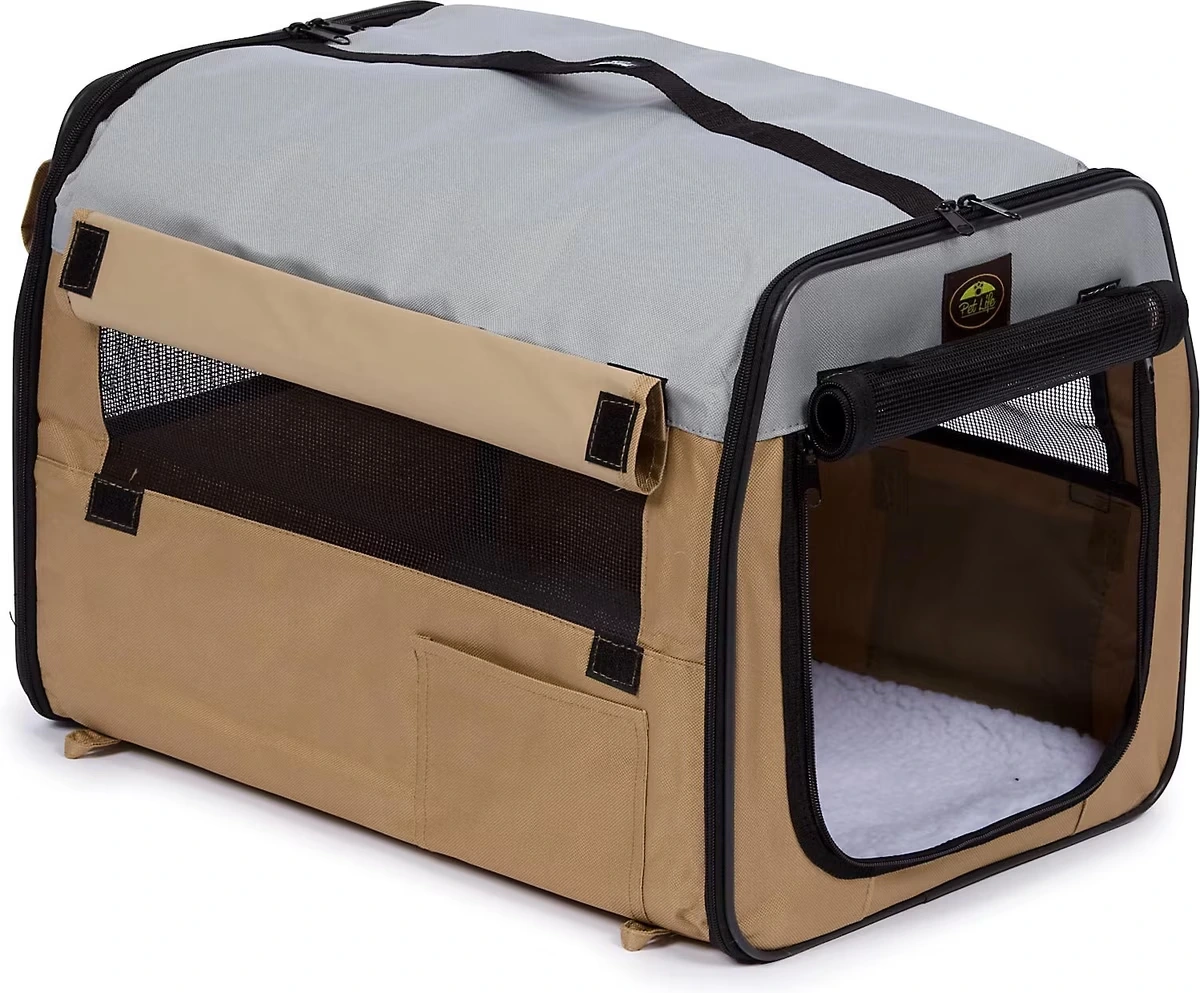
Last Black Friday, I was sold by a stylish soft carrier all over social media. In the photos, a Ragdoll cat sat inside the carrier, set against a backdrop of a café’s floor-to-ceiling window. The lighting was gentle, the scene peaceful. The comments were full of praise: “So classy,” “What a good cat,” “Perfect for photos.” I didn’t hesitate. I placed the order right away.
The day the package arrived, I tore open the shipping bag and pulled out the carrier—it immediately “collapsed” onto the floor. The sides flopped weakly to one side, the top caved in, and the whole thing looked like a crumpled dishrag. I tried to prop it up with my hands, but as soon as I let go, it caved in again. When I put Luna inside, the carrier walls pressed directly against her back. Luna froze for a moment, then started struggling frantically, her four legs pushing against the bottom trying to escape. The carrier kept deforming and collapsing under her movements, like a piece of soft dough being kneaded.
I quickly scooped her out and returned the carrier.
That was the first time I realized: not all soft carriers are the same. Some are “soft but structured”; others are “soft and flimsy”—the latter being what people call the “noodle bag.”
Interestingly, not long ago, when I was writing my “structural analysis” article, I compared soft carriers with hard-shell kennels. But that comparison was between soft and hard carriers. This pitfall taught me that even among soft carriers, the presence or absence of a frame makes a bigger difference than the difference between a soft carrier and a hard kennel.
Table of Contents
Collapsed Right Out of the Box: The “Noodle Bag” I Bought
Data-Backed: The Real Distribution of 202 “Collapse” Reviews
Deep Dive into Frame Types: Comparing Five Frame Structures
Structural Stability Test: Three Ways to Tell If a Carrier Will Collapse
What It Means for Pets: Collapse Isn’t a “Minor Issue”—It’s “Confinement”
Shopping Checklist: Prioritize Carriers with Clearly Described Frames
Frequently Asked Questions
Conclusion: A Carrier Should Be “Soft” but Not “Collapsible”
Collapsed Right Out of the Box: The “Noodle Bag” I Bought
That viral carrier was undeniably good-looking—a muted color palette, rounded lines, very photogenic. But the moment I unboxed it, lifting it out of the shipping bag, it was like a deflated balloon, flopping limply in my hands.
I set it on the floor, and it wouldn’t stand up. The sides tipped over, the top caved in. The only flat part was the bottom (thanks to a piece of cardboard). I tried propping up the sides with my hand, but as soon as I let go, it collapsed again.
I attempted to put Luna inside. The moment she stepped in, the top caved down against her back. She arched her back to push it up, but the walls pressed in from all sides. Panicking, she clawed frantically, her nails catching in the mesh, warping the carrier as it deformed around her. At that moment, it wasn’t “a cat inside a carrier”—it was “a carrier plastered onto a cat.”
I quickly pulled her out. That carrier went from unboxing to return in less than 24 hours.
Later, when I was reading negative reviews, I realized I wasn’t alone. One user wrote:
“It’s a bit flimsy but gets the job done.”
Another put it more bluntly:
“Sides collapse easily.”
“Flimsy”—that word translates to “soft and flimsy.” It’s not just an adjective; it’s a warning.
Data-Backed: The Real Distribution of 202 “Collapse” Reviews
Among the 5,000+ negative reviews I analyzed earlier, 202 were specifically about “structural collapse” or “insufficient support.” I referenced this data in my “structural analysis” article, but at that time, I approached it from the angle of “soft vs. hard carriers.” This time, I’ve broken down the data specifically to focus on the types of collapse within soft carriers:
- Side Collapse (52%) – When placed on the ground, the side flops over; when the pet leans against it, the wall presses directly against the body.
- Top Collapse (28%) – The top sags even when the carrier is empty; when the pet stands, their head touches the top, pushing it downward.
- Overall Deformation (20%) – The carrier twists when lifted, and flattens completely when placed on the ground.
User quotes:
“Sides collapse easily.”
Side collapse is the most common issue. The sides are the pet’s primary contact surface inside the carrier; side collapse means the carrier wall “sticks” to the pet.
“No structure at all.”
This is the most accurate summary of a frameless carrier—not just “soft,” but “lacking structure.”
“It’s a bit flimsy but gets the job done.”
This phrase warrants caution. When “flimsy” appears in a negative review, it shows the user has already identified a problem, even if they’re temporarily settling. But a “flimsy” carrier, when subjected to long trips, external pressure, or a struggling pet, is likely not “getting the job done”—it’s more likely “failing the job completely.”
Deep Dive into Frame Types: Comparing Five Frame Structures
In my “structural analysis” article, I detailed four frame types. This time, I’ve added a fifth—wire frame—and compared all five side by side to give you a comprehensive overview.
1. Frameless (Pure Soft Bag)
Structural Features: No support structure whatsoever; relies entirely on the fabric’s inherent stiffness. The empty carrier collapses when placed on the ground; you can pinch through to the bottom with your fingers.
Collapse Resistance: 1 star
Foldability: 5 star (it’s already collapsed)
Best For: Almost none. Possibly for very short trips (e.g., a quick walk downstairs) with an extremely lightweight and exceptionally cooperative pet.
2. Wire Frame
Structural Features: Similar to tent poles—a wire or spring steel rod runs around the opening or sides, forming a flexible frame. It can be twisted and folded, then springs back when released.
Collapse Resistance: 2 star
Wire frames can hold the empty carrier’s shape but deform under heavy pressure. They spring back after pressure is removed, but repeated deformation can cause metal fatigue.
Foldability: 5 star (can be twisted and folded)
Best For: Light-duty use, short trips, pets that don’t struggle.
3. Plastic Panel Frame
Structural Features: Rigid plastic panels are embedded in key areas (such as the back and sides) to create a fixed shape. Not foldable.
Collapse Resistance: 4 star
Plastic panels provide good support and resist deformation. The weak point is the connections—panels are typically joined by fabric, which may collapse under stress at the joints.
Foldability: 1 star (not foldable; can only be flattened)
Best For: Everyday use where storage space isn’t a concern.
4. Aluminum Alloy Frame
Structural Features: Hollow aluminum alloy tubes form a complete frame around the carrier, similar to a small tent’s structure. Can be removable or foldable.
Collapse Resistance: 5 star
Aluminum alloy offers high rigidity with low weight. When compressed, the frame absorbs the force first, protecting the interior space. It returns to its original shape after pressure is removed and resists fatigue.
Foldability: 4 star (support rods can be removed; the body can be folded)
Best For: Long trips, air travel, situations where safety is paramount. Currently the optimal solution.
5. Composite Frame (Rigid Base + Support Rods)
Structural Features: A rigid base provides bottom support, while metal rods create a frame around the top and corners. This is the mainstream design for high-end soft carriers, balancing storage convenience with safety. I’ve mentioned this structure multiple times in my previous articles, and it’s the type I currently use as my primary carrier.
Collapse Resistance: 5 star
The rigid base prevents bottom collapse; the support rods prevent side and top collapse. This creates a “protective cage” where external forces act on the frame rather than directly on the pet.
Foldability: 4 star(support rods can be removed or folded)
Best For: All-purpose, suitable for most pet-owning households.
Structural Stability Test: Three Ways to Tell If a Carrier Will Collapse
When examining a carrier in a physical store or immediately upon receiving your order, use these three quick steps to assess it. I mentioned this method in my “structural analysis” article; here’s a more detailed version:
Test 1: Can the empty carrier stand on its own?
Place the carrier on a flat surface and let go:
- √ Stands on its own, sides straight, top not sagging → has a frame
- × Collapses immediately, needs support to stay upright → frameless or frame too weak
Test 2: Press the side with your hand
Press the side panel with your palm, then release:
- √ Noticeable spring-back, returns to shape after release → effective frame
- × Collapses under pressure, remains collapsed after release → missing or deformed frame
Test 3: Does it maintain shape when loaded?
Place a weight of about 5kg (or simply put your pet) inside and observe:
- √ Carrier maintains its shape, sides don’t bulge or collapse → good load-bearing frame
- × Carrier deforms, sides bulge outward or cave inward → insufficient frame support
What It Means for Pets: Collapse Isn’t a “Minor Issue”—It’s “Confinement”
Many first-time buyers, including my past self, thought, “It’s okay if the carrier sags a little.” But Luna’s struggle that day taught me: collapse isn’t just “discomfort” for a pet—it’s “confinement.”
Cats are naturally “den animals.” They need clear boundaries to determine whether a space is safe. In a collapsed carrier, boundaries are vague and constantly shifting—walls can press in at any moment, the top can sink down unexpectedly. Inside, the cat lacks the certainty of “this is my safe space” and instead feels the unease of “I’m being squeezed.”
Among the 64 negative reviews I previously analyzed about “cat anxiety/resistance,” a significant portion pointed to structural issues. One user wrote:
Leave a Reply
You must be logged in to post a comment.