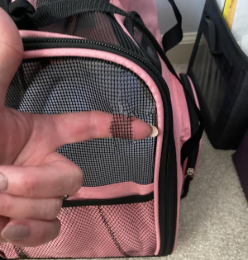
The night Luna first got into her new pet carrier, I placed it in the living room with high hopes, thinking she could get familiar with it. When I woke up the next morning, here’s what I saw—a fist-sized hole on the side of the carrier, the mesh torn into several shreds dangling down, and Luna poking half her head out through the hole, looking at me with an innocent face.
From unboxing to retirement, that carrier lasted less than 12 hours. One cat, one night, one carrier—gone.
From that day on, I embarked on a journey of “carrier swapping.” I learned the hard way about mesh being scratched through, worn through, and seams splitting open. Eventually, I found a genuinely scratch-resistant model. Today, I’ll share everything I’ve learned from those mistakes in one go.
Table of Contents
Luna’s Masterpiece: Retiring a Carrier Overnight
Lessons from the Pitfalls: From Holes to Scratch-Resistant
Data-Backed: Common Causes of Mesh Damage
Mesh Material Comparison: Pros and Cons of Four Mainstream Types
Evolution of Anti-Scratch Design: Three Ways to Make Cats “Paw-Proof”
Shopping Checklist: Three Steps to Judge Mesh Durability
Frequently Asked Questions
Conclusion: Scratch-Resistant Material Is the Carrier’s First Line of Defense
Luna’s Masterpiece: Retiring a Carrier Overnight
Luna is the second cat in my household—a high-energy tabby with an intense urge to scratch anything soft. The carrier I had just bought was the common type with ordinary nylon mesh, thin to the touch with a fairly open weave. Back then, I thought a carrier just needed to hold the cat.
That night, I put the carrier on the living room floor with the zipper open, hoping Luna would explore it on her own. She did go in—and then she didn’t come out. I heard rustling sounds inside and assumed she was playing, so I didn’t think much of it.
The next morning, this is what I saw: the mesh on the side of the carrier had a large hole torn right through the middle, surrounded by scratch marks and shredded threads scattered on the floor. Luna emerged from the hole, stretched, and walked away.
That carrier was retired without ever having left the house.
Lessons from the Pitfalls: From Holes to Scratch-Resistant
The first one I used was made of ordinary nylon mesh. I figured a carrier just needed to hold the cat. Luna scratched through it in one night—it was retired before ever stepping outside.
Then I switched to a slightly thicker nylon mesh, thinking thicker would mean tougher. But after only a short time, the stitching where the mesh met the carrier body started coming undone, slowly opening up a gap. This time, it wasn’t Luna’s scratching—it just gave out after normal use.
Next, I tried reinforced polyester mesh. The weave was definitely tighter, but Luna’s claws would get caught in the openings and pull out threads. The mesh didn’t completely tear, but several small holes had formed, and I didn’t feel safe using it anymore.
I also tried a PVC grid mesh—stiff and hard. Luna couldn’t scratch through it, that’s true. But the breathability was terrible. When I took her out in the summer, she was panting inside from the heat. I stopped using it after one trip.
Finally, I switched to a carrier with double-layer reinforced mesh. After long-term use, the mesh remains intact. Luna scratches at it occasionally, and there isn’t even a mark.
After all these trials, my biggest takeaway is this: the mesh material determines the carrier’s lifespan. Choose wrong, and it’s not just about wasted money—it’s about your cat suffering inside and the carrier failing before long.
Data-Backed: Common Causes of Mesh Damage
Later, I went through negative reviews about “mesh damage” and “seam splitting” and found that many people had experiences strikingly similar to mine.
Some, like me, had their cats destroy the mesh overnight:
“My cat shredded the mesh on the first night. I didn’t even get to use it.”
Others had the carrier fall apart under normal use:
“Noticed it was ripped along the seam after only a few uses.”
And some had their cat’s claws cause “localized breakthrough”:
“My cat’s claw got caught in the mesh and pulled out a thread. Then it just unraveled from there.”
An even more subtle issue appeared at the seams—the mesh itself wasn’t torn, but the stitching connecting it to the carrier body gave way. One reviewer specifically mentioned:
“The mesh is fine, but the stitching around it came apart. Now there’s a gap where the mesh meets the fabric.”
These comments made me realize: mesh damage isn’t just “cat scratched through it.” Seam strength, mesh density, and the material’s own tensile resistance—each link can be the weak point.
Mesh Material Comparison: Pros and Cons of Four Mainstream Types
- Ordinary Nylon Mesh – Scratch Resistance: Poor; Breathability: Good; Durability: Poor. Not recommended for cat carriers. The most common carrier mesh—thin to the touch with a loose weave. A cat’s claw can tear through it easily. Luna destroyed this type in one night. Suitable for cats that never scratch anything, but those are rare.
- Reinforced Polyester Mesh – Scratch Resistance: Medium; Breathability: Medium; Durability: Medium. Best for short trips, gentle cats. Much tighter weave than nylon mesh, with a thicker feel. It holds up to normal scratching, but if a cat’s claws are sharp enough, they can still catch in the openings. Luna once got her claw stuck and pulled out a thread.
- PVC Grid Mesh – Scratch Resistance: Good; Breathability: Poor; Durability: Good. Not recommended (poor breathability). Rigid plastic grid—cats can’t scratch through or bite through it. But the fatal flaw is poor breathability. In summer, the temperature inside can rise several degrees above the outside. One user complained: “My cat was panting after 20 minutes in this. Never used it again.”
- Double-Layer Reinforced Mesh – Scratch Resistance: Good; Breathability: Good; Durability: Good. Best for long trips, multi-cat households. The most scratch-resistant I’ve used so far. Two layers of mesh bonded together—when a cat scratches, it only reaches the first layer, leaving the second intact. Luna has scratched at it multiple times without even leaving a fuzzy mark. Breathability is also good; no issues in summer.
Evolution of Anti-Scratch Design: Three Ways to Make Cats “Paw-Proof”
Beyond the mesh material itself, some carriers incorporate structural design features to resist scratching.
1. Recessed Mesh
The mesh is not directly exposed on the outside of the carrier but set within a frame on the panel, with the edges covered by fabric. The area of mesh the cat can access is reduced, and the edges where they might start scratching are sealed off. The downside is higher manufacturing cost, so this design is typically found only in mid-to-high-end carriers.
2. Double-Layer Construction
The outer layer is made of durable fabric, with only small windows of mesh in specific locations. The areas a cat can scratch are limited to these few small openings rather than the entire side panel. This works well for cats that are particularly enthusiastic scratchers, but the trade-off is reduced visibility—the cat may not be able to see out as easily.
3. Replaceable Mesh Panels
Some brands offer replaceable mesh panels. If scratched through, the mesh can be replaced individually without having to buy a whole new carrier. However, this requires a sturdy frame structure; otherwise, replacing the mesh a few times might leave the frame damaged first.
Shopping Checklist: Three Steps to Judge Mesh Durability
Step 1: Check the Mesh Density
Hold the carrier in good light and look through the mesh to the other side. If you can clearly see the outline of objects on the opposite side, the weave is too loose. If you can only make out blurred light and shadow, the density is sufficient. The kind of mesh where Luna could get her claws caught was the type where you could see clear outlines.
Step 2: Feel the Thickness and Texture
Rub the mesh with your finger:
- Thin, soft, feels like mosquito netting → not scratch-resistant
- Thick, stiff, has some resilience → can hold up for a while
- Double-layer composite with a slight gap between layers → most scratch-resistant
Step 3: Inspect the Seam Construction
Where the mesh meets the carrier body, is it stitched directly or edge-bound?
- Direct stitching: stress concentrates at the seam, making it prone to splitting
- Edge-bound: the edge is wrapped in fabric, distributing stress more evenly for greater durability
One reviewer highlighted this seam issue:
“The mesh itself is fine. It’s the stitching that gave out.”
That comment reminded me: when evaluating the mesh, don’t forget to look at the stitching.
Frequently Asked Questions
Q: My cat has already destroyed one carrier. What type should I get that can withstand it?
A: It depends on your cat’s level of destruction. For cats with average scratching habits, reinforced polyester mesh is usually sufficient. For “professional demolition crew” cats like Luna, go straight for double-layer reinforced mesh or recessed mesh designs.
Q: Is double-layer reinforced mesh breathable?
A: It’s slightly less breathable than single-layer mesh, but adequate. It’s fine in air-conditioned spaces during summer. In direct sunlight or hot conditions, any carrier should be supplemented with cooling pads or ice packs regardless.
Q: Why is PVC grid mesh not recommended?
A: Poor breathability. Cats can overheat quickly inside, especially in summer. Unless you’re only using it for a dog or exclusively for extremely short trips in mild weather, it’s best avoided.
Q: Can a torn mesh be repaired?
A: Small holes can be stitched up, but the repaired area will be stiffer, and the cat may simply start scratching next to it. For large holes, replacing the carrier is better than making do—the hole Luna crawled out of was beyond practical repair.
Conclusion: Scratch-Resistant Material Is the Carrier’s First Line of Defense
Among the negative reviews about mesh damage, one comment really stuck with me:
“The cat did in one night what I couldn’t do in a year.”
As humorous as it was, this comment highlights a truth: a cat’s ability to destroy mesh far exceeds what we typically imagine.
Now when I choose a cat carrier, the mesh is my first screening criterion:
- Mesh that’s too sparse? No—dense enough that you can’t see clear outlines through it is the safe choice.
- Seams that are directly stitched? Be cautious—prone to splitting along the stitching.
- Material not specified in detail? Skip it—“high-density mesh” is vague jargon; “double-layer reinforced mesh” is the real spec worth trusting.
You’re not buying just a bag—you’re buying your cat’s safe haven on the road. And the most vulnerable part of that safe haven is the mesh.
Choose right, and it’ll last for years. Choose wrong, and it’s gone in one night.
Has your cat ever destroyed a carrier? Feel free to share your story in the comments—especially the moment you woke up to find your carrier had vanished overnight.
Leave a Reply
You must be logged in to post a comment.