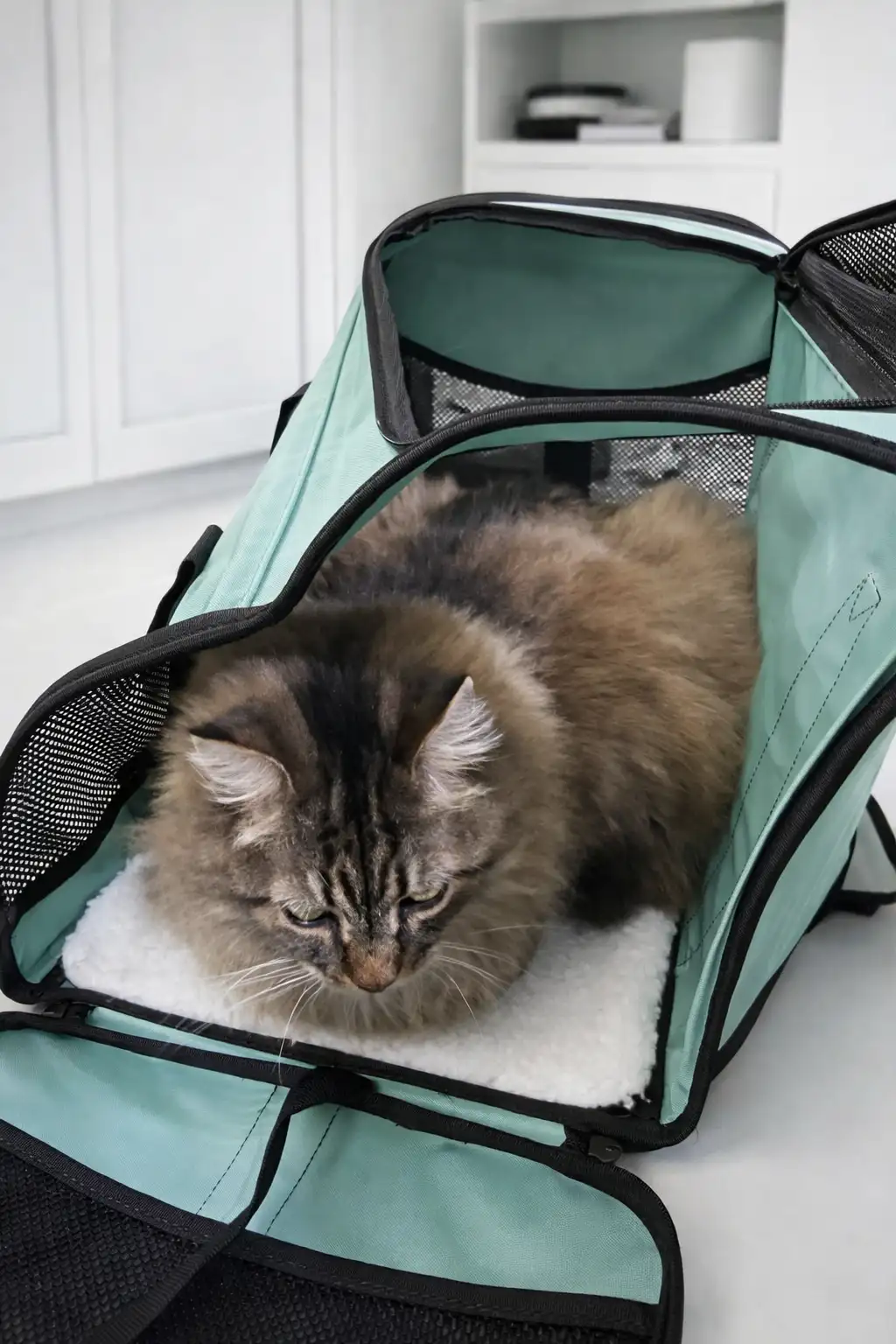
Last fall, I took Luna on a high-speed train ride back to my hometown. The train was crowded, and the overhead racks were full. I had no choice but to place the carrier at my feet, holding it in place with both feet to keep it from wobbling.
Shortly after the train started moving, the passenger next to me got up to retrieve something. He didn’t secure his suitcase properly. As the train passed through a switch, the carriage jolted, and his 20-inch carry-on toppled over, landing squarely on top of my carrier.
I looked down—the side of the carrier was crushed inward, the wall pressed directly against Luna’s back. He had been lying there peacefully, but the sudden pressure made him lunge forward, his front paws scratching at the mesh in search of an escape. The entire side had caved in; there was nowhere to go. His back was pressed against the carrier wall, his ears flattened into “airplane ears,” his eyes wide, mouth slightly open—the very picture of extreme distress.
I quickly shoved the suitcase aside, and the carrier slowly popped back into shape. Luna huddled in the corner, his entire body rigid. It took him several seconds before he dared to move.
Across from me sat an older woman carrying what looked like a similar soft carrier. Her bag had also been jostled by someone nearby, but it only dented slightly before bouncing back, the walls never touching her cat.
Seeing me flustered, she smiled and said, “Your carrier doesn’t have a frame, does it? I used to have one of those—they collapse under pressure, and the cat suffers inside. I switched to one with a frame afterward, and now I don’t worry about pressure.”
That was the first time I realized: even though they’re both soft carriers, the difference between having a frame and not having one is greater than the difference between a soft carrier and a hard-shell kennel.
Reading reviews showed me I wasn’t alone
I later looked through 202 negative reviews about “collapse/structural weakness” and found many people had experienced the same thing. Their descriptions were strikingly similar:
“It’s a bit flimsy but gets the job done.”
“Sides collapse easily.”
“No structure at all. It’s just a soft bag that folds around the animal.”
One user was even more specific:
“Took it on the train. Someone’s bag leaned against mine and the whole side caved in. My cat freaked out.”
When I read that comment, I felt like raising my hand—that was exactly my experience.
Anatomy: The Three Types of Soft Carrier Frames
Soft carriers on the market can generally be divided into three types based on their internal support structure. They may look similar on the outside, but their underlying construction is vastly different.
1. Frameless Soft Carrier (Pure Fabric Bag)
Relies entirely on the fabric’s stiffness and padding to hold its shape.
Typical characteristics:
- The empty bag collapses when lifted; placed on the ground, it flattens into a heap.
- Pressing the side with your hand yields no resistance; you can push all the way through.
- Once the pet is inside, the walls close in from all sides.
Suitable for: Very short trips (e.g., a quick walk downstairs), extremely lightweight pets with cooperative temperaments. Not recommended for long journeys.
One user wrote just four words in their negative review:
“No structure at all.”
Those four words sum up the nature of this type of carrier perfectly.
2. Partial-Support Soft Carrier (Flexible Rods/Plastic Strips)
Embedded with several support strips in key positions, such as around the top rim or two on the sides.
Typical characteristics:
- The empty bag can stand on its own, but the sides collapse when pressed.
- The support is provided by “points” or “lines,” not a continuous “surface.”
- When compressed, the support strips may bend or even pull out of the seams.
Pros: Slightly better than a pure fabric bag; foldable.
Cons: Limited resistance to compression; support strips can fail under concentrated pressure.
3. Composite Frame Soft Carrier (Rigid Base + Metal Frame) – Currently the Best Option
This has become the mainstream design for high-end soft carriers in recent years: a rigid base provides bottom support, while aluminum alloy or high-strength metal rods create a complete frame around the top and corners.
Typical characteristics:
- The empty bag stands on its own; pressing the side produces noticeable spring-back.
- The frame forms a “protective cage.” External forces act on the frame, not directly on the pet.
- The support rods can be removed or folded, preserving storage convenience.
The logic behind this type’s compression resistance is proactive defense by the frame. When compressed, the frame absorbs the force first; it deforms only to a certain extent before holding firm, maintaining a safe space for the pet inside.
Crush Test: When a Suitcase Presses Down, Which One Protects Your Pet?
This is a test I experienced firsthand on the high-speed train—albeit unintentionally.
Later, I conducted a simulation: I placed all three types of carriers on the ground, loaded a 10kg suitcase on top of each, and observed the results.
- Frameless soft carrier: Completely flattened; the walls pressed directly against the base. If a pet were inside, they’d be wrapped in fabric.
- Partial-support soft carrier: Deformed under pressure, the support strips bent, and the walls caved in about 5-6 cm. The pet would feel significant pressure and the space would narrow.
- Composite frame soft carrier: Depressed about 3 cm under pressure, but the frame held. After removing the suitcase, the carrier automatically returned to its original shape. The pet always maintained a safe space inside.
These scenarios aren’t just “what-ifs”:
- Under an airplane seat: passengers shoving luggage beside you
- On a high-speed train aisle: a suitcase sliding over and hitting the carrier
- In the back seat of a car: sudden braking sends the carrier into the front seat
- At home: accidentally stepping on the carrier or dropping something on it
In all these situations, a soft carrier’s “frame” is the pet’s first line of defense. For a frameless carrier, that line of defense is zero.
My Preference: Why I Favor Soft Carriers with a Metal Frame
After trying several types, my current go-to carrier is a composite frame model with a rigid base and an aluminum alloy frame.
1. Foldable, but not flimsy
Hard-shell kennels are safe, but they take up space at home. A composite frame carrier allows you to remove or fold the support rods, compressing the body to fit into a narrow closet gap.
But being foldable for storage doesn’t mean it collapses during use. Once the aluminum alloy frame is locked in place, the walls are firm. Pressing the side with your hand produces clear resistance. When Luna stands up inside, the walls don’t sag against him.
2. Passed the crush test
After the high-speed train incident, I deliberately performed the simulation test mentioned earlier. When the 10kg suitcase was placed on the composite frame carrier, the distance from the top to the base measured 18 cm. Luna’s height when lying down is 15 cm, leaving him completely safe.
After removing the suitcase, the frame returned to its original shape. No deformation, no damage.
3. Metal frame vs. plastic frame
I specifically chose an aluminum alloy frame over plastic strips.
Plastic strips are lightweight, but they can become brittle and snap over time, especially in cold winter temperatures. One user noted in a negative review:
“Used it in winter and one of the support rods snapped when I folded it.”
Aluminum alloy frames are more durable. They hold up to repeated folding without deforming and won’t retain a permanent bend after being crushed by heavy objects.
Frequently Asked Questions
Q: How can I tell if a soft carrier has a frame?
A: Look at the product details. If it mentions “foldable,” “collapsible,” “support rods,” or “frame structure,” it likely has a frame. If it only emphasizes “lightweight” or “soft,” it probably doesn’t. You can also ask the seller directly: “Does this carrier have support rods on the sides? Can it stand up on its own when empty?”
Q: Which is better, a metal frame or a plastic frame?
A: Metal (especially aluminum alloy) is better. Plastic frames are lightweight, but they can become brittle and snap over time. Aluminum alloy frames are more durable, holding up to repeated folding without deforming.
Q: I already bought a carrier and noticed its sides collapse when pressed. Can I add support myself?
A: You can try. Measure the side height, buy two thin aluminum strips from a hardware store, and insert them into the side pockets of the lining. However, this is a modification, and stability won’t match a factory-designed frame. If you haven’t purchased yet, it’s better to choose one with a built-in frame. I’ve seen people in the comments suggest this approach, saying “put in two aluminum strips and it’s much better now.”
Q: How do I choose between a composite frame soft carrier and a hard-shell kennel?
A: It depends on your priorities:
- If safety is your absolute priority and you don’t mind the space it occupies → choose a hard-shell kennel.
- If storage convenience matters and you still want good safety → choose a composite frame soft carrier.
Conclusion: A Soft Carrier’s “Frame” Determines Whether It’s a Paper Tiger
Among the 202 negative reviews about “structural collapse,” one comment stood out:
“Sides collapse easily.”
When a carrier’s sides collapse easily, that translates to: this carrier has no frame, or the frame is too weak.
A soft carrier doesn’t have to mean no structure. A good soft carrier has a rigid base, a metal frame, and spring-back. When compressed, it holds firm instead of transferring the pressure directly to your pet.
When I choose a soft carrier now, the first thing I check is the structure:
- Does it have a rigid base? If not, pass.
- Does it have a metal frame on the sides? If not, pass.
You’re not buying a “fabric bag.” You’re buying a protective shell for your pet while traveling. The “frame” of that shell determines whether, when pressure is applied, it protects your pet—or transfers that pressure onto them.
Choose one with a frame. Don’t let your pet bear the burden.
Have you ever been in an embarrassing situation where your carrier collapsed under pressure? Feel free to share your story in the comments—especially the moment that made you “grab the carrier back in a panic.”
Leave a Reply
You must be logged in to post a comment.