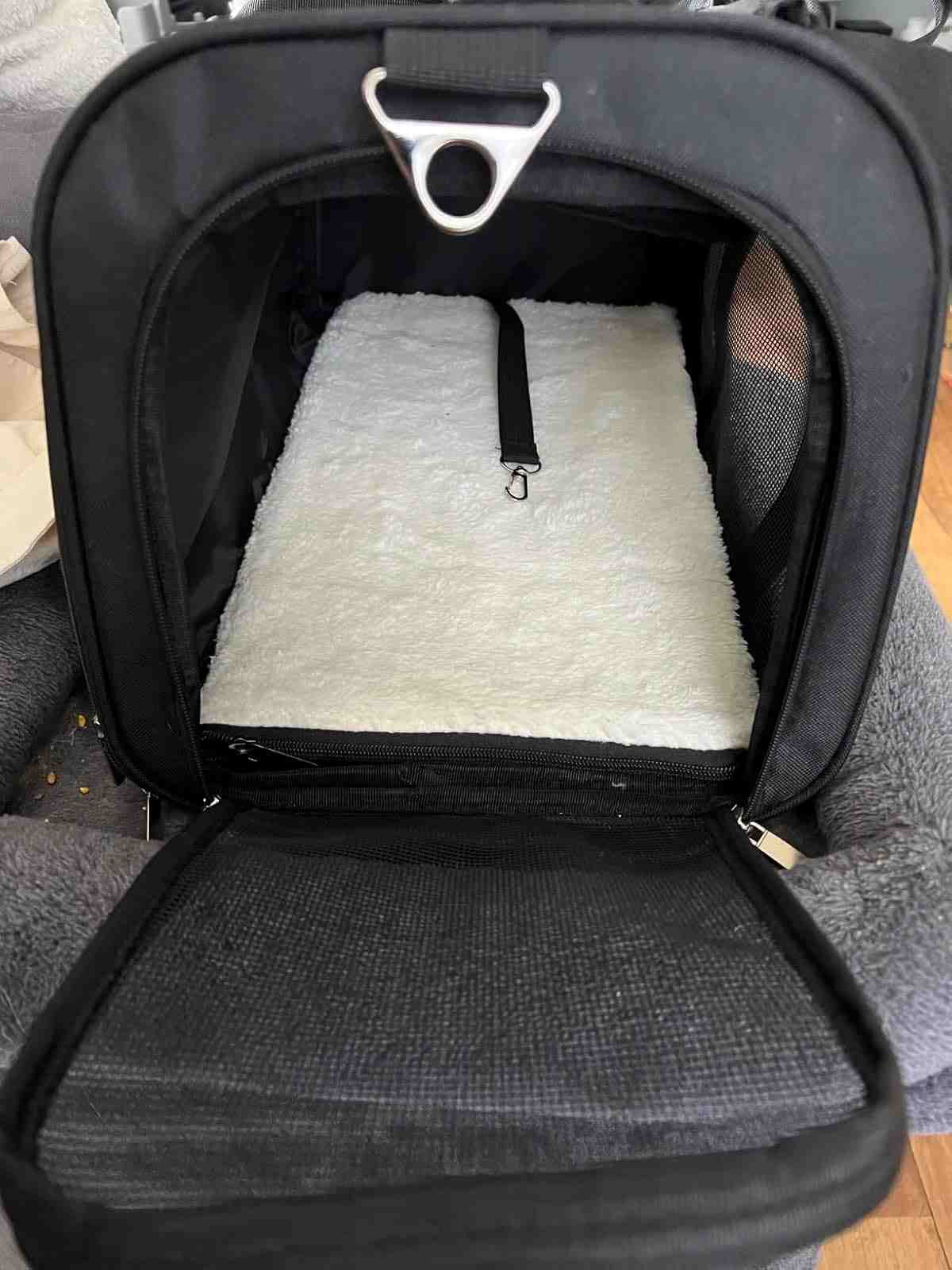
Last month, I came across a desperate plea for help on a pet forum. Attached was a video: a British Shorthair cat was inside a soft fabric carrier, dangling by its owner’s side. The bag swung with every step like a hammock. Inside, the cat’s four legs scrambled frantically, searching in vain for solid footing, its eyes wide with panic.
The comment section was flooded with replies: “This is exactly what happens with my cat!” “My cat refuses to go into the carrier ever since.” I stared at that video for a long time, reminded of the first time I took Luna to the vet two years ago—and how a carrier with a floppy base nearly traumatized her out of ever wanting to leave the house.
Table of Contents
The “Hammock Effect” of Soft-Bottom Carriers: A Video That Broke My Heart
The First Vet Visit: Luna Stood the Entire Ride
The Triple Role of a Hard Base: Support, Security, Durability
Shopping Tips: How to Identify Base Material Through the Liner
Data Insights: The Most Overlooked Details in Negative Reviews
Conclusion: A Removable Hard Base Is the Best Solution
FAQ
The “Hammock Effect” of Soft-Bottom Carriers: A Video That Broke My Heart
The British Shorthair in the video was named “Tuanzi.” Her owner described how, every time she picked up the carrier to go out, Tuanzi would start crying. Eventually, she would hide at the mere sight of the bag. It wasn’t until she one day recorded what happened inside that she understood—her cat wasn’t being “difficult”; she was genuinely terrified.
When a soft-bottom carrier is lifted, all of the pet’s weight presses down on the fabric. The fabric sags inward, forming a “U-shaped hammock.” The cat’s paws can’t find stable footing; they can only claw at the cloth to maintain balance. With every step the owner takes, the carrier sways, and the cat’s center of gravity lurches inside—like walking on a suspension bridge.
Someone in the comments asked: “Why doesn’t the cat just lie down? Wouldn’t that be more stable?”
Another user replied: “Try lying down in a hammock that’s suspended in mid-air. Would you dare to fall asleep?”
That reply hit me like a flashback to Luna.
The First Vet Visit: Luna Stood the Entire Ride
In the fall of 2022, Luna was due for her first vaccinations. I was a new cat owner and had bought a “viral” soft carrier recommended by the pet store—stylish, lightweight, foldable, and, most importantly, cheap. The product page boasted “breathable mesh, comfortable for pets.” I figured it would be fine.
On the day of the appointment, I placed Luna inside and lifted the carrier. She froze.
The bottom wasn’t firm enough. The moment Luna stepped in, it sagged. Her four legs instinctively splayed outward, searching for a stable point to push against—but found none. She tried shifting her paws, but the fabric moved with her, making everything worse.
The walk from my apartment to the underground garage took three minutes. For those three minutes, Luna stood—front legs slightly bent, hind legs tensed, her entire body coiled in a “ready to jump” state. Every step I took, she swayed inside. I looked down at her; she looked up at me, her eyes full of confusion.
In the car, I set the carrier on the passenger seat. As soon as we turned a corner, the bag tilted, and Luna slid sideways, flailing her legs wildly to regain balance.
That round trip, Luna stood inside the carrier for a full forty minutes. She didn’t cry or struggle—she just stood, claws dug into the fabric, never once lying down.
Back home, I opened the carrier. Luna bolted out and dove under the bed, refusing to come out for two hours.
Later, while scrolling through reviews, I found one that could have been written about Luna:
“She stood the entire ride. Never once lay down. I thought she was just alert, but now I realize she couldn’t relax because the bottom had no support.”
That was the moment I understood—Luna wasn’t being energetic; she was afraid to lie down.
The Triple Role of a Hard Base: Support, Security, Durability
1. Biomechanical Support: Protecting the Spine and Joints
This is especially important for kittens whose bones are still developing, and for senior dogs with deteriorating joints. A hard base provides even support, preventing excessive pressure on any one area.
When a pet stands, its weight is transmitted through its legs to the base. A hard base allows the legs to bear weight evenly, keeping joints at a natural angle. A soft base causes the hindquarters to sink and the pelvis to tilt forward; over time, this can increase stress on the hip joints.
A veterinarian friend once told me: “I’ve seen cases of lameness linked to prolonged use of soft-bottom carriers. The pet is constantly tense, trying to maintain balance, leading to muscle strain and joint fatigue.”
2. Fall Prevention: Providing Psychological “Solid Ground”
Cats are instinctively cautious about heights. They need clear tactile feedback to feel safe. A hard base sends the signal: “This is solid—you can stand here.” A soft base sends the opposite: “This is unstable—you might fall.”
That’s why so many cats in soft carriers stand and refuse to lie down—they don’t dare. Lying down means their belly is suspended over emptiness, which offers no sense of security.
After I switched Luna to a carrier with a hard base, I noticed something on the first use: she stepped in, pressed down with her paw to test the floor, confirmed it was solid—and then lay down. That had never happened with the soft bag.
3. Shape Retention: Extending the Carrier’s Lifespan
A hard base has a hidden advantage: it protects the carrier’s structure.
Soft-bottom carriers, over time, develop a permanent sag. The fabric fatigues, seams stretch and may tear. A hard base distributes pressure evenly, preventing localized stress. Plus, when you set the carrier on the ground, a hard base keeps its shape, making it easier for your pet to enter and exit.
Shopping Tips: How to Identify Base Material Through the Liner
Many pet carriers, for aesthetic reasons, hide the base inside a fabric liner—you can’t see or touch it directly. So how do you judge?
Step 1: Press Down with Your Hand
Place the carrier on a flat surface. Press firmly from the inside with your palm:
- If it feels hard with little to no give → Likely a rigid panel (plastic, wood, etc.)
- If it feels noticeably springy or indents easily → Possibly cardboard or a thin foam pad
- If it’s soft when pressed and sags even more when lifted → Probably no hard base at all
Step 2: Lift and Shake
Pick up the carrier (empty) and simulate walking motions:
- If the carrier holds its shape and the interior doesn’t distort much → Has a hard base
- If the whole bag deforms and the bottom sags into a U-shape → No hard base, or the base is too thin
Step 3: Scan the Product Description for Keywords
Look for these terms:
√ “Removable rigid base” “PVC bottom board” “Plywood reinforced” “Support panel” “Reinforced base”
× “Soft and foldable” “Ultra-light soft bottom” “One-piece foldable design” “Rolls up for storage”
Step 4: Ask Customer Service for Detailed Photos
If you’re still unsure, message the seller directly: “What material is the base made of? Is it a rigid board or just a layer of fabric?”
Sellers who confidently answer with specifics usually have a quality product. Those who dodge the question with vague replies like “Don’t worry, it’s good quality” should be treated with caution.
Data Insights: The Most Overlooked Details in Negative Reviews
I later analyzed 202 negative reviews citing “sagging” or “lack of support.” A fascinating pattern emerged: many users initially didn’t realize the problem was the base.
Some blamed their pet’s anxiety. Others complained the bag deformed over time. A few assumed their cat was just “difficult.” It wasn’t until someone pointed out the root cause that everything clicked.
“My cat hated this carrier. I was about to give up until I put a piece of cardboard in the bottom. Now she sits quietly.”
“I didn’t realize the bottom was just fabric until I put my cat in. She kept trying to turn around and couldn’t get any traction.”
And one review that really stuck with me:
“The bag itself is fine, but the bottom sags so much that my dog’s back legs are lower than his front. Can’t be good for his hips.”
These comments made me realize: a soft base problem isn’t always obvious at first glance, but it profoundly affects the pet’s experience—from unstable footing, to fear of lying down, to long-term joint strain. It’s a chain reaction.
Base Material Comparison (Based on Testing & User Feedback)
| Material | Support | Durability | Washable? | Commonly Found In |
|---|---|---|---|---|
| Cardboard | Poor (softens when damp) | Poor (bends easily) | No | Ultra-cheap carriers |
| PVC Board | Moderate | Moderate (can crack in cold) | Yes | Mid-range carriers |
| Plywood | Good | Good | No (avoid soaking) | High-end airline-approved carriers |
| Aluminum Alloy | Excellent | Excellent | Yes | Professional/outdoor carriers |
Conclusion: A Removable Hard Base Is the Best Solution
After all these lessons, my buying criteria are now crystal clear: the carrier must have a hard base—and ideally, a removable one.
Why is removability so important?
- Easy Cleaning: Pets shed, spill water, and have accidents. A removable base can be taken out and scrubbed; the fabric part can be fully aired out.
- Replaceable: If the base gets damaged (e.g., warped or cracked), you can replace just the panel, not the whole carrier.
- Flexible Storage: Insert the hard base for travel security; remove it when you get home to fold the carrier flat and save space.
The carrier I use now has a plywood base wrapped in waterproof fabric. It comes out in seconds for cleaning. When Luna goes in, the first thing she does is lie down—something that never happened with the soft-bottom bag.
FAQ
Q: Are all hard bases the same?
A: No. Cardboard is the worst—it fails if it gets damp. PVC is okay but can become brittle in freezing temperatures. Plywood offers great support but shouldn’t be soaked. Aluminum alloy is the best but adds weight. Choose based on your needs.
Q: I already bought a carrier and the base is too soft. Can I add a hard base myself?
A: Yes. Measure the internal dimensions, then buy a thin piece of PVC board or plywood from a hardware store and slide it under the existing liner. Several reviewers have shared this trick, saying, “My cat finally lies down now.”
Q: Are soft-bottom carriers completely useless?
A: For very short trips with a calm, lightweight pet, they might be okay. But for car rides or extended use, a hard base is essential. Even my 8 lb Luna couldn’t stand steadily; heavier pets absolutely need the support.
Q: How can I tell if a base is hard enough?
A: A simple test: press firmly with your finger. If you feel significant sinking, it’s not hard enough. Ideal is: you can barely press it down, or it only deforms very slightly under strong pressure.
A Final Word to Every Pet Parent:
If your cat, like Luna, never lies down in the carrier, stands the whole time, and bolts under the bed as soon as you’re home—check the bottom. It might be too soft.
Sometimes, all it takes is a rigid board to turn their experience from “enduring it standing up” to “sleeping through the ride.”
Leave a Reply
You must be logged in to post a comment.